Case Study: Leveraging Virtual Reality to Strengthen Industrial Safety Culture
Case Study: Leveraging Virtual Reality to Strengthen Industrial Safety Culture
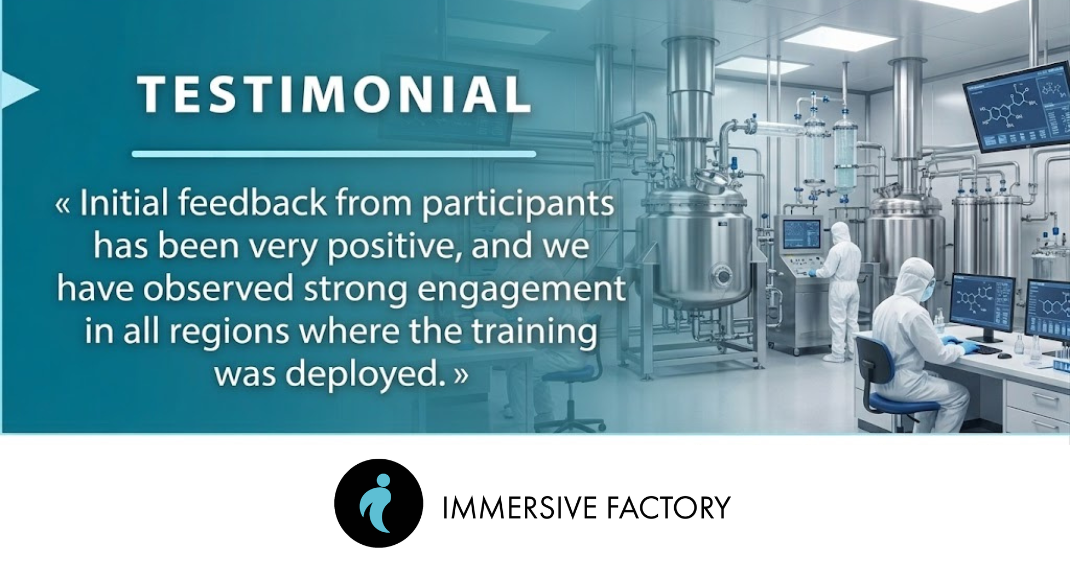
In complex industrial environments, Health, Safety, and Environment (EHS&S / HSE) training is a daily priority. How can companies innovate to better engage employees and mitigate risks?
We gathered insights from Emmanuel Minier, EHS&S Manager, who integrated virtual reality into training programs using the SafetyBox VR solution developed by Immersive Factory. He shares his perspective on this approach, the specific needs it addresses, and the initial results observed on the ground.
Editor's Note: The views and opinions shared in this interview reflect exclusively Emmanuel Minier's personal experience using the solution in his professional capacity. They do not necessarily represent the views of his employer, TAPI. Furthermore, TAPI does not endorse external products or services.
Here is his full testimonial.
Who are you? What is your profession? What is the business of the company you work for?
“My name is Emmanuel Minier. I am the EHS&S Manager for TAPI. TAPI specializes in the manufacture of active pharmaceutical ingredients, operating across production and R&D sites worldwide in complex and highly regulated industrial environments.
In my role, I support the group’s EHS&S vision, the deployment of solutions that help reduce risks, the strengthening of safety culture, and the support of regulatory compliance.”
How did you discover Immersive Factory?
“I discovered Immersive Factory a few years ago at a professional forum where the solution was being demonstrated. I saw the potential of virtual reality as a practical tool to support industrial safety training, particularly because immersive learning allows participants to engage actively with realistic scenarios.”
Why did you choose the SafetyBox VR©?
“Based on my experience, the SafetyBox VR© offered scenarios that were relevant to industrial safety training, was practical to deploy across multiple locations, and provided an engaging format for employees. The solution has been used across our sites as part of safety training, with the objective of reaching a significant portion of our employees.”
What needs does the choice of using virtual reality address?
“The SafetyBox VR© supports two important elements of risk-reduction training.
- First, risk awareness: employees participate in immersive sessions where they are asked to identify hazardous situations in a realistic training environment.
- Second, communication: the sessions encourage discussion between participants and create opportunities to speak up about observed hazards.
More broadly, virtual reality allows employees to train in simulated scenarios without exposure to actual danger, while helping reinforce consistent safety messages across different locations.”
What are the added values and areas for improvement?
“Based on participant feedback, the main added value has been the level of engagement during the sessions and the interaction created between employees around safety topics.”
Did you measure a difference before/after?
“Safety culture takes time to change, and we have not yet measured long-term impact. However, initial feedback from participants has been very positive, and we have observed strong engagement across the regions where the training was deployed.”
Would you recommend the SafetyBox VR©?
“Based on my experience, the SafetyBox VR© has been a useful complementary tool to traditional HSE training approaches. It helped create an engaging environment for discussing safety risks and supporting open communication around EHS&S topics.”

Geschrieben von Aurélie Tavernier
Marketing and Communications Manager at Immersive Factory
She became interested in raising awareness of health and safety at work, convinced that an approach tailored to employees can transform the safety culture and reinforce shared vigilance. Her ambition: to encourage all companies, whatever their size, to invest actively in health and safety prevention for the well-being of their employees.
Teilen
Das könnte Sie auch interessieren
Improving Safety Culture Through Virtual Reality: Feedback from Cummins
How can you tangibly strengthen the Health & Safety culture at work and ensure safe behaviors are adopted on the ground? Perrine Darbouret, HSE Coordinator at Cummins Drivetrain and Braking Systems, shares her feedback...
HSE EDUCATION: The IUT of Poitiers is betting on virtual reality with Immersive Factory
In the face of technological shifts and the growing demands of the professional world, Health, Safety, and Environment (HSE) training must constantly adopt agile and immersive pedagogical methods. At the IUT of Poitiers, Niort,...
Immersed in Veolia’s Recycling & Recovery Branch
In the environmental services sector, risk management is an absolute priority. Damien FONTAINE, QHSE Officer at Veolia’s Recycling & Recovery branch, shares his feedback on integrating Immersive Factory’s SafetyBox VR© into...