Risk Hunting in the Agri-food Industry: Enhanced Safety through Virtual Reality
Risk Hunting in the Agri-food Industry: Enhanced Safety through Virtual Reality
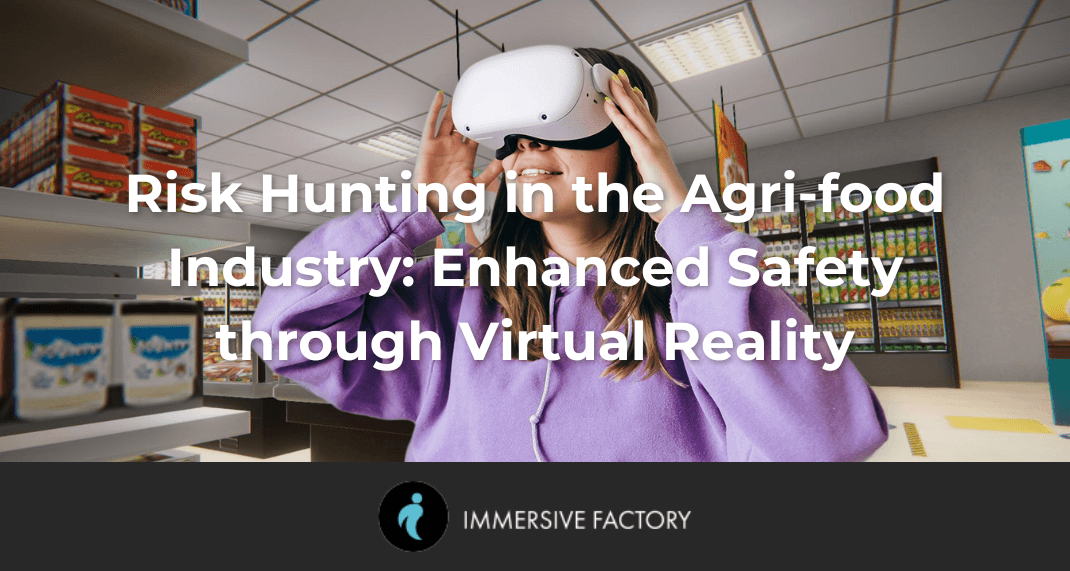
Risk Hunting in Agri-food Industry: Enhancing Safety
Exposure to chemicals, slips, trips, and improper handling of machines—occupational risks in the agri-food sector are numerous. Workers face daily hazards to their health and safety, which can lead to significant economic, material, and human losses for companies. Hence, it is crucial to manage these risks by implementing preventive measures such as risk hunting in the agri-food industry.
Identifying Risks in the Agri-food Industry
Health and safety risks in the agri-food industry are varied:
- Handling chemicals;
- Slips and trips caused by wet and poorly maintained floors;
- Biological contaminations;
- Handling heavy machinery and equipment;
- Working in cold environments.
These occupational risks can have harmful health consequences such as injuries, allergic reactions, burns, and respiratory conditions. In extreme cases, they can even cause cancerand cardiovascular diseases. To minimize these risks and ensure employee protection, agri-food companies must provide HSE (Health, Safety, and Environment) training.
Using Augmented Reality for Risk Hunting
Risk hunting in the agri-food industry is an excellent way to improve worker safety. It can be implemented using augmented reality(AR). Here are some examples of how this technological tool can be used to detect and manage risks:
Training and Awareness
Augmented reality allows thesimulation of hazardous situations, training workers to identify dangers related to handling food or production machines.
Machine Maintenance
Augmented reality devices provide maintenance instructions to technicians, helping them detect the source of malfunctions and repair machines more quickly.
Identifying Risk Areas
Augmented reality can overlay contextual information on a real environment, providing precise data on existing risks and helping workers avoid them.
Virtual Reality Training for Risk Hunting
Virtual reality (VR) training can enhance preparation and response to occupational risks in various ways:
Practical Training
Virtual reality immerses workers in a fictional universe, allowing them to practiceall the safety theories and instructions they have received, teaching them to react actively to dangers.
Active Learning
Virtual reality can reproduce various hazardous situations, allowing learners to practice multiple times until they master the correct safety practices. This active learning promotes knowledge retention.

Creating Complex Scenarios
Virtual reality training is highly realistic, delivering exceptional results. It can create complex and even dangerous scenarios without exposing employees to real dangers.
Customization
Training can be tailored according to the objectives of risk hunting in the agri-food industry and the roles of the workers in the company. This way, they can train on the specific risks they face in their jobs.
Advantages and Limitations
Augmented reality and virtual reality have both advantages and limitations in risk training:
Advantages
One of the main advantages of these technologies is that they provide an engaging and realistic experience for users. Immersing in a virtual environment makes learners active participants in their training. Additionally, VR and AR can lead to long-term savings for companies; although their deployment is costly, digital risk hunts are less expensive to implement than traditional ones.
Challenges
Creating a virtual training program requires technical expertise. Furthermore, using these technologies can be complex for some workers. Companies must train employees on their use beforehand to ensure better results.
Enhancing Safety in Your Companies with Immersive Factory
To reduce workplace accidents in your factories, trust Immersive Factory. We offer various virtual reality training programs to implement risk hunting in the agri-food industry. Through practical learning and immersive training, your workers will become more vigilant daily, better understand dangers, and boost their productivity.


Scritto da Aurélie Tavernier
Responsabile Marketing e Comunicazione presso Immersive Factory.
Appassionata di sensibilizzazione alla salute e sicurezza sul lavoro, convinta che un approccio adattato ai collaboratori possa trasformare la cultura della sicurezza e rafforzare la vigilanza condivisa. Il suo obiettivo: incoraggiare tutte le imprese, qualunque sia la loro dimensione, a impegnarsi attivamente nella prevenzione sanitaria e di sicurezza per il bene dei loro dipendenti.