Science Proves It: Why Augmented Reality is a Powerful Weapon for First Aid Training
Science Proves It: Why Augmented Reality is a Powerful Weapon for First Aid Training
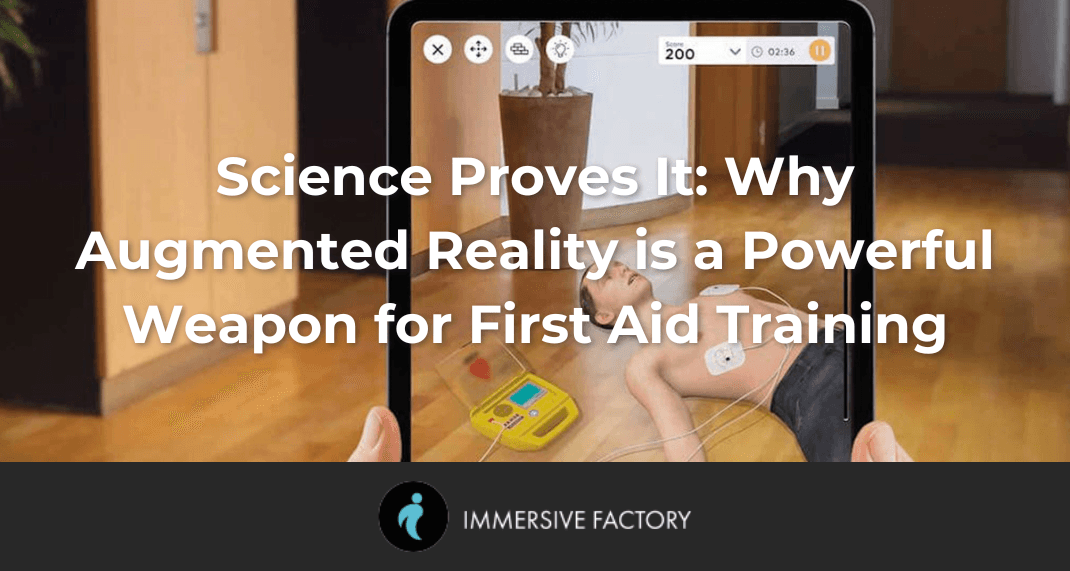
We all know that practice beats theory, especially when it comes to saving lives. Yet, First Aid and CPR training often relies on infrequent sessions, leading to a rapid decay of skills.
Why is Augmented Reality (AR) simulation a game-changer? It’s not just about technology; it’s about neurology and cognitive psychology.
Based on evidence from CPR (Cardiopulmonary Resuscitation) and AED (Defibrillator) training, here is why integrating mobile AR into the Immersive Factory offering is a pedagogical must.
1. The "Testing Effect": Moving from Passive to Active
Watching a video on chest compressions is one thing. Doing it is another.
Cognitive studies demonstrate the power of the "Testing Effect." The simple act of retrieving information from memory to apply it reinforces learning far more effectively than simple review or study.
With our AR modules (powered by Senar), the learner doesn't just check boxes on a quiz. They must act:
- Virtually position the AED pads on the victim.
- Time their chest compressions on the smartphone screen.
- Make split-second decisions.
This active engagement forces the brain to build stronger neural connections. Knowledge becomes a reflex.
2. Psychological Fidelity: Managing Stress
Knowing the technical move is useless if you panic in an emergency. This is where immersive simulation outperforms traditional methods.
Even on a smartphone screen, Augmented Reality creates a sense of presence and urgency—what experts call "psychological fidelity." The learner sees the (virtual) victim lying on the floor of their own office. Overlaying virtual danger onto a familiar real-world environment emotionally engages the user.
The result? Learners trained via AR feel more confident and less stressed when faced with a real situation because their brain has already "lived" the scenario.
3. Accessibility Drives Repetition (Micro-learning)
CPR proficiency drops drastically after just 3 months without practice. Organizing in-person sessions every quarter is logistically impossible for most companies.
Mobile AR breaks this constraint. By making First Aid simulators available on employees' smartphones via the Immersive Factory platform, you enable 5-minute refresher sessions (Micro-learning) at any time.
It is this frequent repetition, facilitated by the lack of heavy hardware, that ensures your teams will be ready when it counts.
Conclusion: Validated Efficiency
Feedback on AR-based CPR/AED training is clear: participants are more engaged, retain procedures better, and develop real confidence in their abilities.
At Immersive Factory, we curate tools that bring real pedagogical value. Mobile AR is not a gimmick; it is the essential complement to your hands-on training to ensure everyone's safety.
Would your employees know how to react to cardiac arrest today? Test our Augmented Reality First Aid module and deploy it instantly to your teams.

Scritto da Aurélie Tavernier
Responsabile Marketing e Comunicazione presso Immersive Factory.
Appassionata di sensibilizzazione alla salute e sicurezza sul lavoro, convinta che un approccio adattato ai collaboratori possa trasformare la cultura della sicurezza e rafforzare la vigilanza condivisa. Il suo obiettivo: incoraggiare tutte le imprese, qualunque sia la loro dimensione, a impegnarsi attivamente nella prevenzione sanitaria e di sicurezza per il bene dei loro dipendenti.