Optimism Bias and Safety: How VR Re-awakens Expert Vigilance
Optimism Bias and Safety: How VR Re-awakens Expert Vigilance
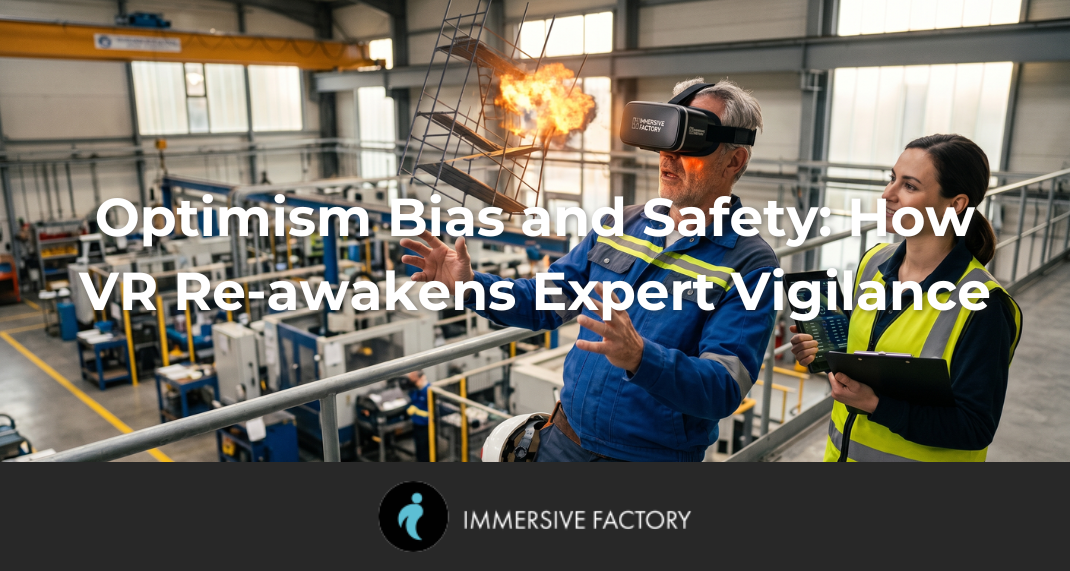
HSE Safety: How VR Breaks the Routine for Experts.
In the industrial sector, one phrase is heard more than any other: “I’ve been doing this for 20 years; I know my job inside out.” This is precisely where the danger begins. While experience is a precious asset, it hides a formidable side effect: complacency.
While newcomers are naturally cautious, experienced workers often develop a psychological immunity to risk. How can you break this routine before an accident occurs? Virtual Reality (VR) is now emerging as the disruptive tool capable of resetting the vigilance of even the most senior profiles.
The Experience Trap: Why Experts Become Vulnerable
In cognitive psychology, two phenomena explain why an expert might ignore a life-threatening danger:
- Risk Habituation: By being repeatedly exposed to a hazard (a noisy machine, heights, electrical circuits) without suffering harm, the brain eventually classifies the danger as "background noise." The internal alarm bell stops ringing.
- Optimism Bias: This is the irrational belief that while an accident might happen, it will happen to others, but never to oneself.
For an HSE manager, training these profiles is a major challenge. Classic theoretical sessions or safety videos often slide right off them without triggering any behavioral change. They feel they have "seen it all before."
The "Pedagogical Shock": Virtual Reality’s Major Asset
This is where Immersive Factory steps in. Unlike passive training, VR places the expert at the heart of a scenario where error is possible, visible, and lived.
1. Experience the Accident Without the Injury
VR allows a worker to simulate the direct consequence of negligence (a fall, an explosion, an electrocution). Although the brain is aware the experience is virtual, it generates real emotional and physiological responses. This emotional "shock" instantly reactivates risk perception.
2. Testing Limits Safely
Experts often need to understand the "why" behind a rule. In VR, they can deviate from standard procedures to see exactly where the tipping point lies. This guided exploration strengthens adherence to safety rules much more effectively than a formal prohibition.
3. Breaking Routine Through the Unexpected
Immersive training scenarios can integrate random variables (a sudden breakdown, a colleague’s mistake, deteriorating weather). This forces the expert to step out of "autopilot" mode and mobilize their real-time analytical skills.
From "Knowledge" to "Shared Vigilance"
Training experts via virtual reality doesn't just protect the individual; it transforms the entire company's safety culture.
An experienced worker who has "lived" a virtual accident becomes a prevention ambassador. They no longer just follow the rules; they are able to explain to younger colleagues why routine is their worst enemy. This is the engine of shared vigilance.
Did you know? According to neuroscience studies, the retention rate after VR training reaches 75% to 90%, compared to only 10% for traditional reading or presentations.
Conclusion: Reinvesting in People Through Tech
Technology isn't here to replace the expertise of veterans, but to protect it. By integrating virtual reality into your training programs, you offer your experts a mirror of their own biases.
Complacency is a luxury the industry cannot afford. It is time to re-awaken the vigilance of those who are the true strength of your company.
💡 Ready to transform your safety culture?
Explore our Virtual Reality training scenarios designed to challenge habits and reinforce memory anchoring for your teams.

Scritto da Aurélie Tavernier
Responsabile Marketing e Comunicazione presso Immersive Factory.
Appassionata di sensibilizzazione alla salute e sicurezza sul lavoro, convinta che un approccio adattato ai collaboratori possa trasformare la cultura della sicurezza e rafforzare la vigilanza condivisa. Il suo obiettivo: incoraggiare tutte le imprese, qualunque sia la loro dimensione, a impegnarsi attivamente nella prevenzione sanitaria e di sicurezza per il bene dei loro dipendenti.