Memory Retention: Why the Brain Retains VR Safety Training 4 Times Better
Memory Retention: Why the Brain Retains VR Safety Training 4 Times Better
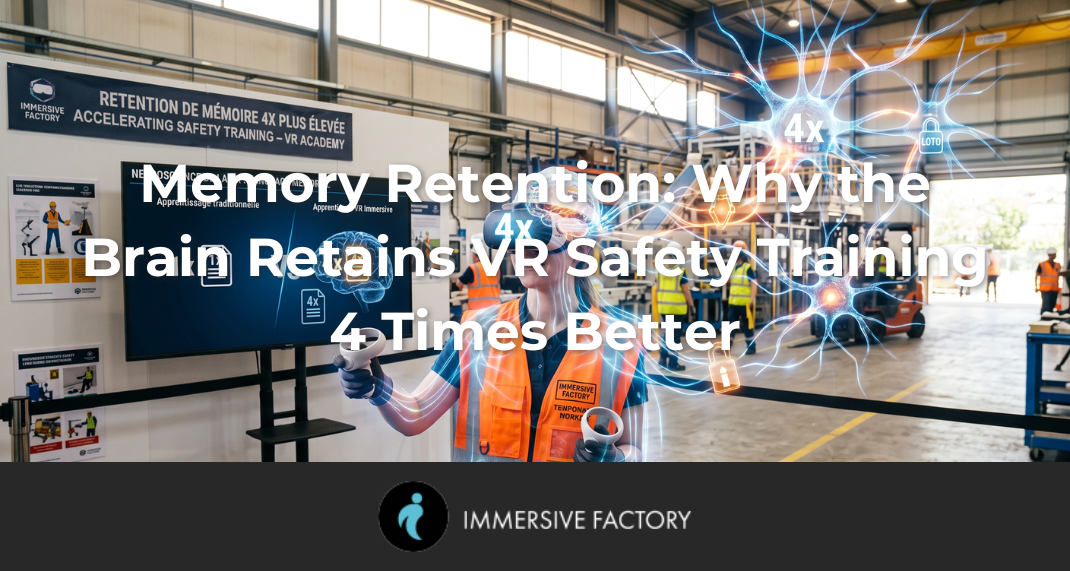
In the field of Environmental Health and Safety (EHS), a recurring question haunts safety directors: why do employees who pass safety quizzes with top scores still make critical mistakes on the shop floor?
The answer isn't a lack of goodwill—it lies in the mechanics of the human brain. Theoretical rules learned passively in a classroom evaporate quickly if they aren't connected to real-life experience.
This is where neuroscience and Virtual Reality (VR) intersect to transform safety culture.
The Forgetting Curve: The Invisible Enemy of Safety Training
In 1885, psychologist Hermann Ebbinghaus conceptualized the "Forgetting Curve": without active reinforcement, the human brain forgets up to 70% of new theoretical information within 24 hours.
In traditional safety briefings featuring dozens of static slides, the brain processes guidelines purely in short-term memory. A week later, when a hazardous situation actually occurs on site, the necessary safety reflexes are missing.
The 3 Neuroscientific Pillars of Virtual Reality
VR bypasses this cognitive limitation by engaging the brain in an active, experiential way. It relies on three key mechanisms:
1. The Illusion of Presence & Kinesthetic Memory
In a VR headset, the brain does not perceive a scene as a video it is watching, but as a physical space it is occupying. Neuroscientists refer to this as the sense of embodiment. By grabbing a safety harness or closing a valve in virtual reality, the employee activates motor (kinesthetic) memory. The brain registers the action as a real-life event.
2. Risk-Free Trial and Error (Learning by Doing)
In a virtual simulation, workers are free to make mistakes—and experience the safe, simulated consequences (a fall, a firespot, a forklift collision). This "false" hazard generates a minor spike in emotional engagement without real trauma, creating a lasting emotional anchor. We rarely forget a mistake we felt we actually lived through.
3. Total Attention (Zero Distractions)
In traditional classroom setups, participants check emails or get distracted. Inside a VR headset, focus reaches 100%. Visual and auditory isolation eliminates external distractions, directing the learner's entire cognitive bandwidth toward the EHS scenario.
What the research shows: According to a landmark study by PwC, VR learners are 4 times more focused than e-learning participants and 275% more confident in applying what they learned on the job.
Moving from "Knowing" to "Reflexive Action"
The ultimate goal of EHS training is not for employees to recall a rule on paper, but to execute an automatic safety reflex when a real hazard presents itself.
By turning passive listeners into active participants, virtual reality activates the exact same neural pathways as real-world experience. It provides valuable "flight hours" on dangerous scenarios that would be too costly or hazardous to simulate in reality.
Turn Neuroscience into Safety with Immersive Factory
At Immersive Factory, our VR scenarios are designed alongside EHS professionals and cognitive ergonomics experts to maximize memory retention. From Lockout/Tagout (LOTO) and chemical safety to working at heights, our simulations put your teams' brains at the center of the action.

Scritto da Aurélie Tavernier
Marketing and Communications Manager at Immersive Factory
She became interested in raising awareness of health and safety at work, convinced that an approach tailored to employees can transform the safety culture and reinforce shared vigilance. Her ambition: to encourage all companies, whatever their size, to invest actively in health and safety prevention for the well-being of their employees.
Condividere
Da leggere anche
ISO 45001 Standard and HSE Audits: How Virtual Reality Secures Your Traceability
Prepare for your occupational health and safety audits with virtual reality. Discover how VR ensures the traceability of your HSE training.
From Passive Compliance to On-Site Engagement: Why Virtual Simulation Permanently Shifts Safety Behaviors
Discover how VR shifts safety culture in industrial workplaces. Explore error-based learning, emotional risk awareness, and interactive safety talks.
Virtual Reality Hazard Hunts: The Ultimate Guide to Boosting Your Safety Culture
The "Hazard Hunt" is a staple in HSE training. The goal is straightforward: to sharpen employees' critical eyes so they can proactively identify anomalies and dangerous situations in their work environment. It is the absolute f...