Industrial Risk Index: Definition, Calculation, Value, and Insurance Applications
Industrial Risk Index: Definition, Calculation, Value, and Insurance Applications
Industrial risk index: precise calculation for your premiums.
Industrial Risk Index
- Immediate Impact: Alerts teams and impacts the insurance balance sheet, requiring a revision of provisions and premiums.
- Calculation Method: An additive formula weights coefficients and illustrates the result using example values.
- Practical Use: Used to index premiums, clarify clauses, and guide VR training to quickly reduce incidents and justify provisions.
The industrial risk index is a key indicator used to track the evolution of costs related to claims in industrial companies. It plays a central role in calculating insurance premiums, updating contracts, and managing prevention policies. Understanding this index allows HSE managers, financial departments, and insurers to better anticipate risks and optimize their decisions.
Definition of the Industrial Risk Index
The industrial risk index is a composite indicator reflecting the evolution of costs associated with accidents and incidents in an industrial environment. It generally incorporates bodily injury, property damage, and indirect costs such as repairs or business interruptions. In practice, this index is primarily used in insurance contracts to adjust premiums and maintain consistency between the risk level and the coverage provided.
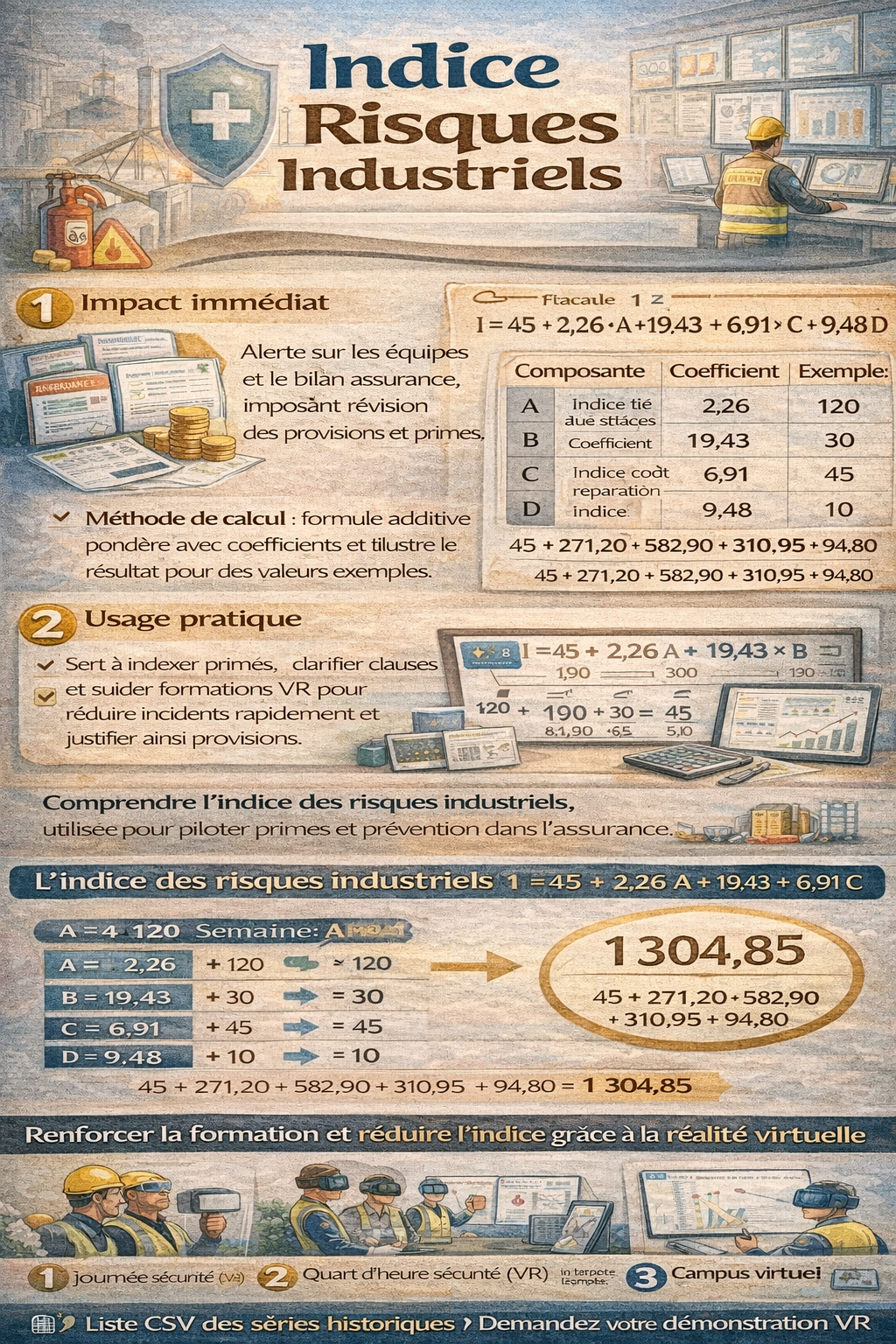
Detailed Calculation of the Industrial Risk Index: Formula and Variables
The formula: I = 45 + 2.26 A + 19.43 B + 6.91 C + 9.48 D
- Variable A: Represents the index related to bodily injury claims.
- Variable B: Represents the index related to property damage.
- Variable C: Measures the average repair cost.
- Variable D: Measures unit ancillary charges.
Step-by-Step Operational Example: Using the values A = 120, B = 30, C = 45, D = 10:
- 2.26 × 120 = 271.20
- 19.43 × 30 = 582.90
- 6.91 × 45 = 310.95
- 9.48 × 10 = 94.80
Final Sum: 45 + 271.20 + 582.90 + 310.95 + 94.80 = 1,304.85
Updates for indexation clauses are based on the ratio between two chosen dates. Sources come from national historical series and technical publications from insurance federations.
Who Publishes the Industrial Risk Index?
The industrial risk index does not depend on a single organization. It is generally constructed by specialized entities such as insurance companies or actuarial firms. This lack of standardization explains why calculation methods and results may vary between providers.
What is the Industrial Risk Index Used For?
The index is primarily a management and adjustment tool. It is used to:
- Revise insurance premiums based on risk evolution.
- Maintain the value of insured capital over time.
- Serve as a monitoring indicator for companies to evaluate the effectiveness of prevention measures.
Why Does the Index Evolve?
The evolution of the index directly reflects operational reality. An increase in accidents, rising repair costs, or the growing complexity of industrial environments can lead to an increase in the index. Conversely, improving safety practices helps stabilize or even reduce it.
How to Reduce Your Industrial Risk Index?
It is important to understand that the index itself is not a direct lever for action. Instead, behaviors and risky situations influence its evolution.
Hazard Identification: Approaches like "hazard hunting" in the industry involve teams in detecting critical situations before an incident occurs.
Training: Traditional formats often show limits in engagement and retention. This is where Virtual Reality (VR) provides an effective response. By simulating dangerous situations without real exposure, employees can train in near-field conditions. Immersive Factory solutions offer immersive modules tailored to industrial environments.
The Immersive Factory Proposal: Strengthening Training Related to the Risk Index
The positioning combines audits, demonstrations, and adaptive modules to make the index "come alive" for teams. The offer includes short sessions, full days, and a virtual campus for continuous monitoring. HSE managers gain operational benchmarks to justify adjustments to provisions and premiums.
VR Training Catalog Targeted at Industrial Scenarios
The range covers chemistry, construction, logistics, and maintenance with scenarios calibrated to different risk components. VR training can simulate claims without risk, measuring behavior in real situations and producing post-training indicators usable for reporting.
Operational Benefits for HSE Managers and HR Decision-Makers
The ROI is expressed in incident reduction rates, avoided costs, and better knowledge retention. An expected metric is a 20% drop in incidents after three months for engaged cohorts. These results allow for the adjustment of provisions and the defense of investments before the financial department.
FAQ - We Answer Your Questions
What is the current Industrial Risk Index?
To be precise, the industrial risk index stands at 7,407 as of April 1, 2026, representing a +1.1% increase over one year. It is a composite index used in insurance to track the evolution of costs related to industrial claims.
What is the FFB index and what is it used for?
In the construction jargon, the FFB (French Building Federation) index is a barometer for construction costs. It is calculated based on the cost price of a standard apartment building in Paris. It tracks cost variations in labor, materials, and finishes. Note: it does not include land value. It is a tool for anticipating budgets, negotiating, and planning to avoid financial surprises.
What are the types of industrial risks?
Industrial risks generally fall into two easy-to-remember categories:
- Physical risks: Related to dangerous working conditions (falls, machinery, fatigue).
- Chemical risks: Characterized by exposure to toxic substances (vapors, dust, etc.). Other angles include fire, environmental risks, and noise, but starting with these two helps build a solid action plan.

Scritto da Aurélie Tavernier
Marketing and Communications Manager at Immersive Factory
She became interested in raising awareness of health and safety at work, convinced that an approach tailored to employees can transform the safety culture and reinforce shared vigilance. Her ambition: to encourage all companies, whatever their size, to invest actively in health and safety prevention for the well-being of their employees.
Condividere
Da leggere anche
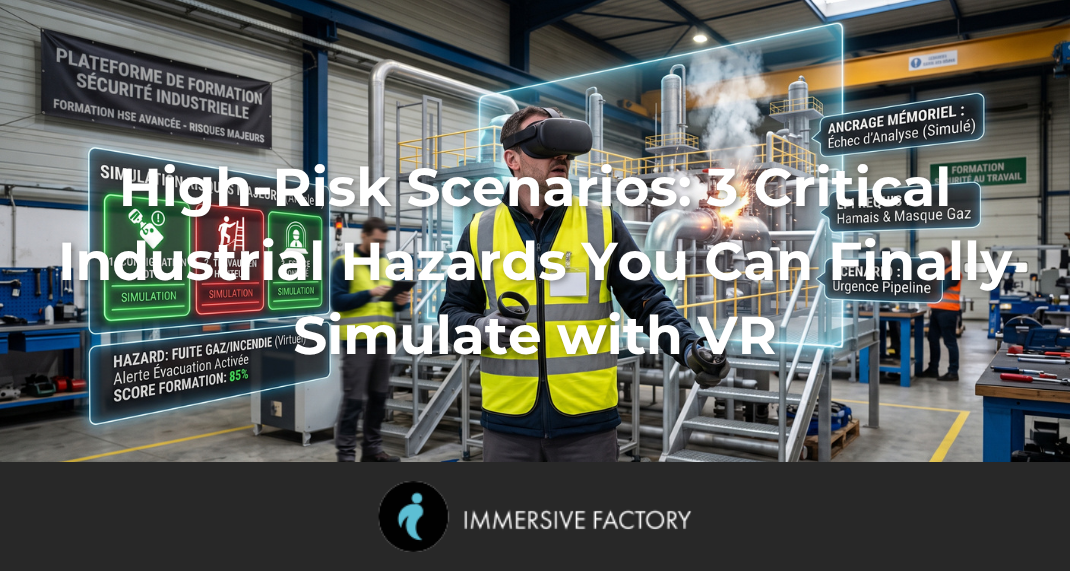
High-Risk Scenarios: 3 Critical Industrial Hazards You Can Finally Simulate with VR
Learn how VR enables safe, realistic simulation of major industrial hazards: Lockout/Tagout (LOTO), working at height, and confined space entry.
Occupational Accidents in Europe (2026): Beyond the Numbers, the Urgency to Act
What do 2026 European workplace accident stats really reveal? Immersive Factory analyzes the EUROGIP study & offers actionable VR safety solutions.
Heatwaves and Extreme Heat at Work: How Virtual Reality Helps Prevent Risks
As summer temperatures continue to soar year after year, extreme heatwaves are no longer exceptional events. For companies worldwide, managing thermal discomfort and high temperatures has become a critical annual health and saf...