Revolutionizing Mandatory Corporate Training with Virtual Reality
Revolutionizing Mandatory Corporate Training with Virtual Reality
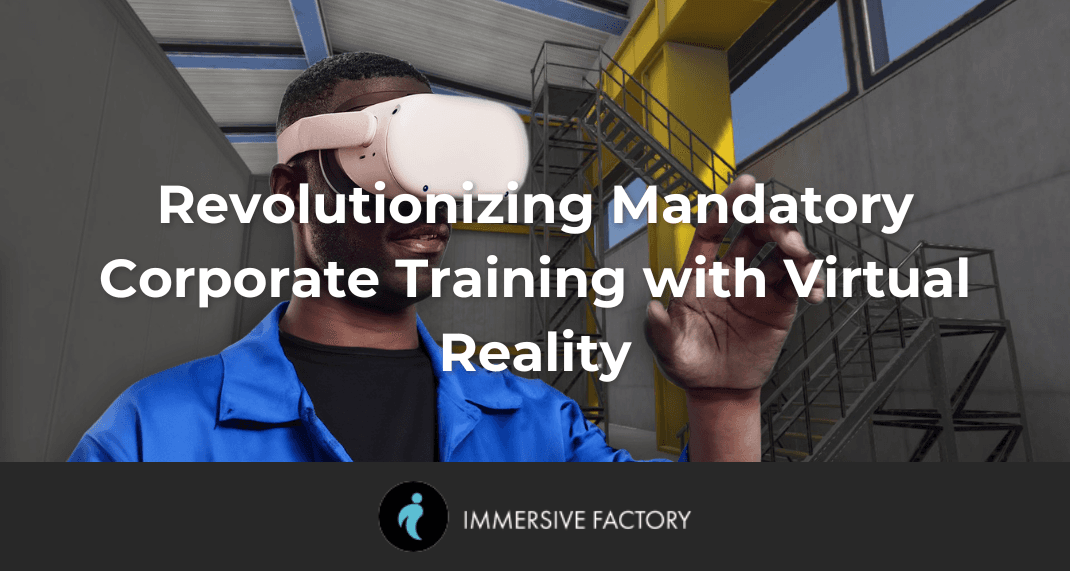
Mandatory Corporate Training: Use Virtual Reality.
Mandatory corporate training aims to ensure workplace health and safety, update employees' skills, and refresh their legal knowledge before new legal requirements come into effect. With technological advancements, trainers now focus on more interactive and personalized methods to maximize training outcomes. One of the most popular tools for active learning is virtual reality.
Types of Mandatory Training
There are several types of mandatory training in companiesdepending on the industry:
- Training for working at heights;
- Training for operating handling equipment;
- Health and safety training: mandatory first aid training, fire safety training, and electrical safety training;
- Hygiene and safety training for food industry professionals;
- Risk prevention training related to chemicals and asbestos;
- Manual handling and lifting training: training in proper lifting techniques for handlers.
Note that mandatory corporate training is governed by Article L6321-1 of the Labor Code. This law applies to all employers and ensures the health and safety of employees at work.
The Role of Virtual Reality in Mandatory Corporate Training
Virtual reality is now highly valued for training on professional risks inherent in each workplace position. It revolutionizes learning in multiple ways.
Development of Practical Skills
Virtual reality training promotes the development of practical skills by preparing employees for real-world scenarios. It immerses them in a fictional environment, allowing them to learn through experience. This immersion enhances information retention.
Reduction of Distraction
In traditional professional training, learners are easily distracted as they remain seated throughout the session. Conversely, virtual reality helps them focus on the instruction as it is more engaging and interactive.
Increased Engagement
In virtual reality learning, workers become active participants in the training. This dynamic approach invites them to directly engage in the experience, boosting their motivation and improving their engagement.
Customization
Virtual reality training can be customizedaccording to each employee's learning pace and the employer’s regulatory obligations as per the Labor Code. This makes the learning experience more inclusive and effective.
Case Studies in Virtual Reality
Here are some cases where virtual reality has been successfully implemented.
Safety Training
Virtual reality is now considered an effective risk prevention tool. It facilitates the implementation of mandatory corporate training in various sectors such as the oil industry or the food industry. For example, Saint-Gobain has partnered with Immersive Factory to enhance their HSE (hygiene, safety, and environment) training.

Maintenance Training
Virtual reality also enables team training in equipment maintenance. For example, EDF uses this technology to teach technicians and engineers the maintenance procedures for complex equipment.
Pilot Training
Future pilots now train on flight simulators. These tools can replicate dangerous conditions to teach trainees emergency procedures. Air France is among the airlines that train their employees in safety and customer service, including pilots and cabin crew.
Advantages and Challenges
Virtual reality has both advantages and challenges for mandatory corporate training.
Advantages
Virtual reality training is very beneficial for employers as it helps them meet their regulatory obligations in health, safety, and risk prevention, and can:
- Promote skill development: Active learning improves information retention as it is presented in a realistic context;
- Ensure the right to make mistakes: Training takes place in a controlled and safe virtual environment, allowing learners to repeat actions multiple times without fear of injury or damage;
- Offer realistic immersion: Virtual reality can reproduce highly realistic situations. This immersion stimulates engagement and facilitates the acquisition of new skills.
Challenges
Despite its benefits, virtual reality training is still challenging to implement due to the high cost of equipment and the complexity of scenario creation. To offer quality training and comply with Labor Code obligations, employers must engage professionals in this field.
Immersive Factory, Your Partner for Virtual Reality Training
To improve workplace safety for your employees, offer them professional training combining innovation and efficiency. At Immersive Factory, we can help you implement virtual reality training on specific themes related to your industry. Whether you need to train your workers in first aid, the use of safety equipment, or health risk management, achieve your goals more easily with the help of our expert technicians.

Long-Term Impact of Virtual Reality on Corporate Training
In a few years, virtual reality will play a predominant role in professional training. Thanks to its flexibility, adaptability, and efficiency, it is already transforming how companies impart new knowledge to their employees. Additionally, it reduces the costs associated with implementing mandatory safety training.

Geschrieben von Aurélie Tavernier
Leiterin Marketing und Kommunikation bei Immersive Factory.
Sie interessierte sich für die Sensibilisierung für Gesundheit und Sicherheit am Arbeitsplatz, überzeugt davon, dass ein an die Mitarbeiter angepasster Ansatz die Sicherheitskultur verändern und die gemeinsame Wachsamkeit stärken kann. Ihr Ziel: alle Unternehmen, unabhängig von ihrer Größe, zu ermutigen, sich aktiv für die Gesundheits- und Sicherheitsprävention zum Wohle ihrer Mitarbeiter einzusetzen.