Chemical Risks: 8 Measures to Protect Your Teams
Chemical Risks: 8 Measures to Protect Your Teams
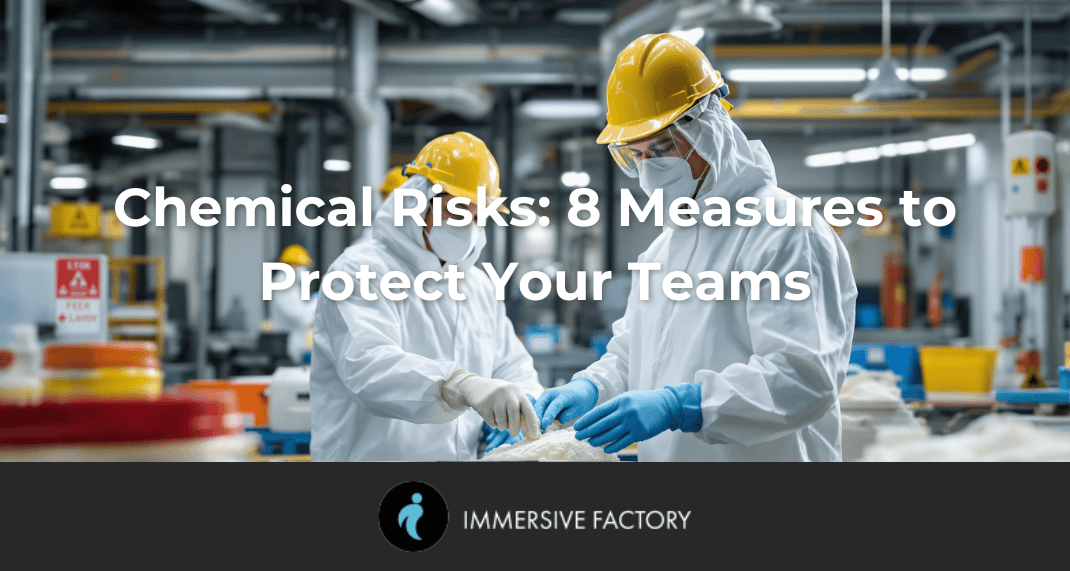
Workplace Chemical Risks: 8 Measures to Protect Your Teams.
Summary: Vigilance and Anticipation in Industrial Settings
- The variability of chemical risks requires meticulous technical analysis; however, routine practices often mask latent danger. In fact, constantly identifying agents from aging processes becomes wise to preserve health.
- From now on, regulatory prevention necessitates dynamic adaptation. Thus, the OEL (Occupational Exposure Limit) guides every decision, whereas a slight modification is enough to unbalance the environment, making anticipation indispensable rather than optional.
The industrial scent often seizes you before you even see the warehouse. You recognize those regular metallic noises, signs of a recurring production environment. Even the solvent placed near you reminds you of the normality of potentially dangerous practices. Dust floats, and you cross paths with it every day without really seeing it. This observation is often confirmed: every gesture harbors a discreet threshold that reveals the latent, yet very real, risk. Why not opt for virtual reality professional training?
Defining Chemical Risks in the Company
Before envisioning an industrial risk hunt, you are confronted with the necessity of dividing professional daily life between innovation and habits, because each product infiltrates differently. This phenomenon repeats often; silica neighbors strong acid and other substances that regulations do not always describe precisely. A simple detergent can prove virulent, while a solvent residue eventually generates unsuspected disorders.
This link is now evident because the rigorous analysis of every tool and every product leads you, consciously or not, toward virtual reality professional training. This principle is no longer up for debate because you have the responsibility not to ignore the multiplicity of agents sometimes resulting from forgotten stocks or aging processes.
This is particularly the case when your health tips over without perceptible warning. You breathe, then later suffer the severity of exposure, however furtive. Indeed, accumulation hides a dangerous inertia, and chronic fatigue reveals the consequence of regular contact. This perfectly illustrates the need for daily control, as every exposure slowly rebuilds the ground for serious pathologies. You remain convinced that today's prudence preserves tomorrow, even in the face of a silent danger.
This point remains central because signage runs on every support, hung on the wall, inscribed in your protocols. In fact, every sheet, every code refers to a safety imperative. You are able to guarantee the attentive reading of symbols, a direct window into the reality of risks. In short, you quickly understand that vigilance is essential and translates a vital need to avoid the illusion of safety.
Regulations on Chemical Risks in the Professional Environment
This functioning imposes itself in usage, placing you before shifting regulations—sometimes distant but always present. You are right to follow the legal framework imposed by the 2025 labor code, which commits you to preventing all risks and constantly adapting your organization. This principle is no longer up for debate because prevention becomes dynamic and demands continuous anticipation.
The OEL (Occupational Exposure Limit), in reality, guides every decision, every station check, and risk analysis. Indeed, you consult these thresholds for every chemical agent, linking theory to the field. You adjust the choice of process or equipment according to nature and toxicity. This point remains crucial because even a slight variation can upset the fragile balance of your environment.
The Eight Measures to Protect Teams Against Chemical Risks
This is often verified: standards alone are not enough without constant adaptation to progress and the reality of the field. This phenomenon repeats in the STOP approach, a tool structuring every prevention effort.
You prioritize substitution over correction because ventilation gains in automation, and every tool must pass through the filter of technical analysis. This observation is confirmed; audacity consists of putting techniques back into perspective, sometimes contrary to habits.
- Meticulous Identification: Ensure careful identification of substances.
- Substitution: This becomes the wise choice in the face of proven danger.
- Specialized Ventilation: This erases passive exposure.
- Training Modules: Organized learning shapes protection reflexes.
- Signage: Displaying warnings generalizes awareness without becoming optional.
- PPE (Personal Protective Equipment): Wearing PPE becomes standard practice.
- Medical Surveillance: Maintain constant medical monitoring.
- Emergency Procedures: Keep a first aid kit and precise procedures available.
You shape safety culture through exchange, listening, and daily adaptation. You relay alerts, whether on-site, in a virtual workshop, or via e-learning. This remains frequent in the digital environment because vigilance becomes a collective good, built over time. You permanently adjust your devices because every return, incident, or analysis pushes reflection. You refuse the status quo, and every unforeseen event forces you to reframe your strategy, supported by documentation. In short, this requirement never completely relaxes.

Glossary: Essential Concepts for Every Professional
- CMR: Carcinogenic, Mutagenic, Reprotoxic agents.
- PPE: Personal Protective Equipment.
- SDS: Safety Data Sheet.
- OEL: Occupational Exposure Limit (VLEP in French).
- SEIRICH: National chemical risk assessment tool (France).
- CARSAT: Retirement and occupational health insurance fund (France).
- Hazard: Intrinsic property of a product.
- Risk: Probability that the hazard causes a health effect.
Immersive Perspective for the Professional Seeking Innovation: Immersive Factory
Immersive Factory revolutionizes corporate chemical risk management thanks to virtual reality. By simulating real danger situations, this technology allows professionals to concretely understand the invisible risks linked to chemical products. Rather than settling for theoretical training, employees live immersive experiences that help them adopt the right safety reflexes, thus reinforcing vigilance and prevention.
This transforms learning into an engaging and realistic experience, contributing to an active safety culture and better adaptation to daily risks.
This point remains fundamental; innovation and information precision structure safety like trust. You often notice that the greatest progress emerges where it is no longer expected.
More Information on Workplace Chemical Risks
What are the 3 professional risks?
Let's speak frankly: professional risks are sometimes a real laundry list, and yet, three risks stand out like stains on a white sheet, impossible to miss, always there, always threatening: falls, that great classic of clumsiness in all its forms; chemical risks—it smells strong, it burns, or it often gnaws in silence, but it scares as soon as it's mentioned; and then obviously, machine risk: that famous metal beast that can do anything, even crunch a distracted finger. We could add psychosocial risks, MSDs, or back pain, but really, falls, chemical risks, machine risk—that's the winning trio (or losing, depending on the point of view) of our professional daily life. Each brings its little anxiety, its unforeseen event, that reminder that working is never 100% relaxing. Yet, with a bit of anticipation, we can tame these professional risks, right?
What are the 9 types of chemical risks?
It is surprising, actually, the diversity of chemical risks—a real bestiary. Asphyxiants, corrosives, irritants, sensitizers: each substance prepares its little surprise. And then, there are the carcinogens, those that send shivers down your spine. Mutagens? Yes, they downright play with the genetic code. Teratogens, reactive flammables, ready to dance a jig at the slightest spark. Nine families, nine atmospheres, nine ways to sabotage the organism on the sly or set fire to the lab. Behind every bottle, a chemical risk—sometimes discreet, sometimes explosive, but always ready to surge, masked, in the routine. We classify them, we name them, but every chemical risk hangs an unexpected suspense, a bit like a failed recipe that turns into drama—one ingredient too many, and everything tips over!
How to protect oneself from chemical risks?
Protecting is a word we hear often, but protecting oneself from chemical risks is concrete; it smells of lived experience. Gloves, safety glasses, adapted mask—that's the quasi-essential gear. We put on gloves, sometimes with the lightness of those who think they master everything, and yet, a moment of distraction, an unforeseen drop is enough, and chemical risk invites itself where it wasn't expected. Mask on the nose (and it's not for laughs), glasses screwed in front of the eyes, and we move forward, a bit tense, a bit concentrated, never quite serene. Because chemical risk, it doesn't take a break. So we multiply layers, reflexes, we check, we anticipate, we protect ourselves daily, because no one wants to live the "it only happens to others" scenario.
What are the 4 types of hazards?
Hazards, in food (and elsewhere, to tell the truth), sneak into the shadow of a dish, interlocked in four categories like a malicious addition. Microbial risks, invisible silhouettes capable of ruining everything on the sly, and then chemical risks, those recalcitrant disruptors. Physical risks (a shard of glass, a bone, a wire in the sauce?), always unpredictable. Finally, allergens, sneaky, powerful, often triggering where we thought we were in control. Microbial, chemical, physical, allergens: a slightly unstable square, always on the edge of vigilance. Barely a misstep, a bad intuition is enough to go from a festive meal to a mishap. Hazards are everywhere, as varied as the dishes of a grand buffet, and really claim their share of awakened attention.

Geschrieben von Aurélie Tavernier
Leiterin Marketing und Kommunikation bei Immersive Factory.
Sie interessierte sich für die Sensibilisierung für Gesundheit und Sicherheit am Arbeitsplatz, überzeugt davon, dass ein an die Mitarbeiter angepasster Ansatz die Sicherheitskultur verändern und die gemeinsame Wachsamkeit stärken kann. Ihr Ziel: alle Unternehmen, unabhängig von ihrer Größe, zu ermutigen, sich aktiv für die Gesundheits- und Sicherheitsprävention zum Wohle ihrer Mitarbeiter einzusetzen.