Fire Safety Logbook: Legal Obligations Companies Need to Know
Fire Safety Logbook: Legal Obligations Companies Need to Know
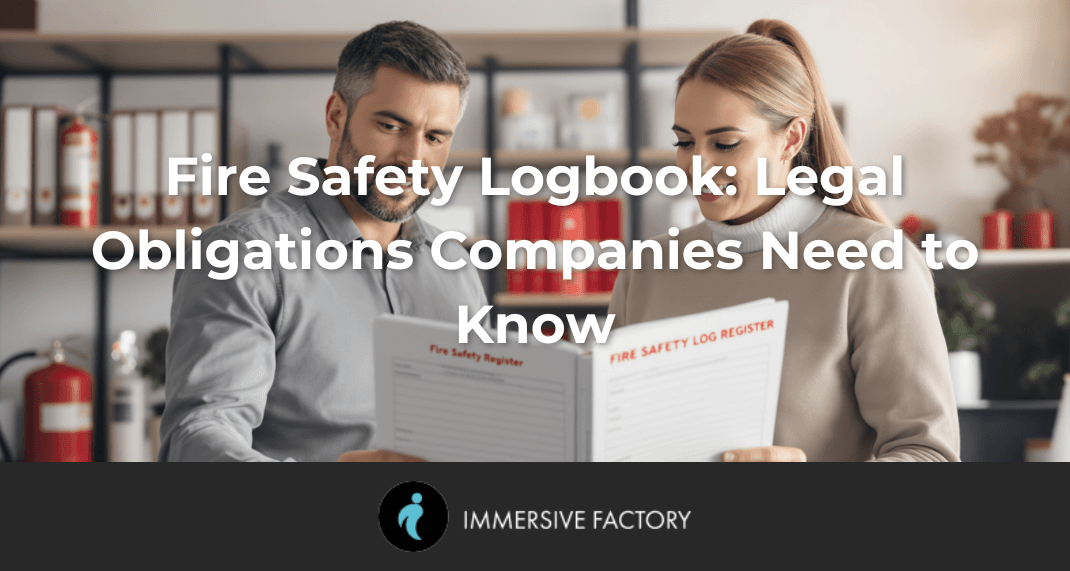
Fire Safety Logbook: Legal Obligations and Regulations.
In your daily professional life, safety is manifested through regular gestures or precise decisions that reinforce vigilance. You sometimes question yourself when an alarm sounds; uncertainty sets in, and the entire environment shifts into "prevention reality." This apparently harmless routine, made up of checks and sign-offs, structures your relationship with legal obligations. Thus, the fire safety logbook represents not just a specific administrative task but the true pillar of risk management in the company. Why not opt for a Safety Toolbox Talk?
The Legal Framework of the Corporate Fire Safety Logbook
An accident, often unforeseen, or a fire drill reminds us of the importance of the logbook, particularly during the famous Safety Toolbox Talk (or "Safety Moment"). This step, devoid of artifice, demonstrates the centrality of this documentary record in the prevention strategy. You carry this logbook as a continuous responsibility requiring rigor and regularity, because no management function escapes regulatory control. This phenomenon repeats itself often, particularly during a disaster or an inspection. The obligations linked to the logbook therefore go far beyond simple administrative compliance, imposing permanent vigilance.
The Fire Safety Logbook
This logbook is not a simple tool of bureaucracy; it constitutes a living memory of prevention actions, checks, and modifications carried out on your site. This principle is no longer up for debate; you embody the discipline required to make this document a daily ally. You record, page after page, every intervention and every measure intended to protect collaborators and visitors. This point remains central because every internal actor participates in building this safety culture. You then demonstrate that regulatory compliance becomes a true professional value.
Applicable Regulations and Official References
The Labor Code (specifically Article R4227-28 in France) obliges the private sector to scrupulously record every safety action. ERPs (Establishments Receiving the Public), governed by the decree of June 25, 1980, fall under Article R.123-51 of the Construction and Housing Code (CCH). You notice that the interpretation of texts varies according to the type of establishment, and it is absolutely necessary to adapt your organization if you manage mixed-use spaces. In short, regulations meticulously infiltrate all contexts, even the most unexpected. Vigilance leaves no room for approximation.
List of Responsible Persons and Compliance Actors
In your structure, designating a person in charge of the logbook is never random. You entrust this responsibility to a trained and qualified person, and this choice is essential to ensure a high level of vigilance. The person in charge then ensures updates, permanent control, and the transmission of any useful information. The circulation of data—between the hierarchy, staff representatives, or authorities—imposes itself as a given. This functioning is standard practice and protects against unforeseen sanctions.
The Scope of the Obligation and Special Cases
You adapt the logbook according to the morphology of the site, the number of employees, or the type of occupancy. However, the law demands identical precision for all contexts, from coworking spaces to mixed-use buildings. No administrative loophole holds up against contemporary requirements; every detail becomes verifiable without notice. It is in your best interest to prove, without delay, the compliance of each element. This phenomenon is easily observed in the multiplicity of current configurations.
Content and Maintenance of the Fire Safety Logbook
You quickly realize that managing the logbook is never just about filling in blanks. Preparation, surveillance, and attention to detail place you in a state of permanent alert. No forgotten column or vague instruction must remain, which imposes the maintenance of a document faithful to the reality of the field. This observation is confirmed during every inspection, as an empty logbook proves useless in front of the authorities.
- Instructions and Evacuation Plans: Detailed information on fire procedures. Updated with every change.
- Equipment Checks and Verification: Maintenance and service reports. Periodic, generally annual.
- Incident and Drill Log: History of drills and disaster/accident declarations. After every event.
- Contact Details of Persons in Charge: Name, title, and contact info of safety referents. Permanently up to date.
Method of Constitution and Updating the Logbook
You choose between paper format and the digital version, depending on your organization's needs. The digital logbook, sometimes derived from an official template, facilitates sharing and backing up modifications. Archiving every change, recording previous versions, and keeping the whole thing up to date demonstrates true responsiveness during inspections. In fact, you save precious time and demonstrate the seriousness of your approach. Updating the logbook must remain a daily priority.
Responsibility for Maintenance and Access to the Logbook
As the safety manager, you show the logbook without waiting during inspections; otherwise, doubt sets in. Authorities, firefighters, and new collaborators must have unrestricted access to this document. You must keep every archive for five to ten years, depending on the criticality of the file being treated. This functioning guarantees transparency and reassures every actor involved. An omission here transforms an oversight into a major fault.

Risks Incurred in Case of Regulatory Breach
Forgetting or negligence in managing the logbook exposes the establishment to immediate sanctions, whether criminal or administrative. You face fines, site closure, or summons before judicial authorities. This observation is confirmed every year, as several companies bear the full brunt of uncompromising inspections. Thus, you cannot put off updating it without risking a brutal fall. A well-kept logbook protects your activity sustainably.
Typology of Administrative and Criminal Sanctions
Non-respect of the logbook leads to a rapid gradation of sanctions. You answer to management, and sometimes in court, for the slightest material oversight. No half-measures survive in recent practice, and the forgotten detail costs very dearly. This principle guides your vigilance because the logbook defends you only if you serve it in return. Protection is never improvised, and a lack of updates is no longer forgiven.
Corporate Risk Management and Dispute Prevention
You anticipate every inspection by archiving and documenting every intervention or incident. The regular exercise of updating forges preventive safety, sheltered from legal disputes or insurance refusals. Indeed, traceability protects your decisions, even under pressure. You cannot let the slightest inaccuracy, even harmless, remain. Any omission blocks reimbursement in the event of an insurance claim.
Summary of Best Practices to Remain Compliant
You verify the completeness of the logbook and the validity of the responsible information before every internal or external audit. This principle is no longer up for debate because updating and organization guarantee the resistance of your system against any incident. You can establish a personalized checklist to mitigate every risk of forgetting. By adapting your habits, you reinforce the collective intelligence of your structure. Between sanction and prevention, there remains a well-kept logbook—a guarantee of serenity.

Fire Safety Logbook and Training with Immersive Factory
You experiment with immersive training or digital logbook management to improve responsiveness and ease of use. Modern technologies, such as virtual reality, reinforce your capacity to simulate, evaluate, and anticipate every incident.
A new generation of HSE managers values the automation of audits and immediacy, while respecting the requirements of the standard. This point does not mean forgetting documentary rigor—quite the contrary. Your future plays out at the intersection of innovation and irreproachable compliance.
Frequently Asked Questions about the Fire Safety Logbook
What is a fire safety logbook?
Imagine an ordinary morning: the fire alarm sounds, a bit too strident, a bit too real, and suddenly, all routines shift. There, in the chaos, the fire safety logbook becomes the silencious guardian. It is the logbook of all measures taken—or forgotten—to protect lives. This document carries weight, literally: it records vigilance, lists all fire safety equipment, drills, tests—everything that has been recorded, signed, dated. If an issue arises, it is the logbook that will speak to the judges, the first thing opened. A true narrator of critical episodes, crucially important.
What should be put in the safety logbook?
Take a moment to imagine this safety logbook, its almost banal allure, but under the cover, what a treasure of details. It takes note of all fire safety equipment, even the little extinguisher forgotten behind the photocopier. It lists protective equipment, but also installations, technical checks, and means of fighting fire. Not forgetting evacuation drills, with the list of first names of those in charge—they are the ones we look for in case of a glitch. Everything that protects, everything that prevents, must be found there, down to the slightest adjustments and observations written in black and white.
Who keeps the safety logbook?
Imagine the scene: an establishment buzzing with activity, a hundred things to manage, and there, at the top of the pyramid, the Head of Establishment (Site Manager/CEO). It is indeed they who hold the reins of the safety logbook. It is to them that one turns when information must be updated, new fire safety equipment recorded, drills verified. They receive it, keep it, hold it ready, because in the event of an inspection or a glitch, it is the Head of Establishment who is accountable. A real responsibility—not always light, sometimes heavy—but essential so that fire safety never rhymes with empty formalism.
What is the fire safety logbook for ERT and is it mandatory?
The fire safety logbook for ERT (Établissement Recevant des Travailleurs - Establishments Receiving Workers), here is a notion that is not just administrative. It is the backbone of corporate fire safety. Mandatory? Yes, and not just to tick a box, but to guarantee true traceability of every measure, every check. By omitting this logbook, the company risks a sanction: 750 euros, not a gentle little reminder. Every employer, whatever the size of the ship, must keep one up to date and record every drill, every piece of fire-fighting equipment, every alert, every repairman who passes through. A rule of the game where fire safety becomes concrete—not just paper, but palpable protection.

Geschrieben von Aurélie Tavernier
Leiterin Marketing und Kommunikation bei Immersive Factory.
Sie interessierte sich für die Sensibilisierung für Gesundheit und Sicherheit am Arbeitsplatz, überzeugt davon, dass ein an die Mitarbeiter angepasster Ansatz die Sicherheitskultur verändern und die gemeinsame Wachsamkeit stärken kann. Ihr Ziel: alle Unternehmen, unabhängig von ihrer Größe, zu ermutigen, sich aktiv für die Gesundheits- und Sicherheitsprävention zum Wohle ihrer Mitarbeiter einzusetzen.