Create a Safer Work Environment Through Safety Training
Create a Safer Work Environment Through Safety Training
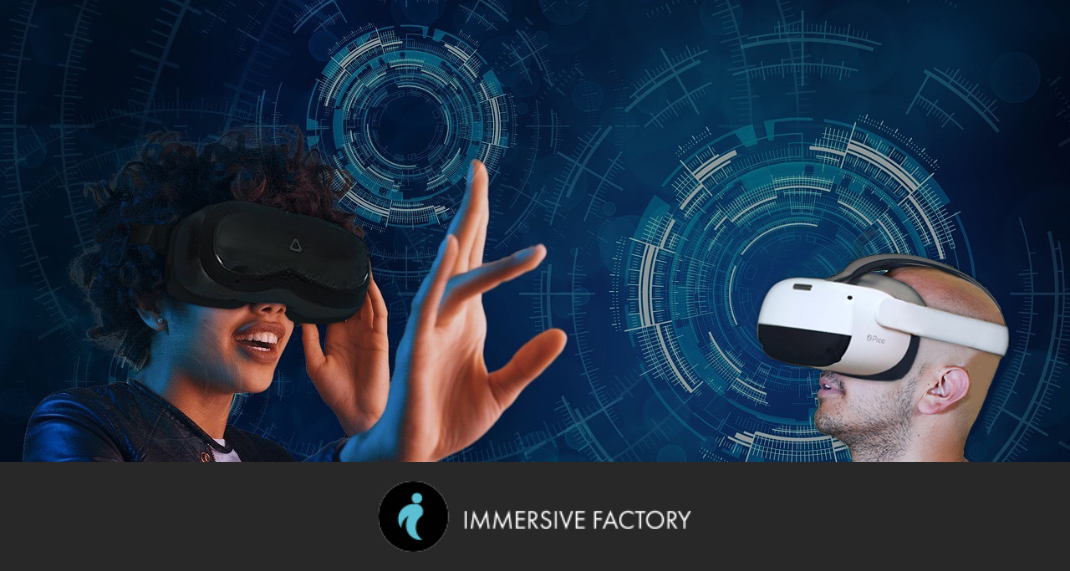
Workplace Safety Training / Its Importance for Employees and the Company.
The health and safety of employees are threatened by many risks daily. To ensure their peace of mind and well-being, employers must initiate preventive measures to protect them. Consequently, undergoing safety training has become essential to identify and prevent dangers.
What is Workplace Safety Training? Definition and content of the training.
To minimize accidents and illnesses, companies are obliged to offer safety training to their teams. These are part of the annual professional risk prevention program. If you are looking for a workplace safety day idea, follow this link.
Training Content
Safety training can cover several topics, including:
- Workplace ergonomics;
- Violence prevention;
- Use of machinery or certain equipment;
- Fire safety;
- Environmental safety;
- Employee health support;
- Online safety.
Challenges of Health and Safety at Work
Work health and safety present commercial (in terms of performance and branding), legal (criminal and civil liability), financial (direct and indirect costs), human and social (psychological impacts of accidents, consequences of absenteeism) stakes.
Objectives and Challenges of Safety Training
Safety training has numerous stakes:
It ensures legal compliance
Depending on the company's activity, the dangers employees face can vary. That's why safety training has been made mandatory. Employers must take necessary measures to protect their physical and mental health. These include:
- Information and training actions;
- Risk prevention actions;
- The implementation of suitable means and organization.
Creating learning programs thus ensureslegal compliance.
It is a performance guarantee for your company
Thanks to training, your employees will acquire new skills. They will be able to control dangers in their work environment and know first aid gestures. Prevention allows teams to adapt to technical, social, and regulatory changes, increasing your company's performance.
It's a recommendation from certain professional sectors
To enable workers to gain the skills they need and implement effective prevention measures, the National Technical Committees propose certain training recommendations for each industry.
It reduces turnover
Employees are more likely to stay in a company that cares about their well-being. Training reduces mishaps and work accidents. Thus, employee satisfaction is proportional to turnover. The more satisfied your employees are, the less you'll need to hire new members.
It ensures better productivity
Thanks to safety training, your collaborators will adopt the right methods to perform their tasks correctly. Knowing their workplace is safe, they'll focus better on their work, guaranteeing better productivity.
It reduces absenteeism
Occupational diseases are mainly due to a lack of safety measures in a workplace. They are caused by various factors such as chemicals, falls, vibrations, and extreme temperatures. By learning to prevent risks, your employees will have better daily protection, reducing absenteeismdue to occupational diseases.
It fosters teamwork and communication
Safety training makes employees realize that they need to work as a team and look out for one another. It strengthens cohesion. It also boosts their motivation, as they'll feel they belong to a community. Training reminds them that they are first and foremost seen as human beings.
It enhances the company's brand image
Besides being a legal obligation, training enhances a company's brand image. It shows its dedication to protecting its employees, attracting the best talents and boosting its reputation.
Skills Acquired After Training
Thanks to quality training, learners will gain new knowledge and skills they can use daily for the company's benefit. If information is conveyed correctly, it should initiate a change in practices and behaviors. Company leaders are required to plan multiple training sessions, which should encompass both theory and practice.
For instance, for fire safety, it's possible to simulate a scenario to help workers master the use of an extinguisher, understand combustion mechanics, and alert emergency services following the company's established protocol.
Similarly, at the end of a first aid rescuer training, learners will be prepared to respond to emergencies and administer first aid to an injured person.
Who is this Training For?
Safety training targets:
- New company employees;
- Employees switching positions;
- Employees returning to their positions (if they've been away for more than 21 days);
- Interns and temporary workers.
Opportunities Offered by the Training
Many opportunities arise after workplace safety training. However, it should be combined with longer, more comprehensive programs. Regardless, it's possible to pursue the following careers after training:
- HSE preventer;
- SST manager (this job is accessible after a few years of experience as an HSE preventer);
- Safety advisor.
Undergoing Workplace Safety Training in VR
Virtual reality is a modern tool allowing a better understanding of occupational risks and determining suitable measures. It simulates a realistic environment using various tools, especially the VR headset. It can be used to train your teams and offers numerous advantages:
- Enhances learning quality and efficiency;
- Reduces training time;
- Offers immersive experiences;
- Promotes information retention.
We offer personalized support for companies wanting to design unique training programs. We have a team of experts that will consider your needs. Moreover, we focus on engaging animations to ensure you meet your goals, like serious games, treasure hunts, and quizzes.
Participants will learn through hearing, sight, spatial orientation, and muscle memory. Our main goal is to help you enhance overall safety in your establishment.

Geschrieben von Aurélie Tavernier
Marketing and Communications Manager at Immersive Factory
She became interested in raising awareness of health and safety at work, convinced that an approach tailored to employees can transform the safety culture and reinforce shared vigilance. Her ambition: to encourage all companies, whatever their size, to invest actively in health and safety prevention for the well-being of their employees.
Teilen
Das könnte Sie auch interessieren
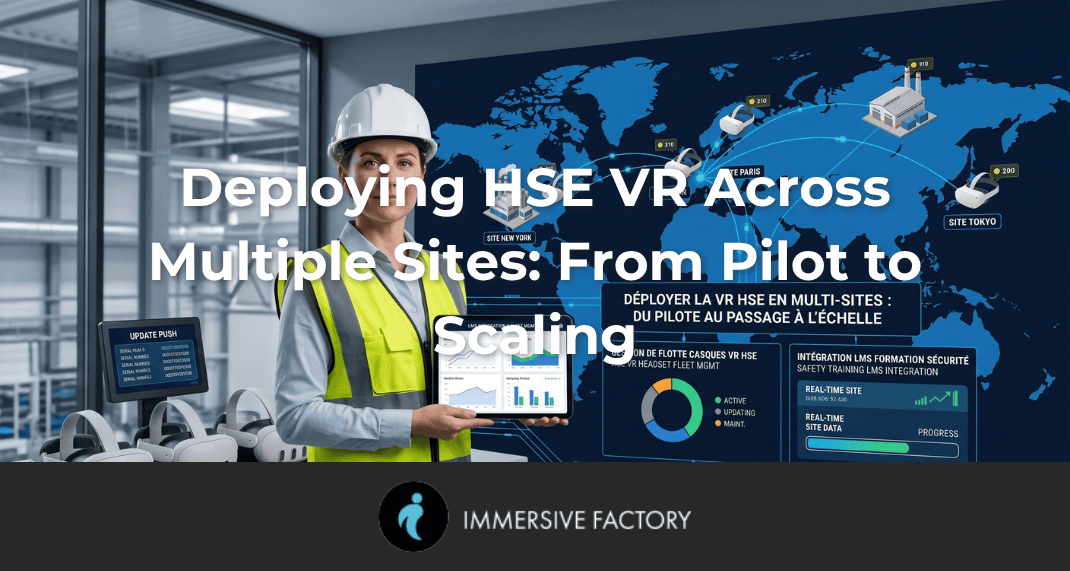
Deploying HSE VR Across Multiple Sites: From Pilot to Scaling
Discover how to successfully scale enterprise virtual reality for multi-site safety training: fleet management, LMS integration, and local adoption.
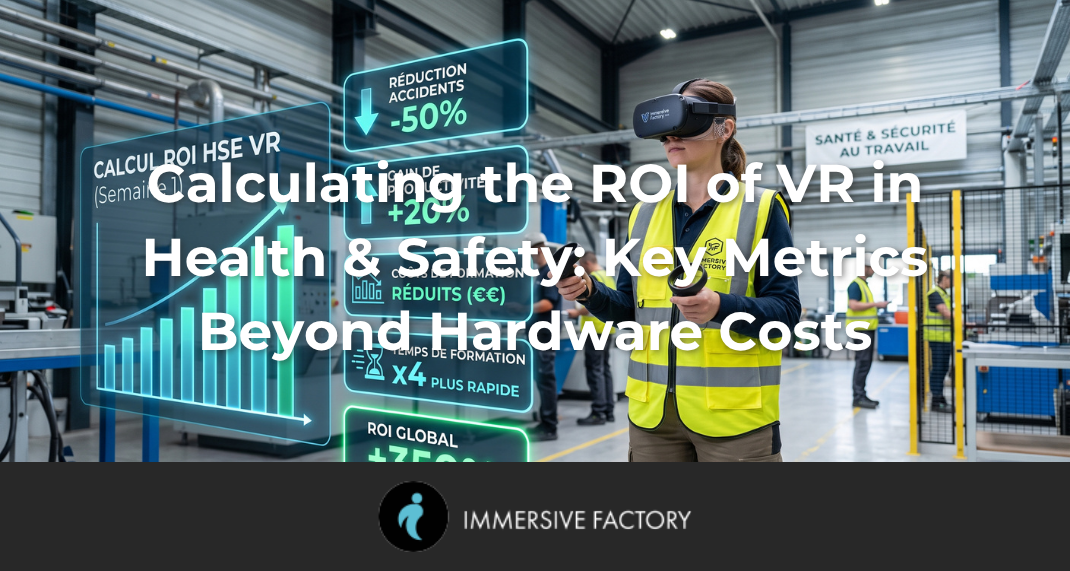
Calculating the ROI of VR in Health & Safety: Key Metrics Beyond Hardware Costs
Learn how to measure the true ROI of virtual reality in HSE safety training. Key metrics, hidden cost savings, and incident rate reduction.
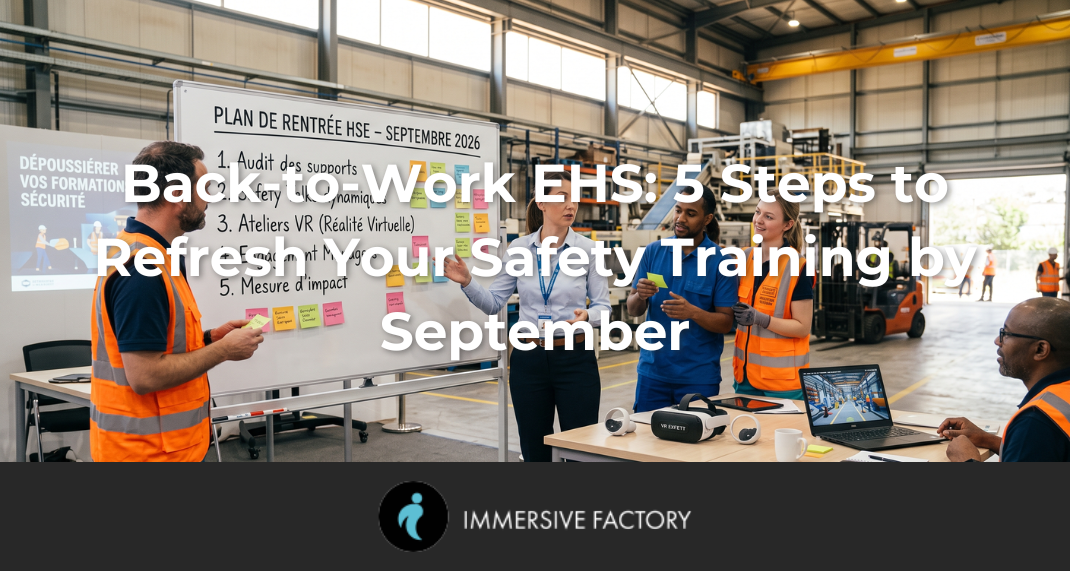
Back-to-Work EHS: 5 Steps to Refresh Your Safety Training by September
Gear up for the fall EHS restart! Discover 5 actionable steps to refresh your safety training, re-engage teams in September, and integrate VR.