Discover the 9 General Principles of Prevention for a Safer Company
Discover the 9 General Principles of Prevention for a Safer Company

Here are the 9 general principles of risk prevention.
Safety in business is crucial to minimize the risks of accidents and occupational diseases. Indeed, the integration of prevention measures allows for anticipating dangerous situations and promoting a safer work environment for employees. Moreover, this helps the company preserve its reputation. To guide employers in identifying, evaluating, and managing occupational risks, the 9 general principles of prevention have been established.
Definition of General Prevention Principles
Explanation of General Prevention Principles
Thegeneral principles of prevention are guidelines aimed at limiting occupational risks. They often originate from the occupational health and safety field. These principles have been established to provide a systematic framework for proactive risk management in business. Indeed, they allow for the implementation of an effective prevention approach and are transferable in different work situations. For example, they are used to guide prevention in theconstruction sector (BTP).
Why are These Principles Important for Safety in Business?
Prevention principles are important for safety in business because they define a methodical framework to anticipate, analyze, and mitigate occupational risks. By applying them, an employer can improve the health and safety of workers and comply with the Labor Code rules. They can also invest in virtual reality training to help them better understand the dangers.
The 9 General Principles of Prevention
Here are the 9 general principles of risk prevention:
- avoid risks;
- evaluate risks;
- combat risks at the source;
- adapt work to man;
- take into account technical evolution;
- replace what is dangerous with what is not or is less so;
- plan prevention by taking into account the technicality, organization of work, and social relations;
- prioritize collective protection measures over individual protection measures;
- give appropriate instructions to workers.
Principle 1: Avoid Risks
This principle involves eliminating the danger or exposure to danger. Indeed, if it proves impossible to eliminate it completely, it is important to be able to reduce or avoid risks that can be.
Principle 2: Evaluate Risks
Some risks cannot be avoided. Thus, it is appropriate to assess their nature and importance to define actions to preserve workers' health. Note that all occupational risks and prevention measures must be recorded in the DUERP or document evaluating occupational risks.
Principle 3: Combat Risks at the Source
Prevention must be integrated as soon as possible to effectively combat risks. You can think about this from the design of workplaces, procedures, or equipment.
Principle 4: Adapt Work to Man
To limit strenuous, paced, and monotonous work, it is advisable to adapt work to man. For this, the employer must consider individual differences and design suitable workstations. For example, if the height of a work surface is unsuitable, it can be identified during the risk assessment phase. Thus, the plan can be lowered or raised to reduce the risk of musculoskeletal disorders.
Principle 5: Take into Account Technical Evolution
Ensure that prevention actions are always in line with organizational and technical evolutions. For this, set up regular monitoring.
Principle 6: Replace What is Dangerous
Some dangerous processes or products should be replaced if safer methods can achieve the same result. For example, a carcinogenic product can be substituted with a less harmful one.
Principle 7: Plan Prevention
Among the 9 general principles of prevention, planningis included. It involves integrating work organization, technique, social relations, working conditions, and the environment into a coherent whole. It is possible to organize prevention in common in case of intervention by several companies.
Principle 8: Prioritize Collective Protection Measures
The employer must prioritize collective protection measures. If they are insufficient, individual protection measures can be added. This is often the case for jobs highly exposed to risks.
Principle 9: Give Appropriate Instructions to Workers
Information and communication are important aspects of the risk prevention approach. For workers to understand the dangers they face, they must have the necessary elements to properly understand the risks.
Applying General Prevention Principles
How to Effectively Apply These Principles in a Business Environment?
To effectively apply the 9 general principles of prevention in a business environment, you can proceed in stages. Analyze workers' activities and identify risks to their health and safety to take efficient prevention measures. This will allow you to prevent risks at the source and adapt work to man. Do not forget to consider human factors in work organization such as fatigue and mental load. Finally, regularly monitor the protection measures you have taken and adjust them if necessary. Likewise, learn from incidents that occur to continuously improve workplace safety.
Illustrations of Some Practical Examples in Business
Here are some practical examples of applying the general principles of risk prevention in business:
1st Case: Prevention at the Source
In a pharmaceutical company, the employer decides to replace a toxic solvent with a less dangerous alternative in manufacturing processes. This eliminates the risk of chemical exposure.
2nd Case: Collective Protection
An import-export company installs efficient ventilation systems in its warehouse to limit workers' exposure to dust. This contributes to both improving air quality and protecting their respiratory health.
3rd Case: Prevention Planning
A construction company integrates fall protection devices during the design of a new building. Thus, risks are anticipated at the beginning of the project.
4th Case: Information and Training
A manufacturing plant regularly organizes training sessions on machine use. This raises workers' awareness of good practices.
Immersive Training to Train Your Teams in Business Risks
Training workers in health and safety risks is crucial in business. For this, you can use virtual reality. This innovative tool guarantees better results thanks to its playful side. Benefit from the support of our experts to set up effective and quality immersive training. Regardless of your field of activity, we offer up-to-date programs accessible by subscription. Thanks to our training, your employees will experience risks as if they were there and change their behavior quickly.

Geschrieben von Aurélie Tavernier
Marketing and Communications Manager at Immersive Factory
She became interested in raising awareness of health and safety at work, convinced that an approach tailored to employees can transform the safety culture and reinforce shared vigilance. Her ambition: to encourage all companies, whatever their size, to invest actively in health and safety prevention for the well-being of their employees.
Teilen
Das könnte Sie auch interessieren

Deploying HSE VR Across Multiple Sites: From Pilot to Scaling
Discover how to successfully scale enterprise virtual reality for multi-site safety training: fleet management, LMS integration, and local adoption.
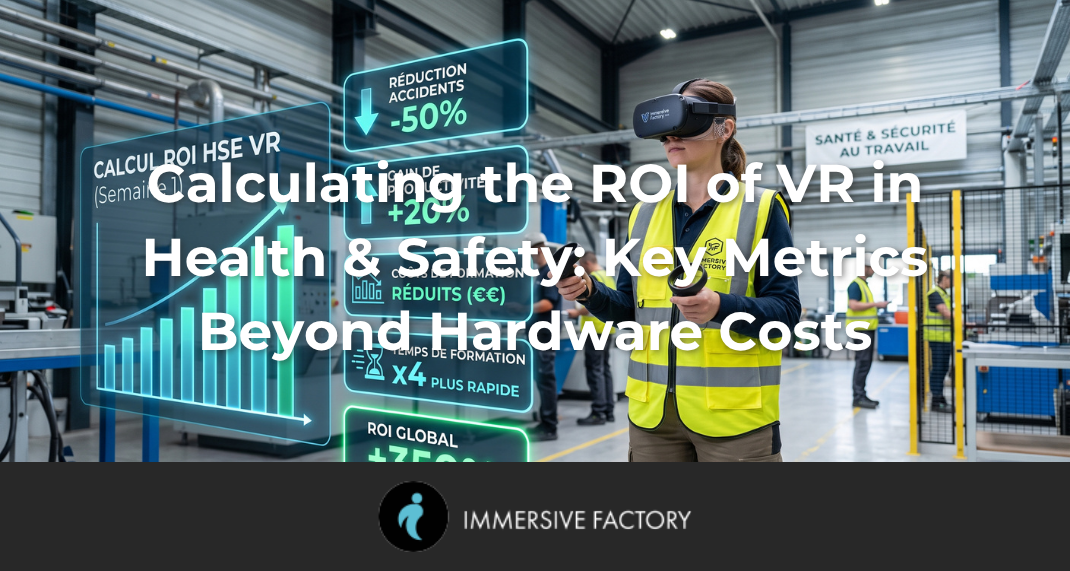
Calculating the ROI of VR in Health & Safety: Key Metrics Beyond Hardware Costs
Learn how to measure the true ROI of virtual reality in HSE safety training. Key metrics, hidden cost savings, and incident rate reduction.
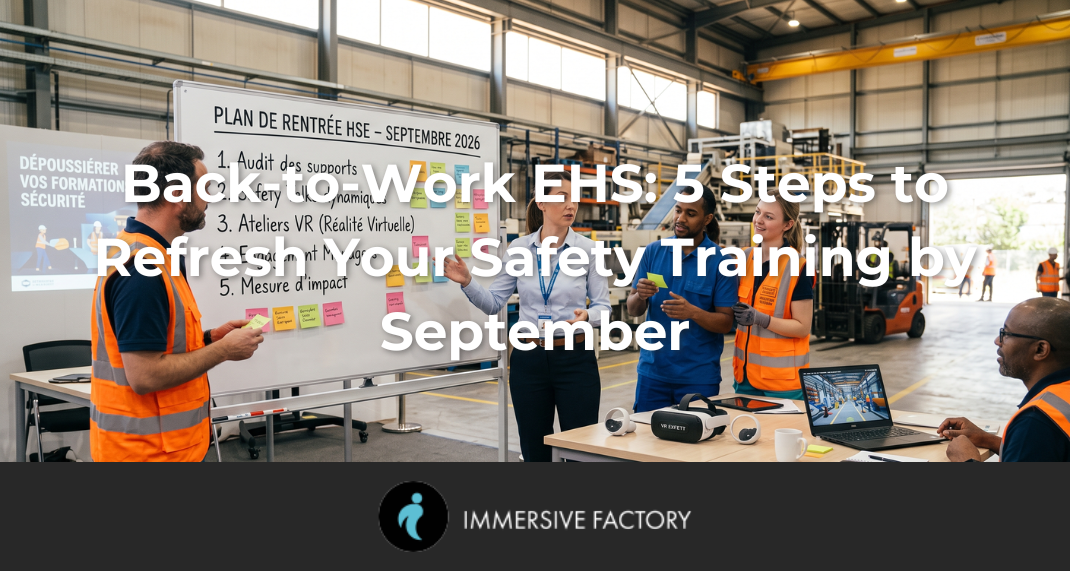
Back-to-Work EHS: 5 Steps to Refresh Your Safety Training by September
Gear up for the fall EHS restart! Discover 5 actionable steps to refresh your safety training, re-engage teams in September, and integrate VR.