Fire Safety Classification for Public Buildings (ERP): Understanding the Categories and Ensuring Risk Prevention
Fire Safety Classification for Public Buildings (ERP): Understanding the Categories and Ensuring Risk Prevention
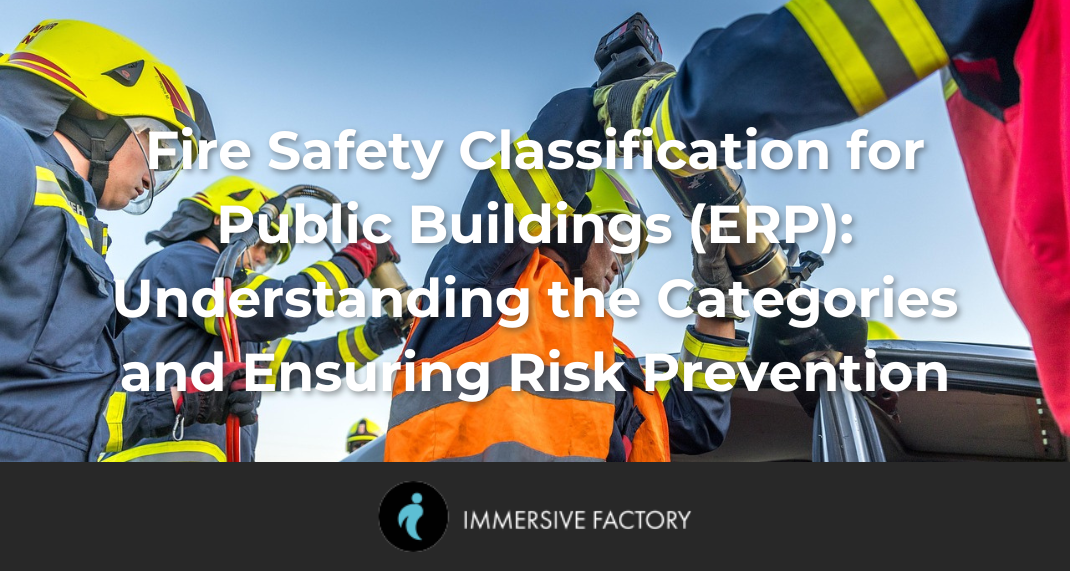
ERP Fire Safety Classification: Categories and Prevention.
Establishments Receiving the Public (ERP) are subject to strict safety obligations because they are required to host a large number of people. Their safety depends on compliance with specific standards and regulations, including the ERP fire safety classification. It is essential to understand and apply these classifications to avoid accidents, ensure legal compliance, and guarantee the safety of all occupants. This guide outlines the various ERP fire safety categories.
What Is ERP Fire Safety Classification?
ERP fire safety classification is a categorization system designed to tailor safety requirements to the specific risks of each establishment. The classification is based on several criteria, including the type of activity, capacity, andspecific operational risks. To fully grasp these requirements, consider implementing VR training in your facility—an innovative and effective educational tool.
According to current regulations, there are five categories of ERP, based on their public capacity:
- Category 1: More than 1,500 people
- Category 2: Between 701 and 1,500 people
- Category 3: Between 301 and 700 people
- Category 4: Up to 300 people, excluding establishments listed in Category 5
- Category 5: Below the regulatory threshold specific to each type of ERP
Many requirements arise from the ERP fire safety classification. These are part of a proactive risk management approach and include facility layout, staff training, and alarm systems. The larger the establishment, the stricter the safety requirements.
ERP Categories and Their Fire Safety Requirements
Each ERP category has specific fire safety requirements:
Category 1
Category 1 ERPs are the largest and most at risk, with a capacity of over 1,500 people. Examples include shopping malls, concert halls, and stadiums. Their fire safety measures must be highly robust and include smoke extraction systems, alarm and evacuation systems, and firefighting equipment. The number of emergency exits must be proportional to the number of occupants. A fire safety officer (SSIAP) is also required.
Categories 2 and 3
Category 2 ERPs host between 701 and 1,500 people, such as large retail stores. Category 3 includes ERPs hosting between 301 and 700 people, like hotels and middle schools. While their requirements are slightly less stringent than Category 1, they still demand rigorous safety measures involving signage, alarm systems, and emergency lighting. Technical installations must be inspected annually, and emergency exits are sized using "Units of Passage" (UP), generally calculated at 1 UP per 100 people.
Category 4
Category 4 ERPs accommodate 300 people or fewer, including restaurants and small performance venues. They must meet general fire safety requirements, with a few eased conditions. For example, while formal risk assessments may be less stringent, they remain essential. Regular evacuation drills are also mandatory.
Category 5
Category 5 ERPs are the lowest-risk establishments. They are subject to minimal requirements regarding signage and prevention. For instance, electrical installations must comply with standards, fire safety instructions must be clearly displayed, and emergency exits must be sufficient and easily accessible. Usually, a basic fire alarm system is sufficient.
How to Comply with Fire Safety Standards Based on ERP Classification
Key Legal Obligations According to ERP Classification
Depending on the ERP fire safety classification, each establishment must:
- Display clear evacuation plans and fire safety instructions
- Install an alarm system suited to the activity
- Provide a sufficient number of fire extinguishers
- Ensure emergency lighting functions even during a power outage
Additionally, all safety equipment must be regularly inspected and maintained to ensure proper functionality. Only an authorized organization can perform these inspections.
The Role of Employee and Safety Officer Training in Ensuring Compliance
To ensure compliance, employees and fire safety officers must receive fire risk training. They need to know how to provide first aid and use fire extinguishing equipment. Regular evacuation drills are essential so that they can apply safety protocols in real-life scenarios.
The Impact of ERP Fire Safety Classification on Risk Management and Legal Responsibility
ERP managers are legally required to comply with the fire safety obligations associated with their building’s classification. Failure to do so may result in serious penalties, including permanent closure and criminal prosecution. Moreover, it puts occupant safety at risk. To avoid these legal consequences, accurate classification is essential. Respecting ERP fire safety classification is a powerful way to prevent risks, reduce incidents, and ensure a safe environment. It also enhances the establishment’s reputation and builds trust with clients and visitors.
Strengthening ERP Fire Safety with Innovative Training Solutions from Immersive Factory
Immersive training is an essential tool for improving fire safety. If you want to minimize risks and ensure regulatory compliance in your facility, adopt our modern solutions and technologies. They simulate various emergency scenarios, offering realistic, risk-free training that makes safety practices easier to retain.
At Immersive Factory, we offer a wide range of services to improve fire safety management in ERPs, including evacuation drills, customized training programs tailored to each ERP category, and interactive modules to raise awareness of potential hazards.

Geschrieben von Aurélie Tavernier
Marketing and Communications Manager at Immersive Factory
She became interested in raising awareness of health and safety at work, convinced that an approach tailored to employees can transform the safety culture and reinforce shared vigilance. Her ambition: to encourage all companies, whatever their size, to invest actively in health and safety prevention for the well-being of their employees.
Teilen
Das könnte Sie auch interessieren
Deploying HSE VR Across Multiple Sites: From Pilot to Scaling
Discover how to successfully scale enterprise virtual reality for multi-site safety training: fleet management, LMS integration, and local adoption.
Calculating the ROI of VR in Health & Safety: Key Metrics Beyond Hardware Costs
Learn how to measure the true ROI of virtual reality in HSE safety training. Key metrics, hidden cost savings, and incident rate reduction.
Back-to-Work EHS: 5 Steps to Refresh Your Safety Training by September
Gear up for the fall EHS restart! Discover 5 actionable steps to refresh your safety training, re-engage teams in September, and integrate VR.