Preventing occupational risks: steps for effective action
Preventing occupational risks: steps for effective action
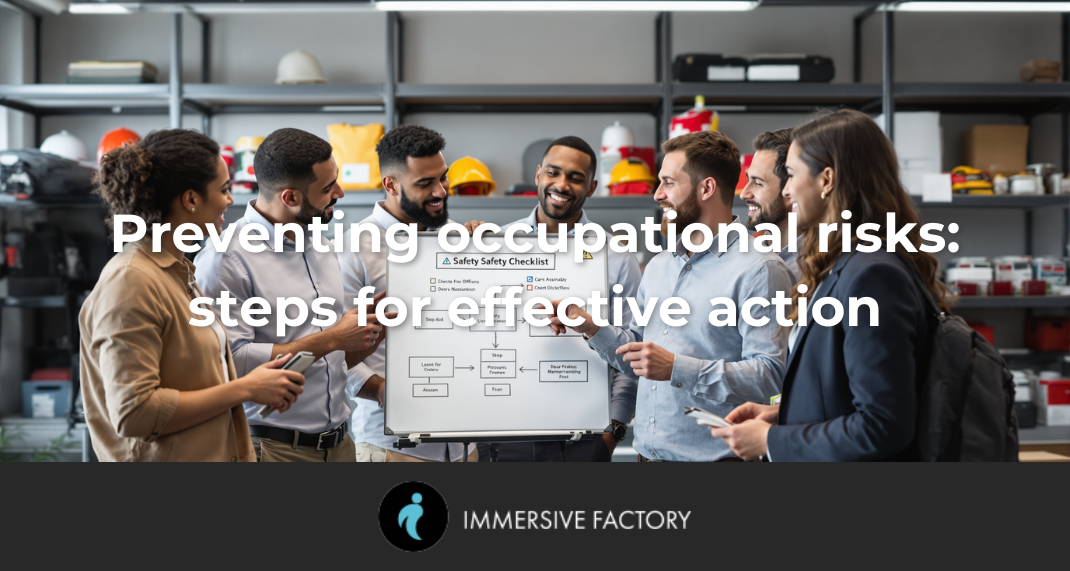
Preventing occupational risks: key steps and practical tools.
Preventing occupational risks: 5 steps for effective action
🔎 Structured assessment: Identify and prioritize all risks through on-site analysis, team consultation, and the Single Document for Risk Assessment (DUERP).
🛡️ Implementation of adapted measures: Eliminate, limit, or manage risks through concrete actions, equipment, and targeted training.
📋 Monitored action plan: Structure your interventions over time, set deadlines, and involve every stakeholder in prevention.
📚 Resource utilization: Rely on practical tools (DUERP, protocols, displays), specialized training, and available financial aid.
🤝 Collective commitment: Mobilize management and employees, communicate regularly, and keep the process alive to ensure sustainable health, safety, and performance.
Do you ever wonder if risk prevention is just about paperwork or a powerful way to protect and motivate your teams? We’ve all seen a colleague get hurt from a routine action or heard about a long-term absence that destabilizes an organization. But a real prevention strategy changes everything on a daily basis. Ready to find out what really works to avoid workplace mishaps and for a safety day?
The definition of occupational risks and why you should care
Behind the term "occupational risk" lie some very concrete realities. An employee can be off work due to a simple fall, a cut, exposure to toxic products, or from stress and pressure, which is why it's important to learn about Safety Day.
Risks are grouped into several categories:
- Physical risks: falls, cuts, burns, noise...
- Chemical risks: contact with harmful substances
- Psychosocial risks: mental overload, tension, harassment
- Biological risks: exposure to viruses or bacteria
- Organizational risks: work overload, staggered hours
Does this sound like your company? According to the INRS, dangers aren't limited to large industries. Construction, small and medium-sized service companies, restaurants: there are risky situations everywhere. And company size doesn't protect anyone. Very small businesses, artisans, or large corporations, all must comply with legal obligations.
What the law says about risk prevention
There’s no getting around it: the Labor Code requires documenting and assessing dangers, then formalizing everything in the famous DUERP. Behind this strange acronym hides a central document for safety.
What should you pay attention to?
- Update the DUERP every year: the employer's responsibility
- Clearly and permanently display safety instructions: the employer's responsibility
- Organize regular safety training, upon hiring or in case of changes: the employer's responsibility
- Provide suitable equipment as needed: the employer’s or employee’s responsibility
Not following these rules risks sanctions, but more importantly, it means missing out on a real collective dynamic.
Did you know? Every year in France, over 640,000 workplace accidents are recorded, but a well-executed prevention strategy could prevent up to 50% of these accidents, according to the INRS.
Why invest in prevention? What really changes
Who has seen a team demotivated by a lack of attention to safety? It’s costly: sick leave, disorganization, absenteeism, a bad atmosphere...
When a company takes care of its teams, there are fewer accidents, a drop in absenteeism, and a real climate of trust. It motivates, builds loyalty, and even attracts talent!
"We felt a real breakthrough after implementing safety workshops. Employees feel heard, feedback is more positive, and incidents have been cut in half." — HR Manager
Steps to build a real prevention policy
Effectiveness comes from a clear process. No magic, just a step-by-step procedure to follow. How do you do it? You start by identifying, analyzing, and then prioritizing risks. You have to talk to the teams, observe work stations, and question what’s happening on the ground. Once the risks are identified, you evaluate their severity and probability.
Practical list of things to check:
- Condition of equipment and machinery
- Actual working conditions
- Access to instructions and displays
- Management of dangerous products
- Continuous staff training
You must not forget the risks related to stress, mental overload, or isolation. This is often where things go wrong, especially in small offices.
How to implement the right measures
You act on three levels:
- Primary measures: eliminating the risk at the source (changing a product, automating a dangerous task)
- Secondary measures: adapting the environment (guards, adjusted schedules, personal protective equipment)
- Tertiary measures: managing consequences (first aid, post-accident support)
Concrete examples of actions to implement:
- Replacing a slippery floor with a non-slip surface
- Training on proper posture and movements
- Installing a support line for employees under pressure
- Organizing an ergonomic audit
An action plan isn't just about big ideas. It needs deadlines, responsibilities, and monitoring indicators. Effectiveness comes from regular follow-up and communicating the results.
Tools that make prevention easier
Need practical solutions? No need to reinvent the wheel: the DUERP, emergency plans, safety posters, and arduousness sheets are your best allies. Making information visible and easy to understand motivates teams to get involved.
Here's what we recommend:
- An always up-to-date DUERP (Excel, PDF format)
- Clear and engaging instruction posters
- Well-displayed evacuation protocols
- Individual follow-up sheets
"Since I put up the safety instructions in the workshop, everyone asks fewer questions and acts faster if there's a problem," says Marc, a team leader.
Boosting prevention through training and support
No effective policy exists without building skills. Safety training isn't just for new employees. Organizations like INRS or Carsat offer modules, webinars, and resources to help, even for very small businesses.
Training to prioritize:
- Safety culture and life-saving actions
- Ergonomics and prevention of musculoskeletal disorders (MSDs)
- Stress management and prevention of psychosocial risks
Furthermore, investing in continuous training creates dialogue and strengthens the team.
Aid and subsidies: a real boost
No need to finance everything alone! Carsat, the state, and Regional Councils offer grants to equip or reorganize workstations, buy safety equipment, or invest in innovation. It's often unknown, but it makes a huge difference.
- TMS Pro subsidy for very small/small and medium-sized businesses: up to 70% of the project cost
- Tax credit for all company sizes: the amount varies
- Regional aid for innovative SMEs: this works on a flat rate
Why pass up on it?
Best practices to avoid pitfalls
Those who succeed in establishing a real prevention culture often have these points in common:
- Involvement of management and on-the-ground teams
- Regular meetings and open communication
- Rewarding good behaviors
- Quick adjustments after an incident
Watch out for common mistakes: forgetting to follow up, acting in an emergency without training, neglecting routine tasks, underestimating hidden risks. A living, updated, monitored, and shared plan is the key.
Prevention, a collective and evolving challenge
Safety is not a static issue. Companies that adapt, invest in support and innovation, and value feedback from the field progress quickly. Have you tested a new method, an app, a training course? Talk about it, share your feedback, and inspire other organizations.
What’s the next step for you to advance prevention in your company? A workshop, a new practical sheet, a collective action? It's your turn to act!

Immersive Factory's Immersive Safety Day: The experience that truly makes a difference
A safety day is often seen as a formality... until Immersive Factory steps in. Here, there's no question of letting prevention be just a simple speech. Each safety day takes a spectacular turn thanks to virtual reality, and suddenly, everyone starts talking about risks, actions, and reflexes—for real. How? With over 30 VR HSE workshops, designed to embed every safety concept in a concrete way, from working at heights to co-activity in a warehouse.
The feedback is clear: companies, HSE managers, and trainers testify to the positive shock felt by their teams. The VR workshops, accessible with a simple standalone headset or via the SafetyBox VR Day, transform abstract concepts into memorable experiences.
- "Traditional training just doesn't measure up anymore!" summarizes an HSE coordinator from Riva Group.
- "Over 10,000 people trained, a true safety culture that is being established for the long term," notes Olivier Pierre, CEO of Immersive Factory.
And for you, what would be the theme of your next safety day? Ready to wake up your teams with an experience that truly leaves an impression?
Our FAQ for preventing occupational risks
How can I prevent occupational risks?
At the heart of every company, preventing occupational risks is much more than an obligation: it is a real health and safety issue for every employee. Preventing risk means, above all, observing the workstation, identifying risky situations, and acting before an accident or an occupational disease occurs. In a prevention strategy, regular team training, providing suitable tools, and clear information on safety measures make all the difference. Communication plays a key role: talking with the prevention manager, organizing safety briefings, sharing examples of good practices... Taking the time to evaluate each activity, reviewing prevention documents, and adapting action plans are all steps for effective prevention.
And in your company, what simple action could improve safety? A poster, a collective reminder, a new tip?
What are the preventions for occupational risks?
Preventing occupational risks is an art! Companies adopt different measures to ensure health and safety at work: analyzing the workstation, identifying danger, and creating a prevention plan. The tools vary: training, personal protective equipment, awareness actions, and regular review of instructions. The process doesn't stop with theory: every professional, every safety manager, every employee must apply these actions daily. Some companies rely on field observation, others on documentation, and still others on creating a shared safety culture. Prevention is based on communication, feedback, and everyone's involvement.
How is occupational risk prevention experienced in your organization? Is there a space to discuss practices or improve the measures in place?
What are the 3 risk prevention measures?
Three prevention measures form the basis of a solid company strategy: evaluation, protection, and training. The first step is risk evaluation: observing the workstation, analyzing activities, and identifying the dangers present in each department. Next comes protection: implementing collective measures (ventilation, barriers, suitable equipment), then individual ones (helmets, gloves, masks depending on the risk). Finally, training remains an essential lever: informing, training, and raising the awareness of every employee about good practices and safety. The professional in charge of prevention must verify that these measures are properly applied and adapted to the workstation.
And in your daily life, what example of prevention has really made a difference? Share your feedback or ask your safety manager: continuous improvement begins with collective action.
What are the 4 levels of occupational risk prevention?
In occupational risk prevention, four levels structure the action: primary, secondary, tertiary, and quaternary prevention. The first level, primary prevention, aims to avoid the emergence of the risk (example: securing a workstation, modifying work organization). Secondary prevention intervenes as soon as a risk is identified: early detection, checking working conditions, and adapting measures. Tertiary prevention concerns the management, follow-up, and limitation of consequences after an accident or an occupational disease. Finally, the fourth level—quaternary prevention—focuses on maintaining employment and supporting employees after an accident. Each of these steps, from identification to support, shapes a comprehensive health and safety strategy in a company.
Which level of prevention could be strengthened in your activity? A specific action plan, measure, or support?
What are the different modes of occupational risk prevention?
The modes of occupational risk prevention are multiple and adapt to each sector of activity and each company. They include: collective prevention (workstation layout, work organization, adapting schedules), individual prevention (equipment, custom training, personalized follow-up). Organizational measures (writing procedures, regular checks of working conditions, involving the safety manager) are just as essential as technical measures (protective equipment, alert systems, signage). Behavioral prevention (awareness-raising, involving every professional, continuous training actions) makes the difference. Each company, depending on its activity, combines several modes to guarantee the safety, health, and well-being of its employees.
Which mode of prevention works best in your company? Have you ever experimented with a new approach to reduce workplace risk?
Who is responsible for preventing occupational risks?
Preventing occupational risks is not the responsibility of just one person: every stakeholder, from the employee to the management, has a role to play. The employer has the legal responsibility to implement prevention measures, but the safety manager, the occupational physician, the CSE (social and economic committee), the HR team, and even every employee, participate in the process. Employee representatives relay concerns, propose actions, and evaluate the results of the measures in place. The company also relies on external partners: occupational health services, prevention consultants, and health insurance organizations. Prevention is based on collaboration, listening, and communication...
And in your team, who takes the lead in running prevention activities? Collective involvement makes every strategy more effective and lasting.

Geschrieben von Aurélie Tavernier
Marketing and Communications Manager at Immersive Factory
She became interested in raising awareness of health and safety at work, convinced that an approach tailored to employees can transform the safety culture and reinforce shared vigilance. Her ambition: to encourage all companies, whatever their size, to invest actively in health and safety prevention for the well-being of their employees.
Teilen
Das könnte Sie auch interessieren
High-Risk Scenarios: 3 Critical Industrial Hazards You Can Finally Simulate with VR
Learn how VR enables safe, realistic simulation of major industrial hazards: Lockout/Tagout (LOTO), working at height, and confined space entry.
Occupational Accidents in Europe (2026): Beyond the Numbers, the Urgency to Act
What do 2026 European workplace accident stats really reveal? Immersive Factory analyzes the EUROGIP study & offers actionable VR safety solutions.
Heatwaves and Extreme Heat at Work: How Virtual Reality Helps Prevent Risks
As summer temperatures continue to soar year after year, extreme heatwaves are no longer exceptional events. For companies worldwide, managing thermal discomfort and high temperatures has become a critical annual health and saf...