Immersive Technologies: Essential Applications for the Professional Sector
Immersive Technologies: Essential Applications for the Professional Sector
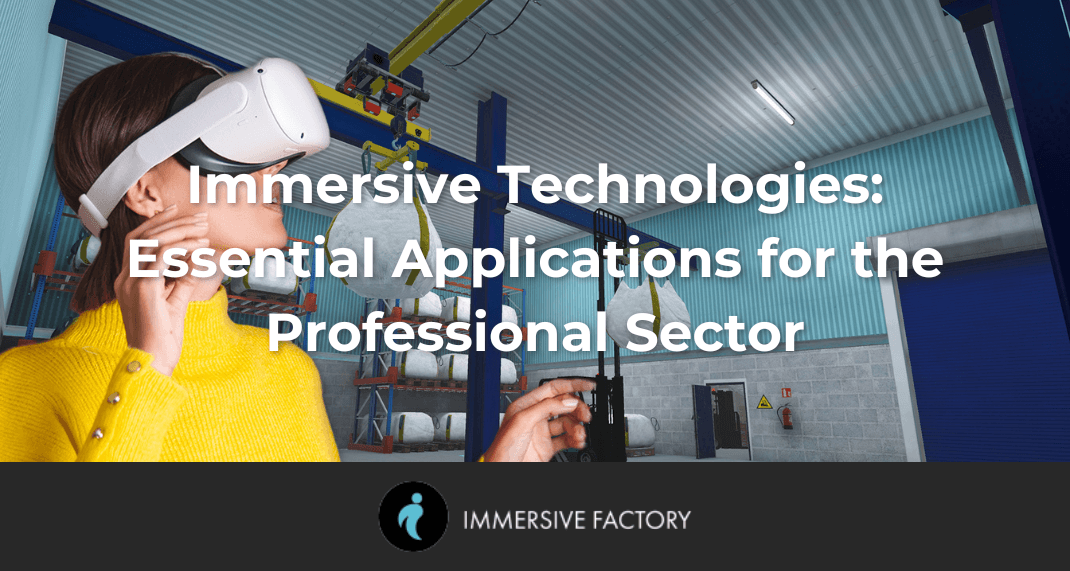
Immersive Technologies: Professional Uses and Innovations.
Do you remember your last meeting on Teams, Zoom, or Meet? Honestly, was it a memorable experience—or just… the usual digital routine? Like you, we’ve felt that disconnect: what’s missing is that “extra something” to feel truly engaged, present, and immersed. And here’s where things speed up: immersive technologies are changing the game—and let’s admit it, they’re unlike anything we’ve seen before.
Imagine: a new employee learning their job through simulators, cultural mediation taking place in your living room while you remain on your couch, or a medical procedure being practiced virtually a thousand times before being performed in real life. Doesn’t that sound fascinating? We’re truly amazed at what digital innovation makes possible. You could even take an immersive training course to learn more.
What motivates us? That mix of technical prowess, emotion, and learning that transforms how we work, persuade, and create—step by step.
But what do we actually mean by “immersive”?
Before diving into use cases, let’s ask: what lies behind all this jargon (VR, AR, MR, 360° video, and even the infamous “Metaverse” your colleagues chat about at the coffee machine)? Let’s clarify: Virtual Reality (VR) fully immerses you; it’s just you, your headset, and a digital environment that replaces your office or workshop. Augmented Reality (AR)—explored through immersive learning—adds virtual elements to your view (imagine maintenance instructions appearing directly on a machine). Mixed Reality (MR) creates a playground where the real and the virtual interact seamlessly—the best of both worlds. 360° video gives you a superpower: observation. You control where to look, every detail matters, nothing escapes you. Revolution or gimmick? It all depends on our creativity.
- Are you wondering where VR, AR, MR, or 360° video fit into the digital landscape?
- Do you want to know if these technologies live up to the hype?
- Looking for real examples where they truly make a difference?
The true differentiator is the level of immersion. Will you completely leave your office behind (VR)? Stay grounded with new reference points (AR)? Navigate the edge of both worlds (MR)? And where does 360° video fit in all this? Each solution has its logic—and its power to transform how we learn, communicate, and train.
TechnologyDescriptionProfessional Application ExampleAugmented Reality (AR)Integration and interaction of virtual with the real worldVirtual tours of cultural or heritage sitesWe, too, were surprised the first time—by the clarity of the 3D, the precision of actions in virtual space, or the feeling of entering a cultural site across the country. Ready to give it a try?
Simulated Environments and Binaural Sound: What If Everything Felt “Real”?
What truly makes immersive experiences work? We’ve asked ourselves that often. It’s not just the image. It’s the sound, the ability to interact, the sense of volume, the tactile feel, the precision of haptic feedback… even that small vibration at your fingertips during a surgical simulation.Be honest: have you ever forgotten you were “just” wearing a headset? We did—the first time a simulator triggered an alarm on our left side, and our reflexes kicked in naturally.
Binaural sound is exactly what the brain needs to believe it’s elsewhere. Sometimes, the difference is palpable: there’s an energy in an immersive workshop, a real tension during a crisis simulation. That’s the power of immersive learning: it transforms how we learn, makes decision-making instinctive, and creates lasting memories.
A New Dimension for Learning: The Expertise of Immersive Factory
At Immersive Factory, it’s not just about training—it’s about immersive experiences that truly make a difference. Their immersive technologies create virtual environments where users interact in real-time with digital content while feeling physically present—without leaving the office.
Their secret? A subtle blend of virtual reality, instructional design, and immersive applications built for corporate education. Their modules expose teams to real-world risks in a safe digital environment, multiplying opportunities for active learning.
That’s the power of immersive learning: offering a tangible solution to safety and performance challenges. Whether you’re in industry, public service, or culture, their solution adapts—and most importantly, it works. If you’re looking for a technology that changes behaviors long-term, you’ve found the right partner.
Where Are Immersive Technologies Already Transforming Our Work?
Here—and probably soon in your organization too—boundaries between training, culture, and industry are disappearing.Can you imagine training a team remotely, just as (or more!) effectively as in-person? Or opening your facility to visitors from across the world?

Education and Training: Who Would Have Thought Virtual Could Reinvent It All?
In schools, training centers, and companies, immersive learning is becoming the norm. Learners no longer want just PowerPoints—they want to live, feel, try, and test themselves in real-world situations (without real-world risks).Today’s apprentices can repeat a professional gesture dozens of times in a simulator.In classrooms, students are transported to Mars or a factory across the globe—all from their chair.
Ready to teach in 3D? To run impossible real-world experiments virtually? We’re excited every day! Companies are increasingly partnering with immersive content creators to meet real needs: job training, crisis management, skill development, recruitment. And in your case, what would revolutionize your daily training?
Culture and Heritage: What If You Could Travel Without Leaving Home?
Who hasn’t dreamed of touring Versailles or Notre-Dame from their couch? We’ve lived it: admiring a lost artwork, hearing a cathedral’s acoustics, circling a threatened monument—that’s the power of augmented digital experiences.
Museums and cultural institutions are reimagining how they open their doors. We’ve spoken with curators—sometimes worried, often excited. Their concern? Losing the authentic connection with the artwork. Their discovery?
Virtual experiences don’t replace—they expand access, spark curiosity, and encourage real-life visits.Emotion, discovery, and sharing: that’s the immersive promise for culture.Would you visit an exhibit if it appeared in your living room, enriched with commentary, games, and stories? We brought the whole family—and even the least tech-savvy were amazed.
Industry, Healthcare, Construction: Simulation Means More Safety, Less Risk
The first time a building engineer, wearing a headset, identified a structural flaw invisible to the naked eye… he didn’t just tell his colleagues. In industry and healthcare,efficiency and safety speak loudest.Who would train their team today without practice, without safety nets?
We’ve met technicians who learned how to save lives, anticipate electrical failures, or spot dangerous cracks—all without endangering anyone. In healthcare, it’s stress management, coordination, and repeated practice of complex gestures that make the difference. Can you imagine empowering new recruits with immersive tech?
What we love: more autonomy, fewer risks, faster skill development. In these fields, every simulation error becomes a valuable lesson—with no real-life consequences.
So—immersive technology: myth or tomorrow’s solution?The real question is: how far are we willing to explore these new worlds together? What story will we write, with our teams, professions, and passions, thanks to virtual or augmented reality? We can’t wait to hear your feedback, ideas, and ambitions. Who’s ready to begin?
Our FAQ on Immersive Technologies
What are the 4 main technologies?
We often refer to the “four pillars”: virtual reality, augmented reality, mixed reality, and extended reality. All of these aim to create experiences that blur the lines between the virtual and the real. Each has its tool: a headset for VR, a mobile app for AR. They’re used in training, entertainment, wellness, and art. The future is immersive.
What is immersive technology?
An immersive technology is one that plunges you into a digital environment. With VR, AR, or MR, you interact with content in a virtual or enhanced real-world setting. It changes how users experience digital—no longer watching, but being part of it. Training, entertainment, medical practice—everything becomes more fluid, engaging, and human-centered. It’s the answer to a growing need for creative interaction.
What is an immersive experience?
An immersive experience is when you leave the physical world to enter a virtual one. Using a headset, haptic tools, or even just an augmented interface, you interact with digital environments as if they were real. The impact is powerful: better focus, greater adoption, more emotion. Brands, students, healthcare, and media all seek this. An immersive experience is more than a display—it’s meaningful immersion.
What are the different types of immersive technologies?
There are several:
- Virtual Reality (VR): headset-based, entering a fully virtual world.
- Augmented Reality (AR): overlays digital content on the real world.
- Mixed Reality (MR): allows real-time interaction between real and virtual.
- Extended Reality (XR): an umbrella term encompassing all the above.
These are used in training, culture, marketing—even surgical rehabilitation.

Scritto da Aurélie Tavernier
Responsabile Marketing e Comunicazione presso Immersive Factory.
Appassionata di sensibilizzazione alla salute e sicurezza sul lavoro, convinta che un approccio adattato ai collaboratori possa trasformare la cultura della sicurezza e rafforzare la vigilanza condivisa. Il suo obiettivo: incoraggiare tutte le imprese, qualunque sia la loro dimensione, a impegnarsi attivamente nella prevenzione sanitaria e di sicurezza per il bene dei loro dipendenti.