Essential Warehouse Safety Rules to Ensure Employee Protection
Essential Warehouse Safety Rules to Ensure Employee Protection
Warehouse Safety Rules : Ensure Employee Protection.
Warehouse safety should never be neglected. Warehouses and logistics centers are places where various handling, storage, and logistics activities take place, making them particularly prone to accident risks. Ensuring worker safety is crucial to prevent workplace accidents, manage stored products efficiently, and maintain a healthy and secure work environment. In this article, we will examine the essential safety rules that will help you protect your employees while optimizing your operations.
Assessing Safety Needs
Risk Analysis and Specific Needs of the Company
The first step to ensuring warehouse safety is identifying potential risks in your work environment. A comprehensive risk analysis helps recognize hazards specific to your sector and operations. This analysis covers various aspects such as the chemicals used, handling equipment, storage conditions, and traffic pathways.
Identifying Weak Points and High-Risk Areas
Once risks are identified, the next step is to locate weak points and high-risk areas. This can include areas where hazardous products are handled, unstable shelving, and passages frequently used by forklifts. A precise risk map will help you prioritize corrective actions.
Using Data and Feedback to Target Priorities
To optimize your safety initiatives, it is essential to rely on accurate data and feedback. Analyze past incident statistics, consult standards like ISO or OSHArecommendations, and adjust your priorities accordingly.
Developing a Tailored Training Program
Designing Custom Training Modules
Safety training programs should be designed according to the specific needs of your company and the skill levels of your employees. These modules should cover safe practices, correct use of personal protective equipment (PPE), and health and safety guidelines.
Integrating Virtual Reality for Immersive Training
In the age of technology, integrating virtual reality into your training program is beneficial. These immersive solutions allow the simulation of various accident scenarios and risks, providingpractical and engaging training.
Adapting Training to Different Skill Levels and Job Positions
Safety training must be adapted to the different skill levels of your employees and their specific job positions. Forklifts, shelving, and storage areas present unique risks that require specialized training.
Involving Employees in the Process
Encouraging Active Employee Participation
Employees must be actively involved in the safety process. Encourage them to report incidents, suggest improvements, and participate in safety committees or working groups.
Creating Safety Committees or Working Groups
Establishing safety committees allows for the gathering of employees from different departments to discuss safety issues and develop concrete solutions. These groups foster a sense of shared responsibility and engagement.
Collecting Employee Feedback and Suggestions to Improve Safety Initiatives
Regularly collecting feedback and suggestions from employees is crucial for continuously adjusting and improving your safety initiatives. This allows forquick resolution of problems and the integration of constructive new ideas.
Using Innovative Tools and Techniques
Virtual Reality and Interactive Simulations
Virtual reality tools and interactive simulations are effective means of raising employee awareness about warehouse risks. These technologies allow forthe safe and immersive experience of dangerous situations.
Games and Activities to Engage and Motivate, Like Safety Moments
A "safety moment" is a simple yet effective method to regularly refresh safety knowledge in a fun way. Use games and activities to make these sessions engaging and motivating.
Practical Workshops and Situational Exercises
Practical workshops and situational exercises allow employees to become familiar with protective equipment, fire safety guidelines, and emergency procedures. These activities strengthen practical and theoretical skills.
Monitoring and Evaluating Impact
Setting Up KPIs to Measure Progress
To measure the effectiveness of your safety initiatives, it is crucial to define specific KPIs related to reducing accidents, improving employee skills, and complying with safety guidelines.
Regular Evaluation of Employee Skills and Knowledge
Regularly assess the skills and knowledge of your employees regarding safety. These evaluations help identify gaps and offer additional training if necessary.
Analyzing Incident Statistics and Adjusting Programs Accordingly
Analyzing incident statistics is essential for identifying trends and common causes of accidents. Use this datato adjust your training programs and safety procedures accordingly.
Promoting a Continuous Safety Culture with Immersive Factory
Regular Communication on Safety Initiatives and Results
Open and regular communication about safety initiatives and results is essential for maintaining employee engagement. Share successes and best practices within the company.
Recognizing and Rewarding Good Practices and Safe Behaviors
Recognizing and rewarding good practices and safe behaviors are powerful tools to encourage employees to adopt safe work habits. Implement reward programs to value these efforts.
Reinforcing Responsibility and Commitment at All Levels of the Organization
To promote a continuous safety culture, it is essential that responsibility and commitment to safety are shared at all levels of the organization, from top management to employees. Everyone should feel responsible for their own safety and that of others. The adoption of immersive tools, like those offered by Immersive Factory, also helps make training more engaging and effective, while reinforcing the assimilation of warehouse safety rules.

Scritto da Aurélie Tavernier
Marketing and Communications Manager at Immersive Factory
She became interested in raising awareness of health and safety at work, convinced that an approach tailored to employees can transform the safety culture and reinforce shared vigilance. Her ambition: to encourage all companies, whatever their size, to invest actively in health and safety prevention for the well-being of their employees.
Condividere
Da leggere anche
Deploying HSE VR Across Multiple Sites: From Pilot to Scaling
Discover how to successfully scale enterprise virtual reality for multi-site safety training: fleet management, LMS integration, and local adoption.
Calculating the ROI of VR in Health & Safety: Key Metrics Beyond Hardware Costs
Learn how to measure the true ROI of virtual reality in HSE safety training. Key metrics, hidden cost savings, and incident rate reduction.
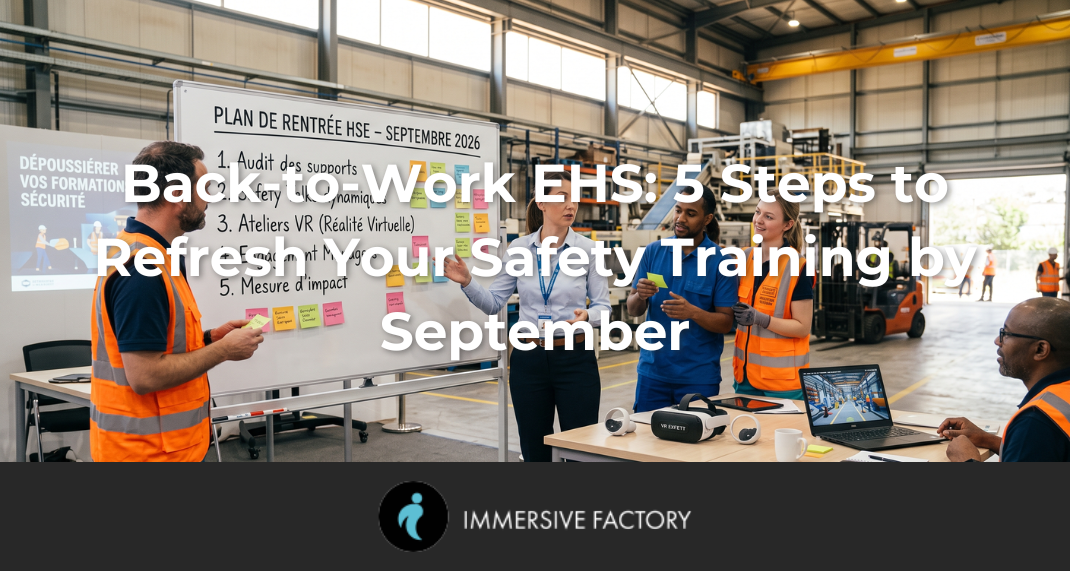
Back-to-Work EHS: 5 Steps to Refresh Your Safety Training by September
Gear up for the fall EHS restart! Discover 5 actionable steps to refresh your safety training, re-engage teams in September, and integrate VR.