How to Improve Workplace Safety Culture: Strategies and Best Practices
How to Improve Workplace Safety Culture: Strategies and Best Practices
How to Improve Workplace Safety Culture: Strategies.
A strong safety culture enables a company to comply with legal standards, reduce occupational risks, and promote the health and well-being of its employees. Moreover, it helps maintain good productivity. The question then arises: how to improve workplace safety culture? Discover the strategies and best practices.
Understanding Safety Culture in the Workplace
Definition of Safety Culture
Safety culture is a branch of corporate culture that encompasses the attitudes, behaviors, and values shared by employees regarding occupational health and safety. The "safety minute," for example, is one of the best tools for occupational risk prevention. Thus, it plays a key role in establishing a safety culture in the workplace.
Key Elements of a Positive Safety Culture
Here are the key elements for establishing a positive safety culture:
- Communication about safety best practices.
- Use of safety technologies.
- Training teams in health and safety.
Digital learningtraining is a good way to convey important safety messages.
Importance of Management and Employee Engagement
Management's commitment confirms the importance of a proactive safety culture within a company and contributes to achieving risk prevention objectives. Employee involvement is equally important as it will significantly reduce incidents and workplace accidents.
Assessing the Current State of Safety Culture
Wondering how to improve workplace safety culture? The first step is to assess its current state.
Methods for Evaluating the Current Safety Culture
Several methods can be used to evaluate the current safety culture:
- Surveys: on-site or via questionnaires.
- Audits: collecting and analyzing relevant safety data (accidents, occupational diseases, incidents...).
- Observations: to analyze work situations and the risks employees face daily.
Assessment of Strengths and Areas for Improvement
Assessing strengths and areas for improvement allows continued efforts, compliance with standards, and reduction of incident-related costs.
Example of a Successful Safety Culture Diagnosis
Following several recent incidents, a construction company decided to conduct a safety culture diagnosis. To identify weaknesses, they used anonymous questionnaires and conducted on-site observations. Survey results showed that management was not sufficiently involved in risk prevention efforts. Moreover, employees received no adequate training on the use of construction equipment. Identified shortcomings led to measures such as organizing safety days and strengthening management communication about the importance of safety.
Strategies to Improve Safety Culture
Specifically, how to improve workplace safety culture? Here are some strategies to implement:
Effective and Transparent Communication on Safety Issues
Communicate regularly and transparently about workplace safety issues. Use clear and positive language to highlight the benefits of a protected work environment. This will help employees understand the stakes of the safety culture. For messages to have more impact, they should be delivered by management.
Continuous Training and Skill Development in Safety
Continuous training is the best way to update workers' skills and knowledge in safety. To do this, regularly organize safety minutes. These periodic meetings can address various occupational health topics or focus on urgent safety issues to be resolved.
Promoting Individual and Collective Responsibility in Safety
Workplace safety is everyone's responsibility. Hence, it is important to promote individual and collective responsibility in this regard. To encourage employees to engage more in risk prevention efforts, offer rewards to the most committed ones.
Integrating Safety into Daily Business Processes
Integrate safety into daily business processes to establish a robust safety culture. To do this, implement ongoing awareness programs and organize safety meetings with management and employee representatives.
Use of Immersive Technologies for Safety Training
Advantages of Immersive Technologies (VR, AR) for Safety Training
Immersive technologies offer numerous advantages for safety training. Virtual realitycan create immersive, realistic scenarios and teach participants how to protect themselves from real-life dangers. Moreover, it allows for repeated practice of scenarios as needed. Augmented reality overlays digital elements on the real world, enabling the safe execution of difficult tasks.
Examples of Using Virtual Reality to Simulate Dangerous Emergency Situations and Train Employees
Virtual reality can simulate various emergency situations such as road accidents, chemical spills, and fires. It trains employees to react correctly to dangers without actually risking their health.
Continuous Monitoring and Improvement of Safety Culture
Finally, how to improve workplace safety culture? Do not overlook continuous monitoring and improvement.
Importance of Regular Monitoring and Evaluation of Progress
Regular monitoring and evaluation of progress are crucial to determine if corrective measures have been effective. It also helps identify new safety issues and adapt to changes.
Methods for Collecting Feedback and Adjusting Safety Strategies
To collect employee feedback, use surveys, individual interviews, and group discussions. Feedback will help adjust safety strategies.
Establishing Rewards and Recognition to Encourage Best Practices
To encourage best safety practices, offer rewards and recognition to employees who actively contribute to improving safety and who adhere to rules and emergency procedures.
Immersive Factory, Your VR Training Partner for a Safe Workplace
Importance of Long-Term Commitment to Improve Safety Culture
Long-term commitment is important to improve workplace safety culture. Not only does it lead to lasting behavioral changes, but it also builds trust between employers and employees.
Explore Solutions Offered by Immersive Factory to Strengthen Workplace Safety Culture
At Immersive Factory, we offer several training programs to animate your safety minutes. Our virtual workshops are engaging and promote knowledge retention. Additionally, we can customize training content according to your safety needs. All this will contribute to strengthening the safety culture within your company.
Contact Immersive Factory for a Demonstration of Immersive Training Solutions
To learn more about our immersive training solutions and the benefits of learning through virtual reality, contact Immersive Factory today. We are ready to support you in establishing a proactive safety culture through innovative and effective training modules.

Scritto da Aurélie Tavernier
Marketing and Communications Manager at Immersive Factory
She became interested in raising awareness of health and safety at work, convinced that an approach tailored to employees can transform the safety culture and reinforce shared vigilance. Her ambition: to encourage all companies, whatever their size, to invest actively in health and safety prevention for the well-being of their employees.
Condividere
Da leggere anche

Deploying HSE VR Across Multiple Sites: From Pilot to Scaling
Discover how to successfully scale enterprise virtual reality for multi-site safety training: fleet management, LMS integration, and local adoption.
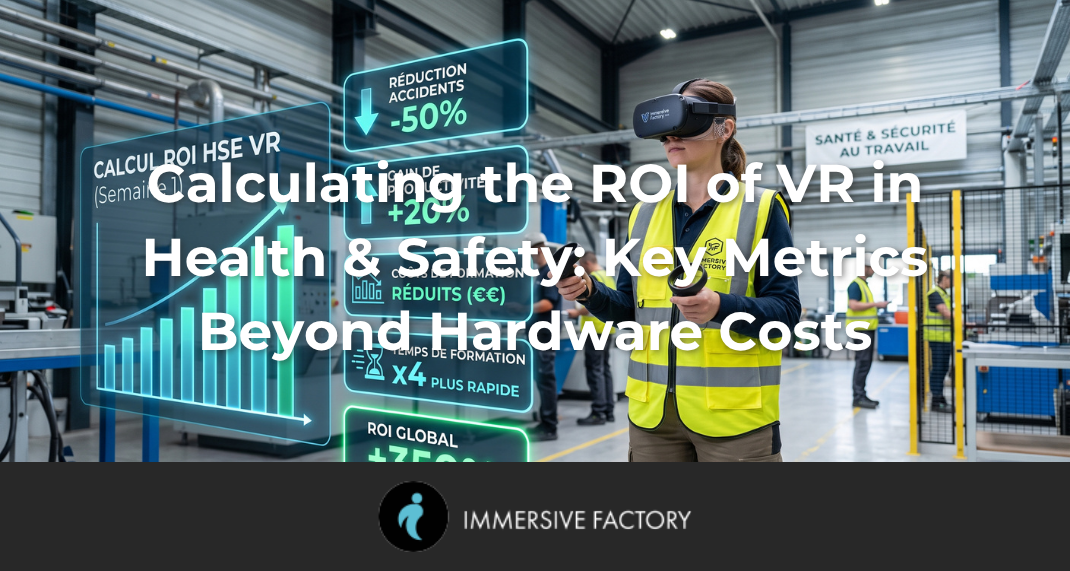
Calculating the ROI of VR in Health & Safety: Key Metrics Beyond Hardware Costs
Learn how to measure the true ROI of virtual reality in HSE safety training. Key metrics, hidden cost savings, and incident rate reduction.
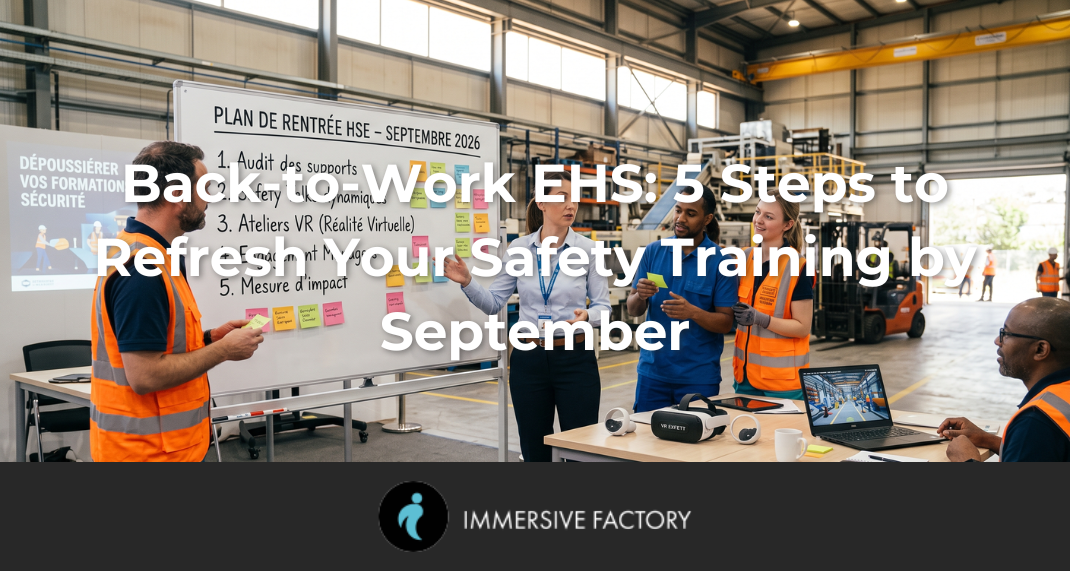
Back-to-Work EHS: 5 Steps to Refresh Your Safety Training by September
Gear up for the fall EHS restart! Discover 5 actionable steps to refresh your safety training, re-engage teams in September, and integrate VR.