Construction Risk Assessment: Improve Site Safety with Virtual Reality
Construction Risk Assessment: Improve Site Safety with Virtual Reality
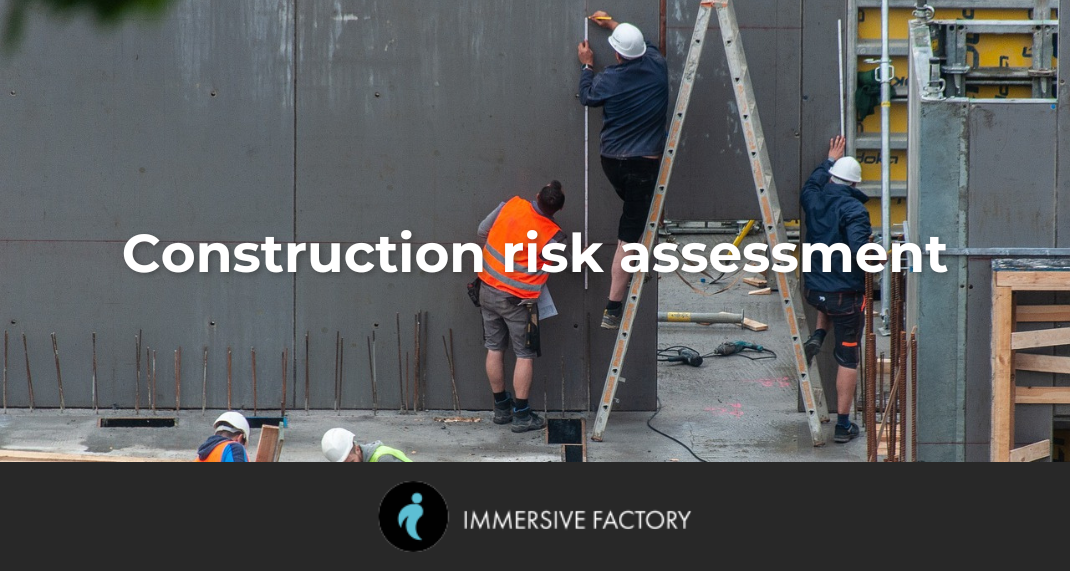
Construction Risk Assessment: A Tool for Securing Worksites.
Typically used as part of a prevention strategy or during a safety day, construction risk assessment is an educational tool designed to raise workers' awarenessof the risks on construction sites. Safety is paramount in the construction sector because incidents can delay operations, damage the company’s reputation, and endanger workers' lives. So, how can construction risk assessment be used to secure worksites? Find the answers in this practical guide.
Key Risks in Construction
Identifying Common Risks
Workers are exposed to various health and safety risks on a construction site, including:
- Falls from working at heights;
- Slips, trips, and falls;
- Asbestos exposure;
- Chemical risks related to handling hazardous substances;
- Electrocution risks;
- Collapses.
By providing them with construction risk management training, you can help prevent workplace accidents.
Accident Statistics in Construction
Construction is one of the most hazardous sectors. According to the latest statistics from Social Security, one in 18 employees experiences a workplace accident in this field. Throughout their career, a construction worker may suffer an average of2.5 accidentsand accumulate 220 days of sick leave. To reduce this rate as much as possible, every company should train its teams in safety. Virtual reality (VR) training is an excellent tool for this purpose.
The Importance of Safety Training
Safety training offers several benefits for construction workers and companies:
- It helps reduce accident risks;
- It raises workers’ awareness of on-site hazards and their potential health and safety consequences;
- It improves productivity and work quality;
- It helps reduce costs related to sick leave;
- It maximizes employee well-being;
- It protects the company’s reputation.
Virtual Reality as a Training Tool
Introduction to Virtual Reality and Its Applications in Construction
Virtual reality (VR) is a computer technology capable of simulating a three-dimensional virtual environment. It allows users to experience immersion and engage in sensory-motor activities within a fictional world. For full immersion, they must wear a VR headset. Virtual reality has various applications in construction, such as risk training, visualizing digital models of structures and buildings, virtual site visits, and construction management.
Advantages of Virtual Reality Over Traditional Training Methods
Compared to traditional training methods, virtual reality has several advantages:
It Enhances Learner Engagement
Using virtual reality during construction risk assessment promotes participant engagement. Active learning is the best way to spark their interest. Being at the center of the action, they are more invested in the training. In contrast, passive learning can lead to a drop in attention, reducing its effectiveness.
It Provides Comprehensive Feedback
During VR safety training, learners can access complete statistics on their performance. This helps them understand their mistakes and continuously improve. Additionally, they become aware of the importance of following proper safety practices and procedures.
It Is Safe
VR training poses no direct health and safety risks to learners in the event of mistakes. Although the scenarios are highly realistic, they do not expose learners to actual dangers. This way, they can train safely.
It Reinforces Actions Through Repetition
With virtual reality, scenarios can be repeated multiple times, helping learners memorize the proper actions and techniques.
It Allows Program Customization
The difficulty level of simulations can be adjusted based on the learner’s skills. This way, they can learn at their own pace and test several scenarios if necessary.
How Does Virtual Reality Training in Construction Work?
Training Process Description
Virtual reality training in construction always begins with creating realistic VR simulations to put participants in various situations. Many tools are required, including headsets, computers, software, and sensors. Before the training begins, instructors must teach participants how to use the VR headsets. Then, the participants directly experience the scenarios based on the topic covered in the training.
Examples of Risk Scenarios Recreated in VR
Here are some examples of risk scenarios recreated in VR:
Scenario 1: Working at Heights
In this scenario, the worker must simulate common tasks performed at heights (drilling, handling heavy materials, screwing, etc.) while adhering to safety guidelines. They must identify safety risks such as scaffold instability. The objective is to help them follow safety protocols for working at heights to reduce the risk of falls and injuries.
Scenario 2: Heavy Equipment Handling
In this scenario, workers learn how to safely operate heavy machinery (cranes, bulldozers, etc.). It is also possible to simulate equipment malfunctions to train teams in emergency procedures.
Get High-Quality VR Training with Immersive Factory
Want to organize a construction risk assessment? Provide your workers with high-quality training through our immersive workshops. Our technologies can simulate various risk scenarios, allowing your employees to train effectively. With our support, you can maximize safety on your construction sites.

Scritto da Aurélie Tavernier
Marketing and Communications Manager at Immersive Factory
She became interested in raising awareness of health and safety at work, convinced that an approach tailored to employees can transform the safety culture and reinforce shared vigilance. Her ambition: to encourage all companies, whatever their size, to invest actively in health and safety prevention for the well-being of their employees.
Condividere
Da leggere anche
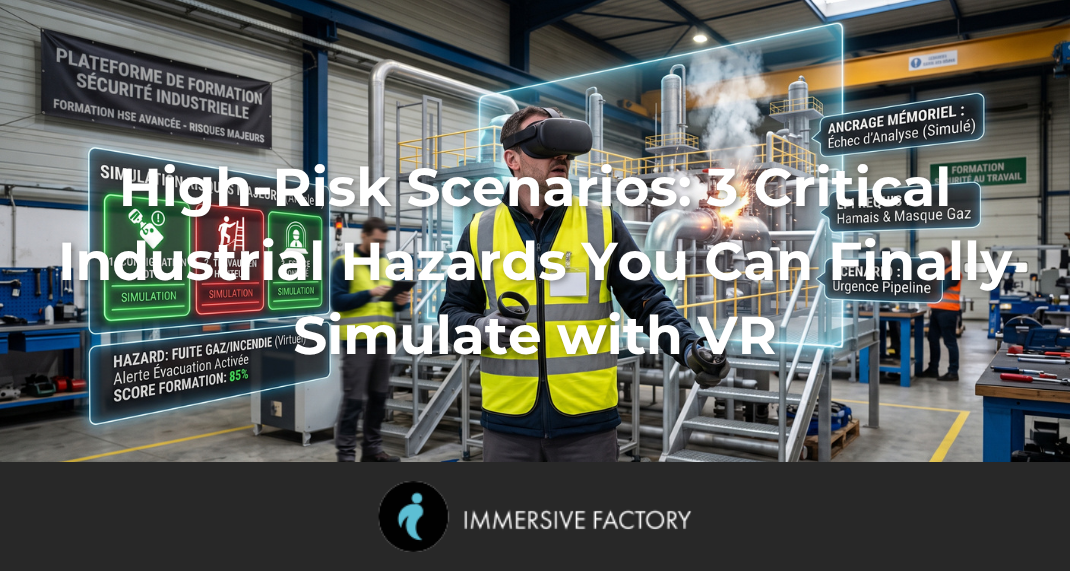
High-Risk Scenarios: 3 Critical Industrial Hazards You Can Finally Simulate with VR
Learn how VR enables safe, realistic simulation of major industrial hazards: Lockout/Tagout (LOTO), working at height, and confined space entry.
Occupational Accidents in Europe (2026): Beyond the Numbers, the Urgency to Act
What do 2026 European workplace accident stats really reveal? Immersive Factory analyzes the EUROGIP study & offers actionable VR safety solutions.
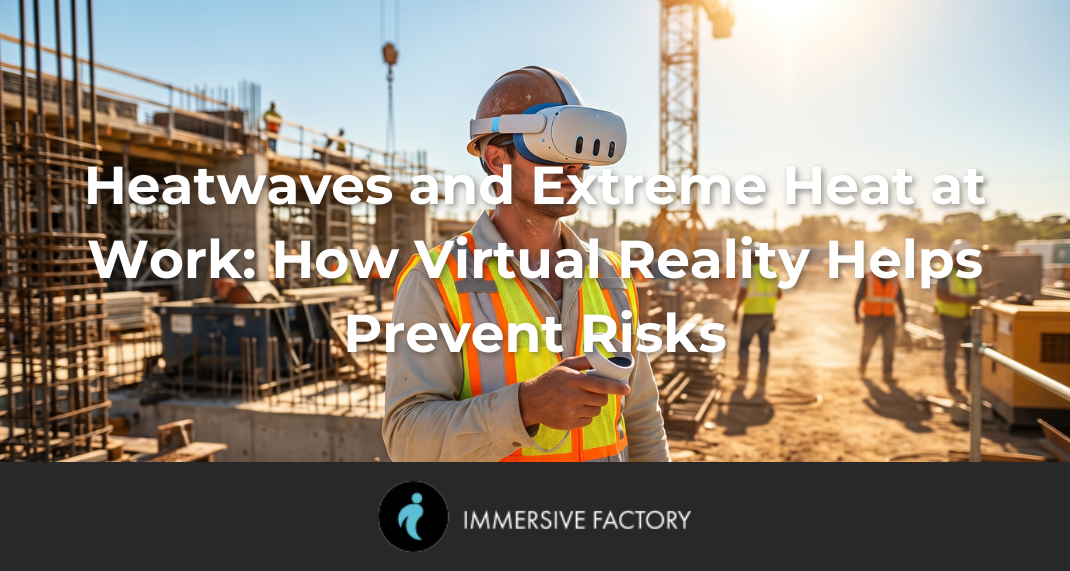
Heatwaves and Extreme Heat at Work: How Virtual Reality Helps Prevent Risks
As summer temperatures continue to soar year after year, extreme heatwaves are no longer exceptional events. For companies worldwide, managing thermal discomfort and high temperatures has become a critical annual health and saf...