INRS Risks: The 5 Families for Evaluating and Preventing in Business
INRS Risks: The 5 Families for Evaluating and Preventing in Business
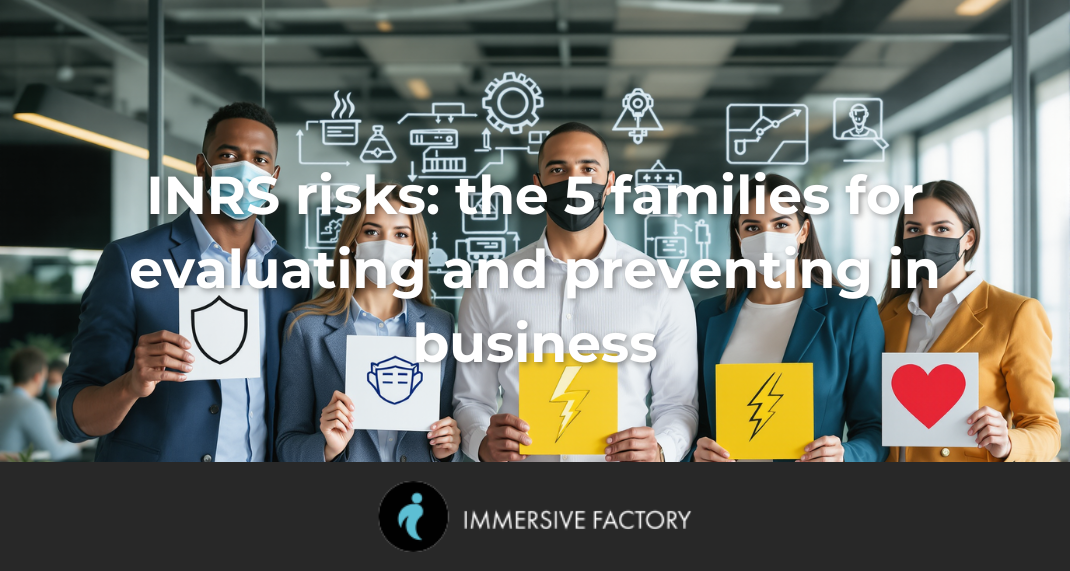
INRS Risks: The 5 Families for Prevention in Business.
Summary: The INRS risk classification for businesses in 3 key points
✔️ The INRS method classifies occupational risks into 5 families: chemical, biological, physical, mechanical, and psychosocial, to effectively structure analysis and prevention.
✔️ This official typologysimplifies drafting the DUER, adapting prevention measures, and raising team awareness with concrete, real-world examples.
✔️ Relying on INRS resources (guides, datasheets, training) and involving employees and managers helps build a sustainable, evolving, and recognized safety culture.
You recognize the importance of risk at work, but how can you structure prevention without wasting time or energy? Every company wants to implement a solid strategy that addresses health, safety, and performance challenges, by relying on simple measures that are shared by everyone.
The INRS has developed a classification of risks into five families, a framework recognized by all stakeholders: managers, HR managers, prevention services, employees, and trainers. This organization clarifies, simplifies, and guides every professional activity, from the industrial sector to food services, from construction to logistics. You can also participate in a safety day to improve your knowledge.
The Official INRS Risk Classification in Business
Why five families? The goal is to conduct a complete INRS risk hunt: to make prevention more accessible, allow every professional to easily identify each danger, and prioritize the measures to be deployed. This breakdown structures the single document for risk assessment and ensures that every manager or employer speaks the same language.
The five risk families according to the INRS:
- Chemical Risk
- Biological Risk
- Physical Risk
- Mechanical Risk
- Psychosocial Risk
Each family has a corresponding INRS fact sheet, video, or brochure, which are useful for leading training, helping to identify, analyze, prevent, and take action.
Did you know? 80% of workplace accidents are linked to less than 20% of the risks identified (source: INRS). A rigorous classification therefore helps to effectively target prevention measures and drastically reduce claims in a company. A safety manager readily uses these resources to formalize their action plan, update the DUERP, or train new employees.
The Objectives of the Five-Family Classification
To clarify, organize, and simplify.
A company that adopts this approach provides every stakeholder with a common framework, from the HSE manager to the on-site employee. The INRS brochures guide risk inventory, the drafting of the single document, and the selection of suitable prevention measures. This breakdown accelerates the annual review and compliance with the Labor Code.
- Identify dangers more quickly
- Assign concrete and measurable actions
- Facilitate team training and awareness
Chemical Risk in the Workplace
Handling chemical products (solvents, glues, gases, disinfectants) exposes workers to dangers that are sometimes invisible but very real: intoxication, burns, allergies, or even occupational cancer. Managers must inventory every substance, keep safety data sheets up-to-date, equip workers, and organize training. Prevention measures include: ventilation, substitution, personal protection, and secure storage.
"During an INRS training session, the trainer demonstrated the effect of chronic exposure to wood dust. By simply holding up a mask, everyone realized how easy it is to prevent the risk."
Biological Risk in the Workplace
Biological risks are found in healthcare, food, and environmental professions. Contact with pathogens (viruses, bacteria, fungi) exposes people to serious illnesses, and sometimes to epidemics. The INRS brochures recommend: vaccination, hand washing, wearing gloves, ventilation, and waste disposal procedures.
Physical Risk and Its Manifestations
Noise, vibration, extreme temperatures, radiation: physical risk lurks in every factory, warehouse, kitchen, construction site, or laboratory. Analyzing exposure helps to deploy suitable tools (sound meters, thermometers, dosimeter badges), and then correct the workstation through soundproofing, better ventilation, or task reorganization.
Mechanical Risk in Daily Activity
Machinery, tools, and vehicles create their share of dangers: cuts, crushing, collisions, and falls from heights. A safety manager regularly tours the workshop, checks equipment compliance, organizes training sessions, and performs a root cause analysis in case of an accident. The goal: to protect the health and safety of personnel, limit incidents, and prevent any workplace accident.
Psychosocial Risk, the New Frontier of Prevention
Stress, isolation, moral or sexual harassment, excessive mental workload: these invisible dangers weigh on mental health, motivation, and work life. Surveys, situation reviews, interviews, and questionnaires help pinpoint the origin of psychosocial risks. Prevention requires active listening, a suitable work organization, time for discussion, and concrete action plans.
- Tools: interviews, discussion groups, posters, videos, webinars
- Prevention actions: reorganization, participatory management, hotlines, access to occupational medicine
The Steps of Risk Assessment According to INRS
The first step of any strategy is to identify risks. Reviewing work situations, consulting employees, and tracking incidents all inform the diagnosis.
The analysis is based on objective criteria: severity, frequency, number of exposed employees, and the effectiveness of existing measures.
Integration into the DUERP happens with each update, at least once a year or after any accident, the arrival of a new product, or a job change.
Best Practices for a Collaborative Approach
Nothing can replace collective commitment. Regular training, follow-up meetings, and participatory gatherings instill prevention for the long term. Displaying guides and videos, and using INRS brochures during service meetings or safety days strengthens the shared culture. CSE or CHSCT members become relays, actors, and ambassadors for best practices.
- Tool: root cause analysis for a workplace accident
- Implementation: action plan updated with each annual review
- Result: everyone's involvement, a decrease in accidents, legal compliance
Prevention Levers Adapted to Each Risk Family
- Technical, organizational, training, communication: the winning quartet for each risk family.
- Technical: noise sensors, dust extraction, safety barriers
- Organizational: adapted scheduling, job rotation, workload management
- Training: modules adapted to each job, videos, quizzes, brochures
- Communication: feedback sessions, accident summaries, root cause analysis
Example: In a transport company, road risk training, awareness workshops, regular accident analysis, and the distribution of an INRS video reduced incidents in the fleet by half in less than a year.
Useful Resources to Go Further
Need templates?
INRS brochures, PDF guides, videos, and practical datasheets are available online for every sector. The templates for the single document for risk assessment can be customized by job, size, and situation. The social security also offers root cause analyses, checklists, and practical FAQs to help with every step.
Tips for Ensuring Sustainable Prevention Follow-Up
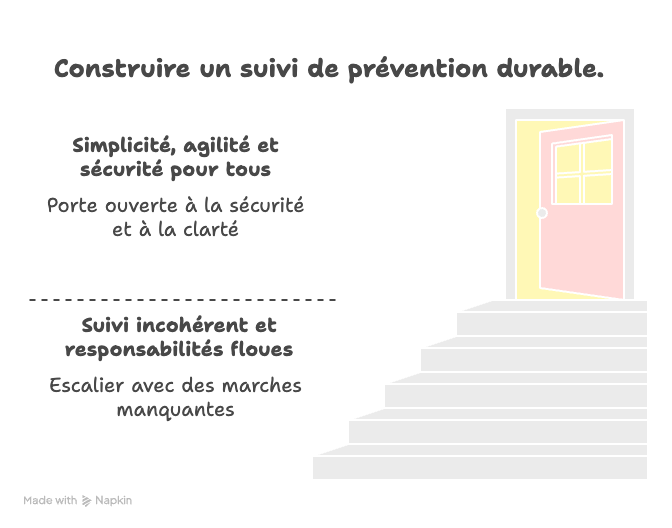
The key is follow-up:
Regular audits, incident analysis, continuous training, and employee involvement ensure the dynamic. A transparent approach, where everyone knows their responsibility, builds trust. The recognition of employee involvement, valuing feedback, and direct dialogue with management make every action more effective.
Relying on the INRS classification means choosing simplicity, agility, and safety for everyone.
How will you integrate it into your next prevention plan? Which actions do you want to prioritize? Use the available tools, guides, and brochures, and put safety culture at the heart of your work life: your teams will only come out stronger.

Immersive Factory's Safety Day: Experience Prevention Like Never Before
A traditional safety day? A parade of slides, a few videos, and employees who quickly lose interest... Who hasn't experienced that famous day where the word "safety" seems to rhyme with "yawn"? Yet, in a company, every project, every team, and every employee needs prevention, awareness, and action in the face of workplace risks. Immersive Factory is reinventing Safety Day with a completely new approach: welcome to virtual reality!
With the Immersive Factory solution, the workshop becomes an event:
On-demand activities, a dedicated consultant, cutting-edge VR equipment, and the ability to train around 50 people per consultant in one day.
Over 30 immersive workshops, designed for every need: from risk hunting in a warehouse to work postures to road behaviors. The catalog keeps growing, just like your safety culture!
A participant's comment: "After an Immersive Factory day, it's impossible to forget safety reflexes. Virtual reality makes every scenario impactful and concrete!"
The proof: effectiveness soars with +275% confidence in those trained. The company truly instills a culture of prevention, and employees react better to risky situations.
What kind of Safety Day do you really want to make memorable? Share your experiences, and lead your teams into a new era: prevention that's alive, impactful, and, most importantly, finally memorable thanks to Immersive Factory.
Our FAQ on INRS Risks
What are the 3 major types of risks?
In every company, risk lurks in several forms. The dominant trio? Physical risk, of course—the one that lies in wait during every activity, from manual labor to repetitive effort, not to mention every tool or machine. Then comes chemical risk, whether it's from a cleaning product or occasional exposure on the job: pay attention to health! Finally, biological risk is part of the prevention strategy, especially when working in an environment with living agents: bacteria, viruses, allergens... Every measure taken, every action carried out must be tailored to these three major risks, to ensure safety, training, and protection for every employee on a daily basis.
What are the 5 families of risks?
In the professional world, it's impossible to ignore these five families of risks that shape the life of every company. On the front line, physical risk—accidents, falls, injuries... There's also chemical risk, which is omnipresent as soon as products are handled or stored. Biological risk looms whenever a living agent is involved. Psychosocial risks, meanwhile, creep in subtly: stress, harassment, burnout... And we must not forget mechanical risk, linked to the use of machinery, equipment, or tools. Each family has its prevention plan, its single document, its actions, and its training. Working on these five areas provides safety for every employee and anticipates any accident or occupational disease.
What are the 4 major risks?
Four major risks disrupt daily life in business and require strong measures. Fire risk is at the top: every activity and every building must anticipate this event. Explosion, another giant danger, demands constant vigilance in sensitive sectors. The risk of chemical pollution, especially in industry or the food sector, can turn everything upside down in an instant. Finally, health risk—pandemics, contamination, occupational diseases—affects every employee's job. Each of these risks requires an adapted prevention strategy, an updated single document, and targeted actions for everyone's health and safety. Identify, analyze, act: there's no room for improvisation!
What are the 4 types of risks?
When it comes to workplace safety, four types of risks constantly reappear. Physical risks strike quickly and hard: cuts, falls, shocks, vibrations, noise... Chemical risks make their way, sometimes silently, through the air or direct contact. Biological risk concerns all those exposed to living agents, from dust to bacteria. Finally, psychosocial risks introduce stress, burnout, or pressure, sometimes leading to an accident. Identifying these risks is the foundation of an effective prevention strategy, with every action designed to protect health, ensure safety, improve organization, and equip every manager.
What are the 6 main categories of occupational risks?
Six main categories of occupational risks are part of every activity: physical risks (accidents, injuries, falls...), chemical risks (inhalation, contact...), biological risks (viruses, allergies...), psychosocial risks (stress, harassment), mechanical risks (tools, machines, vehicles), and organizational risks (workload, pace, vague instructions). Assessment, action, training: everyone is involved, from the employee to the manager, from management to the representative body. The single document becomes the key tool, prevention the daily mission, and every measure is adapted to the reality of the job, the position, and the sector. Safety is built at every step, from identifying the danger to implementing suitable solutions.
What are the 9 types of risks?
It's difficult to list them all, but the 9 types of risks cover the entire professional landscape: physical, chemical, biological, psychosocial, mechanical, electrical, road, organizational, and radiological. Every activity, every sector, every job carries its own dose of risk! For each risk, there's a measure, a plan, and a prevention action. The assessment process, training, and the single document: the entire safety ecosystem is mobilized to identify, analyze, prevent, inform, and protect. The key is commitment: to make prevention alive, accessible, useful, and always in tune with the real needs of employees.

Scritto da Aurélie Tavernier
Marketing and Communications Manager at Immersive Factory
She became interested in raising awareness of health and safety at work, convinced that an approach tailored to employees can transform the safety culture and reinforce shared vigilance. Her ambition: to encourage all companies, whatever their size, to invest actively in health and safety prevention for the well-being of their employees.
Condividere
Da leggere anche
High-Risk Scenarios: 3 Critical Industrial Hazards You Can Finally Simulate with VR
Learn how VR enables safe, realistic simulation of major industrial hazards: Lockout/Tagout (LOTO), working at height, and confined space entry.
Occupational Accidents in Europe (2026): Beyond the Numbers, the Urgency to Act
What do 2026 European workplace accident stats really reveal? Immersive Factory analyzes the EUROGIP study & offers actionable VR safety solutions.
Heatwaves and Extreme Heat at Work: How Virtual Reality Helps Prevent Risks
As summer temperatures continue to soar year after year, extreme heatwaves are no longer exceptional events. For companies worldwide, managing thermal discomfort and high temperatures has become a critical annual health and saf...