Industrial Safety & Protection: 8 Steps to Ensure Regulatory Compliance
Industrial Safety & Protection: 8 Steps to Ensure Regulatory Compliance
Industrial safety and protection: 8 steps for regulatory compliance.
In short, industrial safety: not just a routine
- Industrial safety is never a reflex: it is anticipated, maintained, and cultivated. On a worksite, rigor takes no coffee breaks; even an ill-adjusted helmet becomes an invisible flaw.
- Regulatory compliance is a permanent balancing act between monitoring, analysis, and protocol: the slightest discrepancy leads to an audit or a fine, and sometimes, panic.
- Continuous improvement is no joke: every incident becomes a lever, every failure a basis for progress. The team moves forward because routine is no longer an excuse.
Stop for a second; imagine the din, the mechanics, a form of ballet. You move through the heart of the site; signals multiply, and the noise of machinery echoes like an infinite industrial weave. Nothing is instinctive; everything is calculated, verified, anticipated. You can feel this tense, precise climate that suspends the slightest negligence. A helmet gleams, a badge activates—vigilance tolerates neither laziness nor approximation. You will likely need a Safety Toolbox Talk (Quart d’heure sécurité) training session to grasp all these concepts.
French industry no longer tolerates shadows; it hunts for the grain of sand. You look for the gap between routine and a misstep, and that gap obsesses you. Yet, the border between an incident and an accident remains thin. As you know from your Industrial Hazard Hunts, a prevention policy is never a luxury; it shapes the sustainability of sites and, sometimes, the health of a worker lost in the workshop.
Virtual Reality training: a new approach to industrial safety
To strengthen compliance and safety on your industrial sites, it is essential to implement innovative and effective training. A rapidly growing method is Virtual Reality (VR) training, particularly suited for high-risk environments.
Immersive Factory offers VR training for corporate safety, allowing your teams to train in immersive and controlled environments, reproducing real-life situations without the associated dangers. This approach allows employees to experience high-risk scenarios, such as emergency evacuations, handling complex equipment, or managing unexpected situations, while immersed in a 3D environment that perfectly simulates field reality.
The benefits of VR training for industrial safety are manifold:
- Realistic Simulation: Reproduce complex or dangerous situations realistically without endangering worker safety.
- Continuous Training: Offer the possibility of repeated learning, where each employee can react to varied scenarios until they achieve perfect mastery.
- Adaptability: Customize training according to the specificities of your site and its particular risks.
- Tracking and Evaluation: Use integrated analytical tools to track the performance of each employee and identify areas for improvement for increased safety.
By integrating VR training into your prevention policy, you add an innovative and proactive dimension to your compliance efforts while maximizing team engagement and responsiveness.
Context and stakes of safety and protection in industry
The industrial fabric is wound around standards, procedures, and sometimes slightly absurd routines. But something escapes you—a broader ambition: safety is lived, not endured. If you resist the obvious, look closer.
Definition of industrial safety and regulatory compliance
You build your industrial safety on an invisible network of procedures, equipment, and training—at every level, every station, every moment. In 2025, regulatory compliance is played out elsewhere: it requires sharp analysis, adapted solutions, and permanent acuity under the watchful eye of French and European legislation. You do not have the right to minimize fire, chemicals, or falls.
Moreover, every site deserves the same obsession. It is not uncommon to hear about Safety Toolbox Talks in major workshops, treated as a strategic break, not a formality. In short, protection is never exhausted by dusty instructions; it infiltrates every crack of the activity.
Key stakes for French industrial companies
In France, nothing makes regulations bend. You organize your assessments risk by risk; you compose training; you orchestrate prevention according to the material, the season, and the level of danger. However, the flaw sometimes persists, fossilized by routine. Behind the numbers, you perceive the stoppages, the anxiety, the fines, and the swaying reputation. Industrial safety is not a slogan; you make it exist tangibly on the margins of daily life.
Major families of applicable standards and regulations
The Labor Code reigns, but in fact, it is not enough. You constantly flip between the INRS, the European Seveso directive, ISO 45001 certification, and the subtlety of local protocols. Sometimes the gymnastics tire you, and regulatory monitoring seems Kafkaesque. Yet, a good reading of a single text can lift you to the peak of compliance. In short, one error is enough to trigger an audit. Authorities do not joke with the interpretation of SEVESO thresholds.
The role of stakeholders and reference institutions
Institutions, HSE consulting firms, private agencies—this whole world aggregates, each seeking the same thing: maximum reliability. You establish diagnostics, shape your action plans, and lead your projects with the requirement of compliance. An INRS document can sometimes change the course of an internal policy. The diversity of actors feeds collective vigilance; their dialogue guides practice, enriches prevention, and consolidates innovation. Thus, you cede nothing to chance or routine.

The eight key steps to ensure regulatory compliance in industrial environments
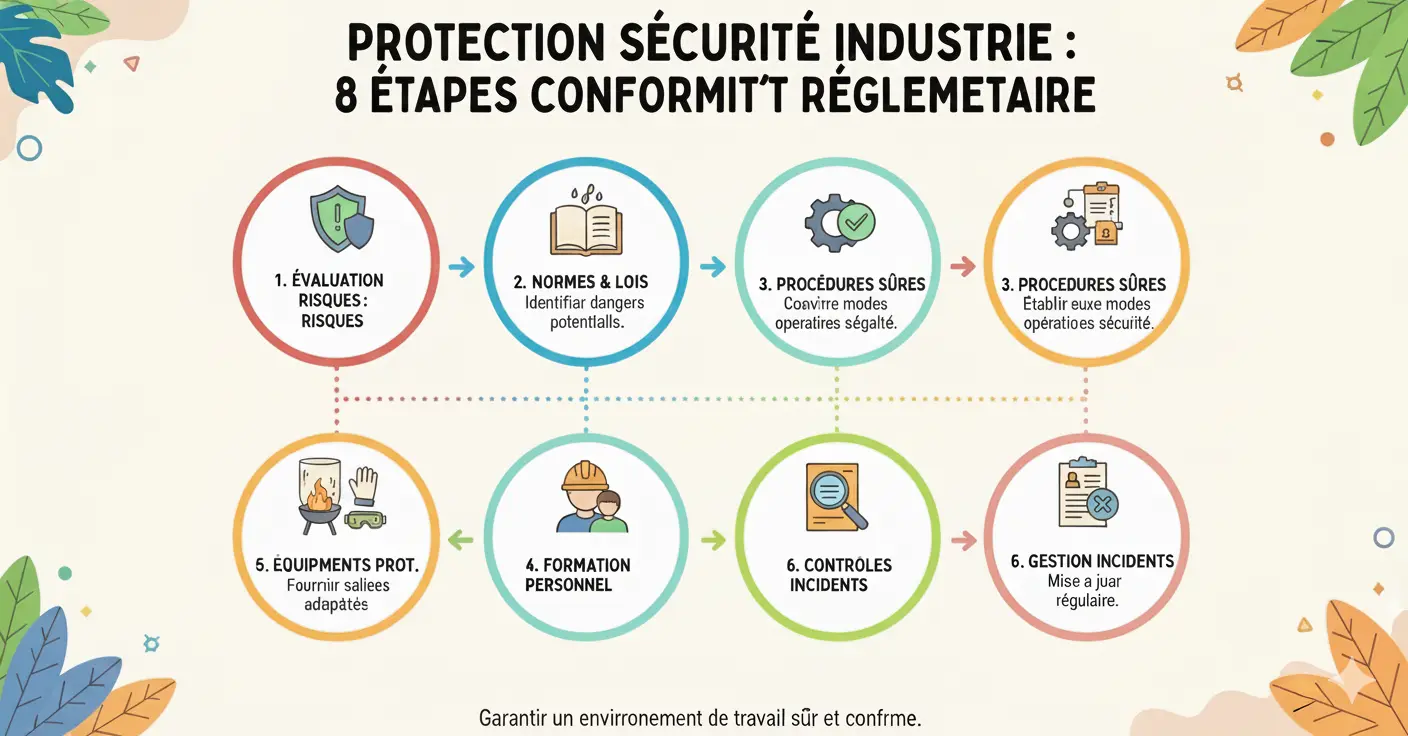
You were waiting for this—the passage where everything takes off, where the vague becomes precise, broken down into tested and proven steps.
Initial assessment of risks and requirements
You begin, invariably, with the inventory—sometimes tedious, sometimes staggering—of every danger. A fire doesn't exist without a forgotten extinguisher. Conversely, a fall arises from an insignificant detail on a walkway. Analysis imposes periodicity, updates, and frankness, and you sometimes feel the vertigo of exhaustiveness. You eventually tame it.
Consultation and integration of specific regulations
You layer the national stratum onto the European one, and each text piles up, sometimes contradicting the next. The ATEX procedure refuses simplification; the ISO 45001 standard tolerates no omissions. At this stage, you respect protocols down to the comma; you follow the logic. Yes, specialization is implacable; you monitor it.
| Standard/Regulation | Field | Scope | Application |
|---|---|---|---|
| Labor Code (France) | Workplace Safety | National | All industrial sectors |
| ATEX Directive | Explosive Risk | European | Chemical, oil industry |
| ISO 45001 | OHS Management | International | Global |
| Seveso III | High-risk sites | Europe | Large industrial sites |
Definition of adapted prevention and protection devices
You sharpen your requirements: the glove, the helmet, the physical barrier, the non-slip slab—nothing escapes study. Sometimes the solution is obvious; sometimes nuance decides. A helmet that is too heavy is replaced as surely as an erroneous instruction. Prevention is owned in the details; useless repairs are no longer an option. You measure buy-in by the flexibility of the tool, the comfort of the movement, and the simplicity of the instruction.
Development and communication of the safety action plan
You put your ambitions on paper, adjust priorities, and share them again and again. Pedagogy does not stifle rigor; regular reminders do not insult collective intelligence. You multiply sessions and simulations, linking the meeting room to the field. The flow of information gives rise to stubborn vigilance, an almost natural culture. An action plan is not a burden; it galvanizes.
The follow up, the continuing improvment and the management of compliance audits
Time flies, regulations shift; you relax neither your watch nor your control. It is sometimes exhausting, often rewarding.
Operational monitoring and regulatory watch
You monitor, analyze, and adapt every installation and protocol with digital tools that now serve as proof. Cybersecurity concerns you immediately; maintenance suffers no hesitation. Compliance is something to be displayed and lived.
Internal and external compliance audits
You audit, you re-examine, you resist the mundane. You sometimes task an outsider to destabilize you, to point out the flaw, to refresh the correlation between promise and reality. One audit pushes you toward anticipation, another toward certification. Self-assessment sharpens instinct; external opinions boost competence.
The importance of continuous improvement and feedback
You collect incidents, blunders, emergency exits, and doubtful cases; you process them and extract the substance. Sometimes a meeting disrupts the standard, redefines a daily gesture, or shifts parking lot signage. Thus, you transform constraint into progress.You don’t repeat the mistake; you cancel it before it reappears elsewhere. Improvement takes root; it irrigates all practices. Collective demand sharpens, protection evolves, and trust settles in.
Available support tools and resources
You accumulate guides, checklists, fall simulators, procedures, and online training platforms—a diverse but necessary and evolving arsenal, tailored to the unexpected. The resource becomes an ally; the tool does not wear out, it renews itself. In short, support is never improvised: it is documented, evaluated, and bounces back every time context or legislation imposes a new challenge.
You wonder if, one day, industrial safety will become pure inspiration? You already carry the absolute refusal of half-measures; you manage the site as a link in a living, adaptive, collective system. It is about believing in the strength of a shared momentum—a regulatory, technical, almost poetic breath. There is no acceptable flaw; in 2025, safety knows no half-measures; it is cultivated daily.
Q&A on industrial safety and protection
What are the 4 pillars of security?
A quick reminder from the field: the four pillars are Governance (the collective GPS), Protection (the daily shield), Defense (the action plan against the unexpected), and Resilience (starting again when everything collapses). The essential part? Teaming up, learning from failures, challenging habits, and transforming every "fail" into a skill upgrade.
What are the 12 types of industrial safety?
Imagine a major project where everyone gets involved—from the manager to the temp worker. Physical safety, personnel safety, cybersecurity, document security... the list is long! Twelve challenges for a tight-knit team. With an action plan in hand, every collaborator has a role to play.
What are the 3 categories of PPE?
PPE is like a collaborator’s toolbox: three categories—Mechanical (shocks, projections), Electrical (live contacts), and Biological/Chemical (field experience). The goal? Preserve every mission and strengthen team spirit.
What are the 3 pillars of safety?
A manager, a team, and plenty of surprises. The three pillars of safety are: Technical Reliability (the morning's assurance), Management System (the compass), and Human and Organizational Factors (the team spirit that saves everything). It’s a collective challenge. Success is the evolution of the group over time.

Scritto da Aurélie Tavernier
Marketing and Communications Manager at Immersive Factory
She became interested in raising awareness of health and safety at work, convinced that an approach tailored to employees can transform the safety culture and reinforce shared vigilance. Her ambition: to encourage all companies, whatever their size, to invest actively in health and safety prevention for the well-being of their employees.
Condividere
Da leggere anche
Deploying HSE VR Across Multiple Sites: From Pilot to Scaling
Discover how to successfully scale enterprise virtual reality for multi-site safety training: fleet management, LMS integration, and local adoption.
Calculating the ROI of VR in Health & Safety: Key Metrics Beyond Hardware Costs
Learn how to measure the true ROI of virtual reality in HSE safety training. Key metrics, hidden cost savings, and incident rate reduction.
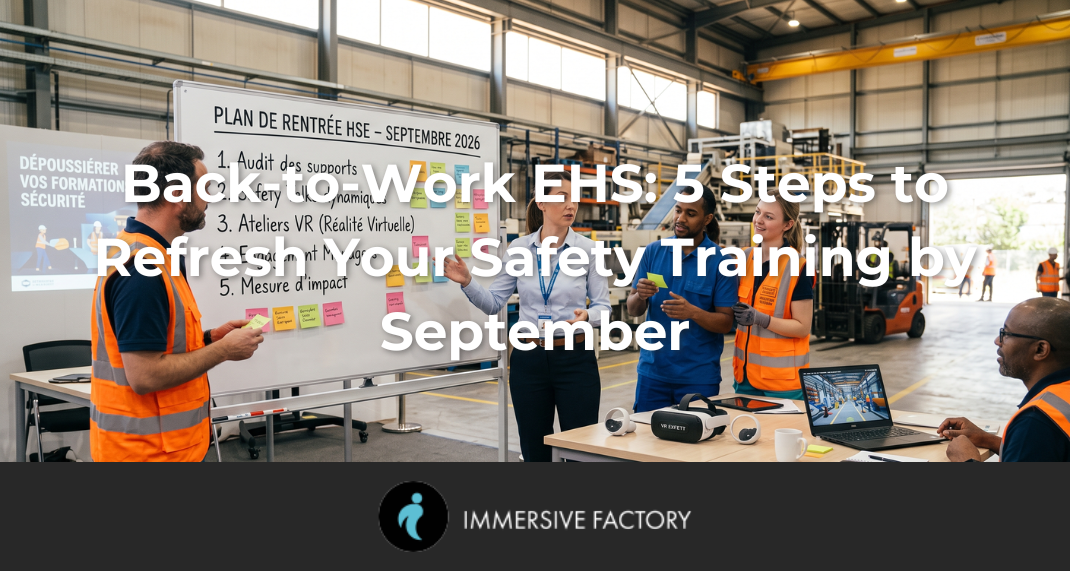
Back-to-Work EHS: 5 Steps to Refresh Your Safety Training by September
Gear up for the fall EHS restart! Discover 5 actionable steps to refresh your safety training, re-engage teams in September, and integrate VR.