High-Risk Scenarios: 3 Critical Industrial Hazards You Can Finally Simulate with VR
High-Risk Scenarios: 3 Critical Industrial Hazards You Can Finally Simulate with VR
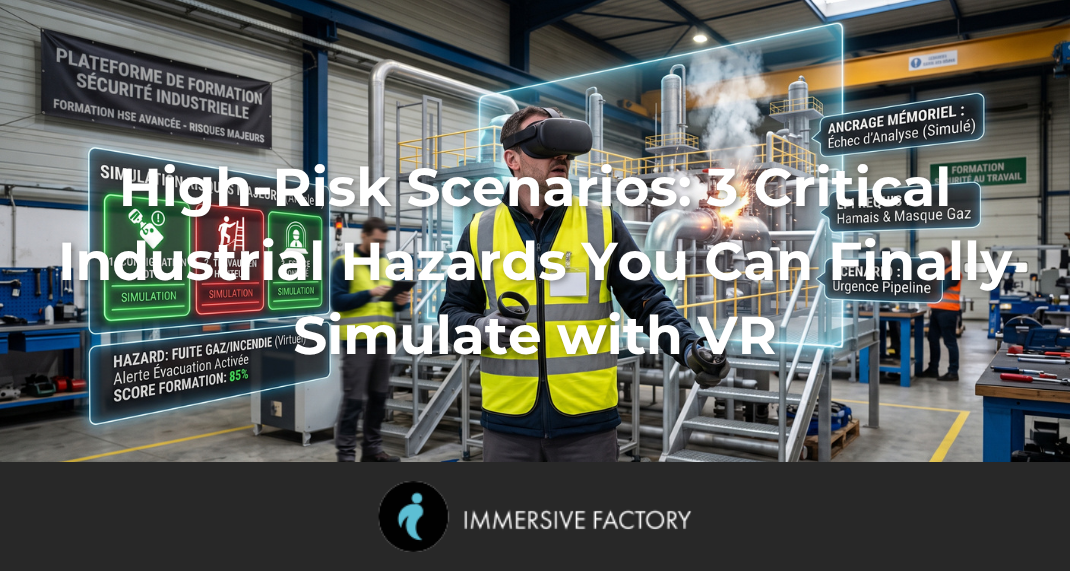
Training workforce teams for high-risk industrial tasks poses a fundamental dilemma for HSE leaders: how do you expose an operator to life-threatening hazards to teach safety protocols without placing them in actual danger?
Classroom slide decks lack situational realism, whereas live physical drills on active machinery are expensive, logistically complex, and inherently risky. Virtual Reality resolves this dilemma by flawlessly replicating high-hazard environments in total safety.
1. Three Critical High-Risk Industrial Scenarios in VR
Lockout/Tagout(LOTO) Procedures:
Failure to comply with LOTO protocols remains a primary cause of severe maintenance accidents. In VR, trainees must locate energy sources (electrical, pneumatic, hydraulic), apply padlocks, and test for zero energy state. Skipping a step triggers a vivid virtual re-energization event, instilling immediate hazard awareness.
Working at Height& Fall Prevention:
Falls from height represent a major fatality risk across manufacturing and construction. VR modules reproduce height exposure and vertigo, prompting workers to meticulously inspect harnesses, lanyards, anchor points, and lifeline attachments before ascending.
Confined Space Entry& ATEX Environments:
Entering storage tanks, vessels, or silos requires strict gas monitoring, ventilation, and permit compliance. Virtual simulations model toxic atmospheric surges, oxygen deficiency, or ignition events, training operators on emergency egress and rescue protocols.
2. Multi-Site Rollout: Overcoming Hardware & IT Barriers
Deploying safety technology across multiple manufacturing plants or distribution centers requires seamless logistics:
- Standalone "Plug & Play" VR Headsets: Modern standalone headsets operate without external PCs or cables, enabling quick setup in any room.
- LMS Integration & Compliance Tracking: Completion rates, scores, and safety metrics sync directly to your enterprise Learning Management System (LMS) for regulatory compliance.
3. Checklist: 4 Steps to Pilot VR on an Industrial Site
- Target a High-Impact Risk: Select a priority hazard with high accident frequency or severity.
- Engage Field Operators Early: Involve safety managers and site workers during initial trials to gather immediate feedback.
- Track Completion & Retention Metrics: Evaluate training speed, knowledge retention, and user engagement against traditional methods.
- Assess Scalability: Measure logistical savings before expanding the program across additional regional or global facilities.
Conclusion:
By turning hazardous, hard-to-replicate scenarios into safe, repeatable practice, Virtual Reality delivers a new benchmark for high-risk industrial safety training.

Scritto da Aurélie Tavernier
Marketing and Communications Manager at Immersive Factory
She became interested in raising awareness of health and safety at work, convinced that an approach tailored to employees can transform the safety culture and reinforce shared vigilance. Her ambition: to encourage all companies, whatever their size, to invest actively in health and safety prevention for the well-being of their employees.
Condividere
Da leggere anche
Occupational Accidents in Europe (2026): Beyond the Numbers, the Urgency to Act
What do 2026 European workplace accident stats really reveal? Immersive Factory analyzes the EUROGIP study & offers actionable VR safety solutions.
Heatwaves and Extreme Heat at Work: How Virtual Reality Helps Prevent Risks
As summer temperatures continue to soar year after year, extreme heatwaves are no longer exceptional events. For companies worldwide, managing thermal discomfort and high temperatures has become a critical annual health and saf...
Neuroscience and HSE: Why Our Brain Retains Risks 4 Times Better Thanks to VR?
When it comes to Health, Safety, and Environment (HSE), the goal of training isn’t to hand out attendance certificates—it’s to save lives. Yet, training directors frequently battle a formidable enemy: Ebbinghaus’s forgetting cu...