Why Virtual Reality Is Used: The Gaming Tech Long Overlooked by Businesses, Doctors, and Trainers
Why Virtual Reality Is Used: The Gaming Tech Long Overlooked by Businesses, Doctors, and Trainers
At a Glance
Virtual reality addresses concrete needs where screens and manuals reach their limits.
- 82% of industrial companies exceed their goals after adopting VR, according to Capgemini
- VR activates the same neural pathways as real physical experience
- Hospitals use VR headsets to reduce pain and anxiety without medication
Virtual reality is establishing itself today as a tool for mastery, not escapism. Where a video explains and a manual describes, a virtual environment brings things to life: the user acts, repeats, fails without consequences, and retains information. This fundamental mechanism explains why sectors as diverse as surgery, logistics, and EHS (environmental health and safety) training are adopting VR with growing conviction. Understanding why virtual reality is used means first understanding what it does to the brain and body that no other digital interface can do. You might opt for a VR safety day.
The Real Purpose of Virtual Reality Is Not Escapism, but Mastery
What is the purpose of virtual reality beyond entertainment?
Virtual reality generates a state that researchers call presence: the feeling of being physically inside an environment that does not exist. This state triggers authentic behavioral and emotional responses. A user placed virtually at a great height steps back. A trainee confronted with a simulated fire outbreak adopts the right reflexes. This is not interactive fiction; it is functional simulation. It is therefore time to launch a hazard hunt.
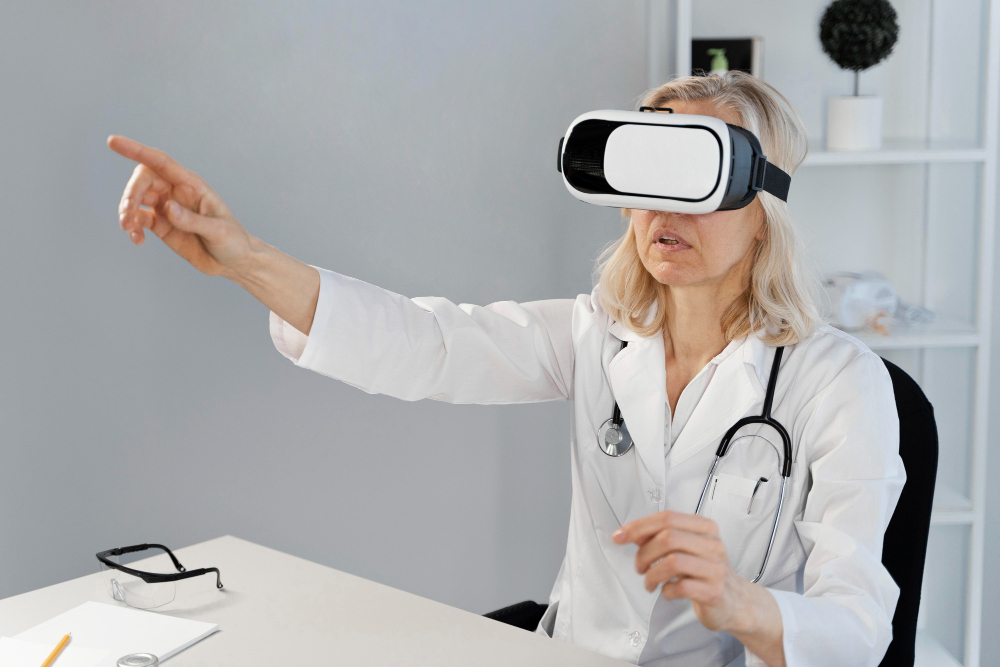
Professional applications exploit precisely this property: the virtual world reproduces real conditions with enough fidelity for the brain to process the experience as real. As a result, skills acquired in VR transfer to the physical world—something screen-based training cannot achieve to the same degree.
QUOTE: Virtual reality does not simulate a situation; it brings it to life.
The 3 Pillars of Virtual Reality: Immersion, Interaction, and Sensory Presence
Inria, the French benchmark in computer science research, identifies three structural components of VR:
- Immersion: The degree of isolation from the physical world achieved through the headset, which blocks out the external visual and auditory field.
- Interaction: The user's ability to act upon the environment in real time via gestural interfaces, controllers, or haptic gloves.
- Sensory presence: The result of both—the brain interprets the signals received as real.
These three pillars explain why a simple slideshow or a 360° video does not produce the same cognitive effects. Without interactivity, there is no presence. Without presence, there is no deeply anchored learning.
KEY TAKEAWAY: The three VR pillars—immersion, interaction, and sensory presence—form a system: removing one drastically reduces the technology's effectiveness.
What VR Headsets Do to the Brain That Other Interfaces Cannot
Research published in the Journal of Surgical Education demonstrates that surgical training in virtual reality measurably reduces operative errors compared to conventional methods. A VR headset forces the brain to recruit procedural memory—the same type used during actual physical action—whereas watching a video primarily relies on declarative memory. These are different neural circuits, and the outcomes in terms of information retention are not comparable.
Why Industrial Companies Use Virtual Reality Where Screens Failed
Virtual Design and Prototyping: Testing Before Building for Real
Renault and Dassault Systèmes use VR to validate automotive prototypes before any physical manufacturing. An engineer navigates inside a full-scale virtual cockpit, detects ergonomic issues, and modifies dimensions directly within the 3D environment. This process cuts design lead times and eliminates costly iterations on physical parts. Traditional CAD displays a representation; VR brings the product to life.
KEY METRIC: 82% $\rightarrow$ Of industrial companies that have adopted VR meet or exceed their objectives, according to Capgemini.
Remote Maintenance and Digital Twins: High-Performance Tethered VR at the Heart of Industry 4.0
A recent trend in heavy industry confirms a return to high-performance tethered VR. The reasons are technical: the billions of polygons required for the faithful modeling of a factory overwhelm the mobile processors of standalone headsets. The digital twin of a complex industrial facility demands computational power that only a connected PC can deliver. In practice, a maintenance technician wears a headset connected to a desktop PC, navigates through the exact digital model of the physical equipment, and identifies the faulty part before intervening physically.
82% of Industrial Companies Exceed Their Goals with VR: What the Capgemini Study Reveals
The Capgemini study published in 2020 measured the concrete results of 700 companies that deployed immersive technologies. 82% met or exceeded their set targets, particularly in productivity, error reduction, and training. This figure reveals something that tech editorials often overlook: industrial VR is not a bet on the future; it is a technology whose ROI is being measured today.
BENEFITS:
- Shorter prototyping lead times
- Zero physical risk during training
- Documented ROI in 82% of industrial cases
What Virtual Reality Does to the Body and Pain That No One Tells You
Anti-Anxiety and Pain-Relief Headsets in Hospitals: How the Mind Acts on the Nervous System
The hospital in Niort deploys VR headsets across multiple departments to manage pain and anxiety prior to certain medical procedures. The mechanism is neurological: the central nervous system prioritizes immersive information over pain signals. With attention captured by the virtual environment, the perceived intensity of pain drops—a phenomenon documented in studies on burn wound dressings and pediatric venipunctures. No medication is involved.
TIP: In hospital settings, VR headsets are used as an adjunct to standard medical protocols, never as a replacement. Effectiveness depends on the degree of immersion and exposure time.
VR and the Immune System: An Angle Research Is Beginning to Document
Research reported via France 24 in partnership with Andrea Serino documents an unexpected result: subjects exposed in virtual reality to sick avatars approaching them triggered a measurable immune response. This link between immersive simulation and physiological activation opens up new territory. VR does not merely replicate behaviors; it activates biological mechanisms that the brain associates with real-world stimuli.
Virtual Reality as a Therapeutic Tool for Family Caregivers of Alzheimer's Patients
The Conversation documents the use of VR for family caregivers of Alzheimer's patients. These individuals experience chronic exhaustion that often goes unseen by healthcare professionals. Immersive sessions in a calm virtual environment produce measurable reductions in perceived stress. The application does not treat Alzheimer's disease; it acts on the caregiver's nervous system. An important distinction.
What Are the Advantages of Virtual Reality over Traditional Methods?
A Virtual Environment That Allows Repetition Without Risk or Additional Cost
This is the foundational argument, and it remains the strongest. Training a logistics operator in warehouse hazard management using a VR simulation is less expensive than shutting down an actual production line. Repetition is limitless. Every mistake in the virtual environment yields immediate feedback with no physical consequences or production downtime. Companies like Immersive Factory build on precisely this rationale: replicating hazardous scenarios under safe conditions.
Parameter | Virtual Reality vs. Real Life |
Cost of error | Zero in VR, high in real life |
Repeatability | Unlimited without additional resources |
Availability | 24/7 without an instructor present |
Adaptability | Scenario customizable to the learner's skill level |
VR Activates the Same Brain Mechanisms as Real Experience
Inria states this clearly in its work on human-computer interfaces: the human brain does not draw a binary distinction between reality and virtuality. Sensory presence activates the amygdala, the hippocampus, and motor areas in a manner nearly identical to a real situation. This is precisely why VR is used to treat certain phobias: exposing a patient to a virtual spider triggers the same anxiety response as a real one, enabling gradual desensitization.
Simulation, Sensory Interactivity, and Information Retention: What the Numbers Confirm
PwC published data comparing virtual reality training with e-learning and classroom methods. Learners trained in VR learn four times faster and demonstrate confidence levels 275% higher than those trained through traditional e-learning. The combination of simulation, sensory interactivity, and immediate feedback produces deeply anchored learning that screen-based applications cannot replicate. This figure is not trivial—it justifies the investment.
Why Consumer Virtual Reality Partially Failed and What This Reveals About Its Real Uses
The Flop of VR Gaming: Cybersickness, Space Constraints, and Friction to Entry
RTBF summarizes the problem accurately: in VR gaming, the user must clear space, put on the Oculus or HTC Vive headset, calibrate the room, and hope they do not develop cybersickness in under 20 minutes. This friction to entry is a dealbreaker for the general public. Cybersickness—the virtual-environment equivalent of motion sickness—affects a significant proportion of users, especially during navigation in virtual space that is out of sync with the physical body.
WARNING: Cybersickness represents a genuine limitation of consumer VR. Professional applications bypass this issue by restricting scenarios to short, stationary, and tightly scripted experiences.
What Consumer Failure Proves About the Technology's True Value
Here is what we believe, and we stand by it: the relative failure of consumer VR does not invalidate the technology. It confirms that its value lies not in passive entertainment, but in active utility. VR is not a movie screen strapped to one's face. It is a simulator. And simulators, ever since the beginnings of aviation training with early US Navy equipment, have always had their primary utility in the professional realm, not the living room.
Virtual Reality Is Establishing Itself as Infrastructure, Not a Trend
Virtual reality is used because it delivers measurable results where other digital technologies hit a ceiling. Risk-free training, accelerated prototyping, pain management, phobia treatment: every application area relies on the same fundamental mechanism. The brain believes what it experiences, not what it reads. We are convinced that enterprise VR is only getting started, and that XR—extended reality in the broad sense, encompassing AR and MR—will reshape workplace interfaces over the coming decade.
Virtual Reality FAQ
Why use virtualization?
Virtualization, in the IT sense, creates isolated software environments on the same physical hardware to optimize resources. Virtualization in the VR sense follows a different logic: reproducing a physical experience within a digital space to train, test, or treat without deploying physical infrastructure. Both concepts share a common principle: decoupling the experience from hardware constraints.
What are the 3 pillars of virtual reality?
Inria and academic literature converge on three pillars: immersion (sensory isolation from the physical world via the headset), interaction (the ability to act upon the virtual environment in real time), and presence (the cognitive state in which the brain treats the virtual environment as real). Removing any one of these three elements reduces VR's effectiveness to that of an ordinary interactive video.

Scritto da Aurélie Tavernier
Marketing and Communications Manager at Immersive Factory
She became interested in raising awareness of health and safety at work, convinced that an approach tailored to employees can transform the safety culture and reinforce shared vigilance. Her ambition: to encourage all companies, whatever their size, to invest actively in health and safety prevention for the well-being of their employees.
Condividere
Da leggere anche
ISO 45001 Standard and HSE Audits: How Virtual Reality Secures Your Traceability
Prepare for your occupational health and safety audits with virtual reality. Discover how VR ensures the traceability of your HSE training.
From Passive Compliance to On-Site Engagement: Why Virtual Simulation Permanently Shifts Safety Behaviors
Discover how VR shifts safety culture in industrial workplaces. Explore error-based learning, emotional risk awareness, and interactive safety talks.
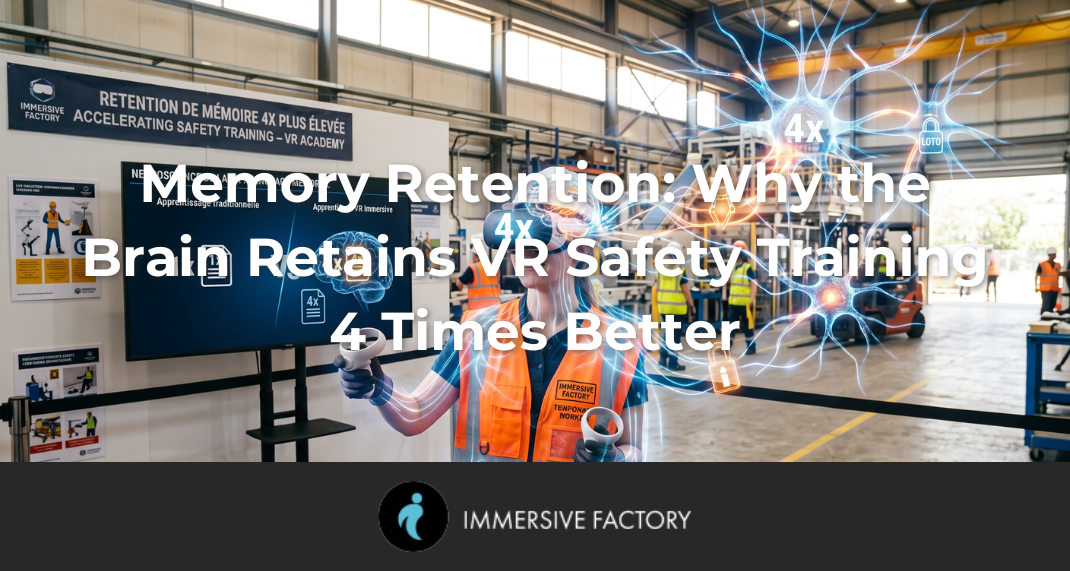
Memory Retention: Why the Brain Retains VR Safety Training 4 Times Better
Discover the neuroscience behind virtual reality: why memory retention and experiential learning make VR safety training up to 4 times more effective.