Virtual Reality: A New Angle for Safety at Régie des Eaux Gessiennes
Virtual Reality: A New Angle for Safety at Régie des Eaux Gessiennes
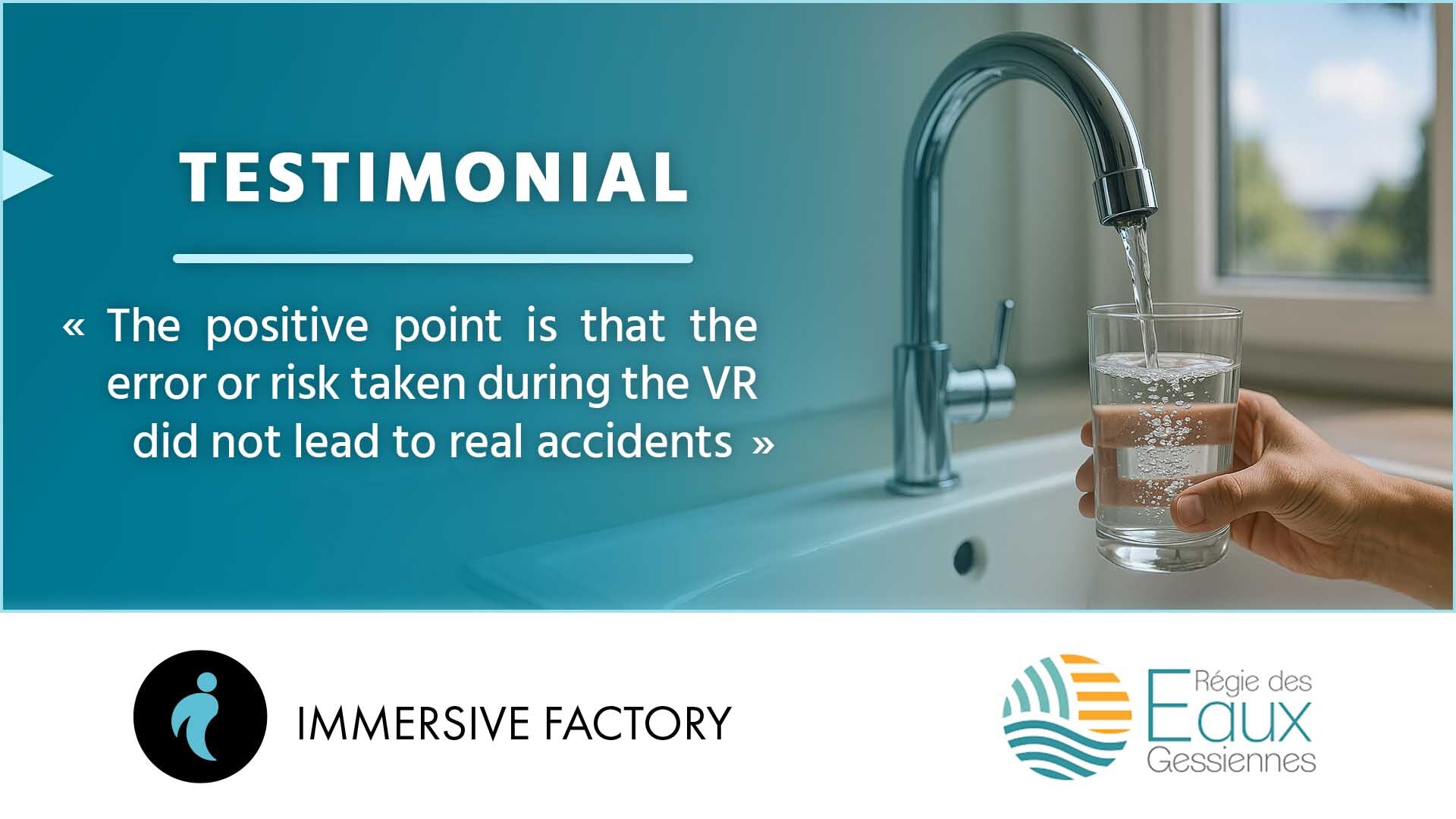
Innovating in safety is a constant challenge for companies, especially when it comes to keeping teams engaged. Laurent Pillard, QHSE Manager at Régie des Eaux Gessiennes, shares his experience and approach to tackling safety from a new perspective, thanks to virtual reality.
A Discovery at the Préventica Exhibition
It was at the Préventica exhibition in Lyon that Laurent Pillard discovered the SafetyBox VR©by Immersive Factory. His company, Régie des Eaux Gessiennes, is an essential player in the transport and distribution of drinking water, as well as the collection and treatment of wastewater. The constant search for effective awareness-raising methods is therefore crucial for this high-risk sector.
The SafetyBox VR©: Ease of Use and Impact
The choice of the SafetyBox VR© was driven by its ease of handling and use. Régie des Eaux Gessiennes opted for a one-day rental, a timely approach that met their need to experiment with this new method.
The objective was clear: to approach the topic of safety from a new angle. And the initial feedback is promising. Laurent Pillard highlights a major advantage of virtual reality: "The positive point of virtual reality is to allow our employees to be confronted to risky situations without real consequences, reinforcing the safety culture and the “observe before acting” spirit." This is the full power of simulation: allowing one to learn from mistakes without suffering real consequences.
Areas for Improvement and Targeted Use
While the overall experience is positive, Laurent Pillard points out an area for improvement: “To grow the efficacity of the exercises, it would be interesting to develop scenarios centered on our specifics subjects, as water and sanitation”.
The SafetyBox VR© is recommended by Laurent Pillard, but he specifies the importance of adapting its use to the size of the structure. For a company of 70 people like his, year-round use would be ideal. However, with the aim of diversifying awareness-raising tools and changing approaches, occasional use via rental is preferred.
In summary, virtual reality is establishing itself as a powerful educational tool for safety, offering risk-free experiences and stimulating the proactive thinking of employees.

Scritto da Aurélie Tavernier
Marketing and Communications Manager at Immersive Factory
She became interested in raising awareness of health and safety at work, convinced that an approach tailored to employees can transform the safety culture and reinforce shared vigilance. Her ambition: to encourage all companies, whatever their size, to invest actively in health and safety prevention for the well-being of their employees.
Condividere
Da leggere anche
Improving Safety Culture Through Virtual Reality: Feedback from Cummins
How can you tangibly strengthen the Health & Safety culture at work and ensure safe behaviors are adopted on the ground? Perrine Darbouret, HSE Coordinator at Cummins Drivetrain and Braking Systems, shares her feedback...
HSE EDUCATION: The IUT of Poitiers is betting on virtual reality with Immersive Factory
In the face of technological shifts and the growing demands of the professional world, Health, Safety, and Environment (HSE) training must constantly adopt agile and immersive pedagogical methods. At the IUT of Poitiers, Niort,...
Case Study: Leveraging Virtual Reality to Strengthen Industrial Safety Culture
In complex industrial environments, Health, Safety, and Environment (EHS&S / HSE) training is a daily priority. How can companies innovate to better engage employees and mitigate risks?We gathered insights from Emmanue...