A 45% Drop in Workplace Accidents Thanks to Virtual Reality Training!
A 45% Drop in Workplace Accidents Thanks to Virtual Reality Training!
Yes, the benefits of Virtual Reality (VR) in preventing workplace accidents are now scientifically documented. Researchers and occupational health organizations agree that while VR does not replace theoretical training, it makes it significantly more effective by acting on emotional memory and risk perception.
Here is a summary of recent studies (2024-2025) and key figures demonstrating its impact.
1. Compelling Statistical Results
Recent studies comparing traditional training (videos, presentations) with immersive training show significant gains:
- Accident Reduction: A University of Maryland study cited in 2024 showed that companies using VR record a 45% drop in accidents compared to those using classic methods.
- Increased Retention: The information retention rate (recall rate) reaches 90% after VR training, compared to only 78% for computer-based training (University of Maryland).
- Learning Speed: According to a PwC report, employees train up to 4 times faster in VR than in a traditional classroom setting.
2. Recent Scientific Studies and Meta-Analyses
Several academic publications from 2024 and 2025 confirm these benefits:
- Meta-analysis (2024): A systematic review published on ResearchGate covering 52 articles shows that VR consistently outperforms traditional methods in terms of knowledge acquisition and long-term retention.
- Industry 4.0 and Self-Efficacy (2024): A quasi-experimental study on 200 participants revealed that VR training increased risk perception by 30% and strengthened workers' sense of self-efficacy (their confidence in their ability to react correctly in danger).
- Construction Sector (2024): A study published in the Journal of Medical Internet Research (JMIR) demonstrated that coupling an occupational health check-up with a VR session significantly increased workers' vigilance regarding co-activity risks on construction sites.
3. Why is VR More Effective?
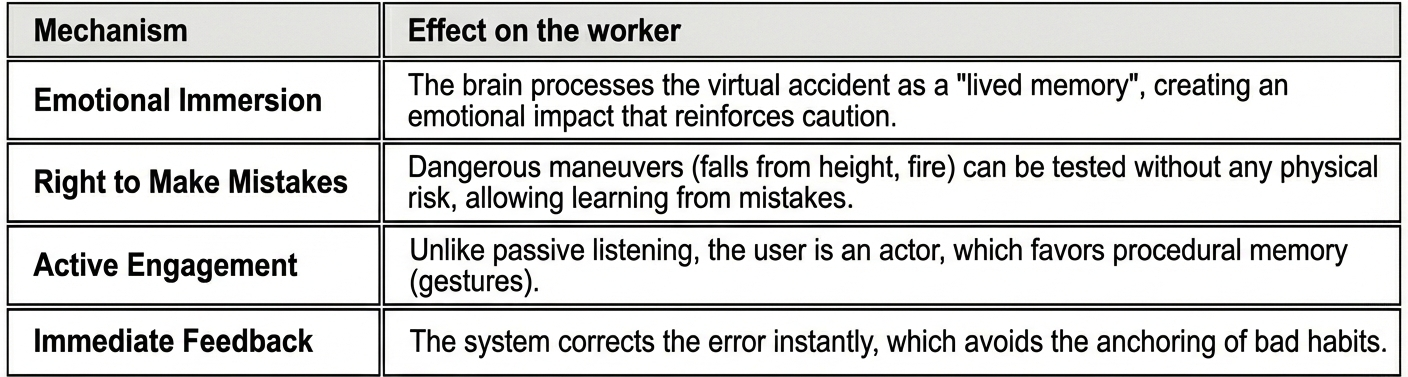
Scientists explain these results through several psychological and cognitive mechanisms:
Discover our virtual reality HSE catalog: https://immersivefactory.com/content?tags=vr

Geschrieben von Aurélie Tavernier
Marketing and Communications Manager at Immersive Factory
She became interested in raising awareness of health and safety at work, convinced that an approach tailored to employees can transform the safety culture and reinforce shared vigilance. Her ambition: to encourage all companies, whatever their size, to invest actively in health and safety prevention for the well-being of their employees.
Teilen
Das könnte Sie auch interessieren
From Passive Compliance to On-Site Engagement: Why Virtual Simulation Permanently Shifts Safety Behaviors
Discover how VR shifts safety culture in industrial workplaces. Explore error-based learning, emotional risk awareness, and interactive safety talks.
Memory Retention: Why the Brain Retains VR Safety Training 4 Times Better
Discover the neuroscience behind virtual reality: why memory retention and experiential learning make VR safety training up to 4 times more effective.
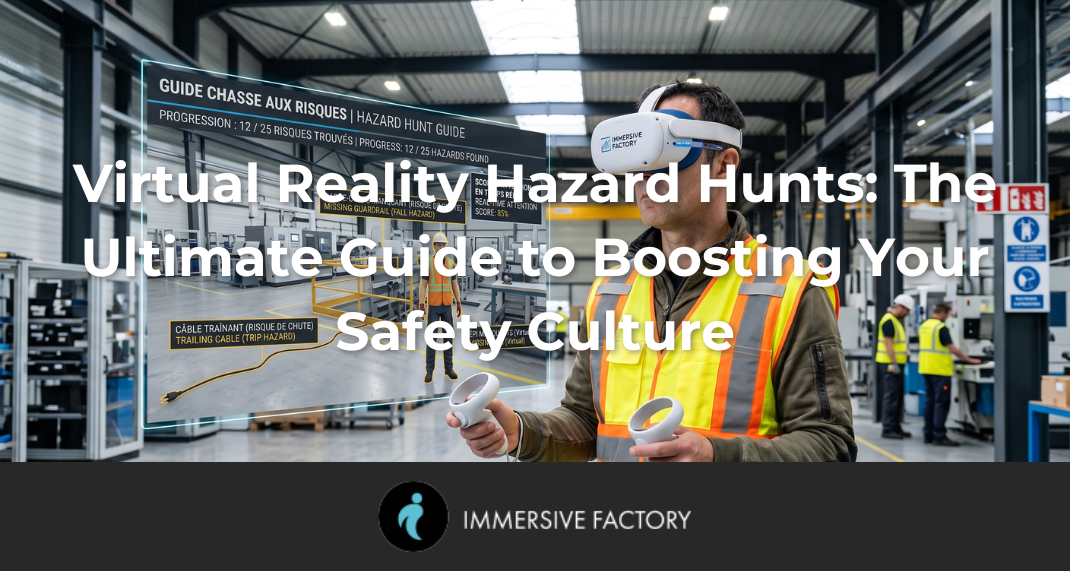
Virtual Reality Hazard Hunts: The Ultimate Guide to Boosting Your Safety Culture
The "Hazard Hunt" is a staple in HSE training. The goal is straightforward: to sharpen employees' critical eyes so they can proactively identify anomalies and dangerous situations in their work environment. It is the absolute f...