ISO 45001 Standard and HSE Audits: How Virtual Reality Secures Your Traceability
ISO 45001 Standard and HSE Audits: How Virtual Reality Secures Your Traceability
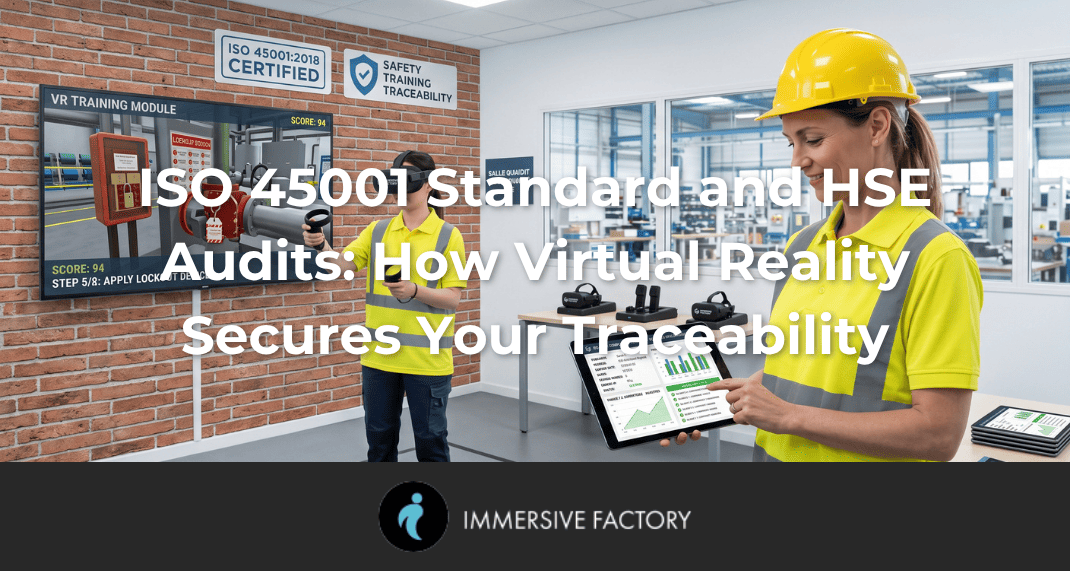
Preparing for an occupational health and safety audit is often synonymous with stress for HSE teams. You have to gather attendance sheets, compile training certificates, and prove to auditors that employees truly master the procedures.
But what if your training tool automatically generated your compliance evidence? Beyond its impact on learner engagement, the alliance between the ISO 45001 standard, VR, and safety radically transforms how industrial companies demonstrate their regulatory compliance.
Beyond the Attendance Sheet: Validating Behaviors, Not Just Attendance
Traditionally, proof of training relies on a signature at the bottom of an attendance sheet. However, passively sitting through a PowerPoint presentation guarantees nothing about an operator's ability to react to a fire outbreak or perform a lockout/tagout procedure.
This is where virtual reality changes the game. VR does not certify an employee's presence in a room; it certifies their ability to execute the right actions under stress. OHS (Occupational Health and Safety) skills assessment shifts from a theoretical format (multiple-choice questions) to immersive practical application, offering a much stronger guarantee in the eyes of an auditor.
Alignment with the ISO 45001 Standard (Clause 7.2)
One of the pillars of ISO 45001 certification lies in Clause 7.2 regarding "Competence." This clause requires organizations to ensure the competence of their workers and to retain "appropriate documented information as evidence of competence."
Thanks to virtual reality, HSE training traceability becomes foolproof. Every session completed by an employee in a VR headset generates objective data:
- Decision-making time.
- Chronological adherence to procedures (PPE, lockout, signage).
- Hazard identification in the environment.
This data constitutes the perfect "documented evidence" demanded by certifying bodies.
Leveraging Error Analytics: From Correction to Prevention
The ISO 45001 standard advocates for continuous improvement (the famous PDCA cycle). The Immersive Factory platform doesn't just deliver a passing score; it maps out errors (virtual near-misses).
By analyzing your headset fleet's dashboard, you might identify that 40% of your operators systematically forget a critical step in a specific procedure. This data allows you to implement corrective actions (dedicated toolbox talks, safety posters) before a real accident occurs. This is the very essence of the proactive approach highly valued during an audit.
Building a Bulletproof Evidence File for Certifying Bodies
When the auditor arrives, the VR management platform allows you to export clear and indisputable reporting.
Key Indicators to Present During Your Audit:
- Practical Completion Rate: Proof that 100% of the teams have confronted major risks in simulation.
- Score Progression: Demonstration of skills acquisition between the first and second VR attempts.
- Validated Competency Register: A detailed export per employee, often interfaced with your LMS (Learning Management System), proving that authorization is justified by practical application.
In summary: Virtual reality is not just a tremendous educational tool; it is a compliance shield. It transforms sometimes cumbersome regulatory obligations into a fluid, measurable, and perfectly documented process for your future ISO 45001 audits.
Secure your upcoming HSE audits. Discover how the Immersive Factory platform tracks and certifies your teams' skills.

Geschrieben von Aurélie Tavernier
Marketing and Communications Manager at Immersive Factory
She became interested in raising awareness of health and safety at work, convinced that an approach tailored to employees can transform the safety culture and reinforce shared vigilance. Her ambition: to encourage all companies, whatever their size, to invest actively in health and safety prevention for the well-being of their employees.
Teilen
Das könnte Sie auch interessieren
From Passive Compliance to On-Site Engagement: Why Virtual Simulation Permanently Shifts Safety Behaviors
Discover how VR shifts safety culture in industrial workplaces. Explore error-based learning, emotional risk awareness, and interactive safety talks.
Memory Retention: Why the Brain Retains VR Safety Training 4 Times Better
Discover the neuroscience behind virtual reality: why memory retention and experiential learning make VR safety training up to 4 times more effective.
Virtual Reality Hazard Hunts: The Ultimate Guide to Boosting Your Safety Culture
The "Hazard Hunt" is a staple in HSE training. The goal is straightforward: to sharpen employees' critical eyes so they can proactively identify anomalies and dangerous situations in their work environment. It is the absolute f...