HSE Digitalization: Why Safety Training Can No Longer Stay "Offline"
HSE Digitalization: Why Safety Training Can No Longer Stay "Offline"
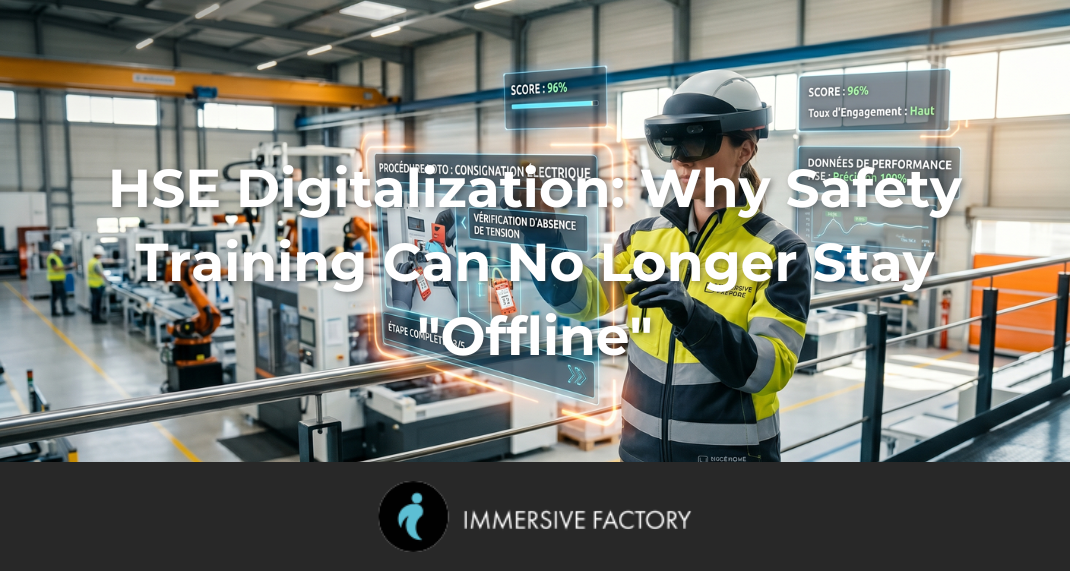
Digital Safety Training: Boost Your HSE Prevention.
For decades, workplace safety training was built on two pillars: dusty procedure manuals and endless PowerPoint presentations in a cramped breakroom. But in the era of Industry 4.0, this approach has reached its breaking point.
Digital safety training isn't just about scanning PDFs; it is a radical transformation of how employees perceive, learn, and apply prevention rules. Here is why going digital has become vital for your HSE strategy.
1. Accessibility: Training Anywhere, Anytime, Without the Logistics
One of the biggest challenges for HSE managers is coordination. How do you train teams spread across multiple sites, night shift workers, or subcontractors without paralyzing production?
Digitalization removes these barriers. Through online training platforms and immersive modules, you get:
- Total Flexibility: Learners can train at the most convenient time.
- Message Consistency: Every employee receives the exact same level of information and pedagogical quality, eliminating variations between different trainers.
- Instant Updates: A new regulation? A newly identified risk? Content can be updated in one click across the entire organization.
2. Engagement Through Action: Ending Passivity
The number one enemy of safety is boredom. An employee subjected to passive training retains, at best, only 10% of the information. Digital training, specifically through gamification and Virtual Reality (VR),turns the learner into an active participant.
By placing users in interactive work situations, you engage both procedural and emotional memory. You are no longer just telling them what to do; you are asking them to make decisions. This interactive approach creates much higher engagement because a mistake made virtually leaves a far more lasting impression than a simple text-based warning.
3. Data-Driven Management: Moving from Intuition to Insight
This is perhaps the most strategic advantage of digital safety training: traceability.
Where a signature on an attendance sheet only guarantees physical presence, digital tools provide valuable KPIs (Key Performance Indicators):
- Success Rates and Failure Zones: If 40% of your teams fail a specific module (e.g., harness attachment), you identify a critical safety gap before an actual incident occurs.
- Progress Tracking: You monitor your company's competency levels in real-time.
- Compliance Proof: In the event of an audit, you have a complete, accurate, and tamper-proof digital history of all completed training sessions.
4. Blended Learning: The Best of Both Worlds
Digitalizing safety doesn't mean removing the human element. The current trend is Blended Learning (a hybrid approach).
Digital tools handle the theoretical portions and the simulation of high-risk scenarios, while the human trainer focuses on sharing experience, answering specific questions, and validating technical gestures in the field. It is the most efficient use of everyone's time.
Conclusion: An Investment, Not an Expense
Digital safety training is no longer a "gadget" for innovative companies; it is a lever for global performance. By reducing accidents through better memory anchoring and optimizing logistical costs, it offers a clear and measurable ROI.
The future of prevention is digital, immersive, and data-driven. Is your company ready to take the leap?

Geschrieben von Aurélie Tavernier
Marketing and Communications Manager at Immersive Factory
She became interested in raising awareness of health and safety at work, convinced that an approach tailored to employees can transform the safety culture and reinforce shared vigilance. Her ambition: to encourage all companies, whatever their size, to invest actively in health and safety prevention for the well-being of their employees.
Teilen
Das könnte Sie auch interessieren

ISO 45001 Standard and HSE Audits: How Virtual Reality Secures Your Traceability
Prepare for your occupational health and safety audits with virtual reality. Discover how VR ensures the traceability of your HSE training.
From Passive Compliance to On-Site Engagement: Why Virtual Simulation Permanently Shifts Safety Behaviors
Discover how VR shifts safety culture in industrial workplaces. Explore error-based learning, emotional risk awareness, and interactive safety talks.
Memory Retention: Why the Brain Retains VR Safety Training 4 Times Better
Discover the neuroscience behind virtual reality: why memory retention and experiential learning make VR safety training up to 4 times more effective.