Understanding Enterprise Safety Standards: The Role of Virtual Reality in Training
Understanding Enterprise Safety Standards: The Role of Virtual Reality in Training
How to know the safety standards in a company?
Safety in business carries several stakes, such as the protection of property and people. It involves the prevention of hazards and workplace accidents. Its aim is to provide a safer working environment for employees. To ensure this, the employer must implement training actions. Here, virtual reality emerges as the most innovative tool. It recreates realistic situations and enhances worker engagement. Thus, what role does this technology play in training and how to know the safety standards in a company? This guide answers your questions.
The Safety Standards in Business
The primary safety standards in business
According to theLabor Code, the employer is responsible for ensuring the physical safety of its employees. They must provide:
- Secure workstations;
- A protection system against noise;
- Adequate lighting;
- Ventilated and purified premises;
- Sanitary facilities;
- Arrangements to reduce the risk of musculoskeletal disorders (MSDs);
- Fire extinguishers to combat fires;
- Personal protective equipment;
- First aid materials;
- Protections to prevent eye fatigue.
Besides national regulations, other safety standards apply in business, notably the ISO standard (International Organization for Standardization) and the French standards NF EN ISO 9001 (quality management) and NF EN ISO 14001 (environmental management).
Note that practices, procedures, and policies aiming at ensuring employee protection and preventing workplace accidents are encompassed in the HSE standard. If you wonder how to know the safety standards in a company, look into this law.
The importance of adhering to these standards for accident prevention and employee protection
Adhering to these standards is crucial for preventing accidents and protecting workers. Indeed, it guarantees risk reduction in the workplace and promotes the development of an effective safety culture. Furthermore, failing to meet obligations like establishing a safety induction can expose the company to penalties. To ensure regulatory compliance, businesses can be assisted by corporate lawyers.
The limitations of traditional safety training methods
Many employees are unaware of how to know the safety standards in a company. Participating in training can help them stay informed about the latest regulations. However, traditional learning methods are no longer advised for workplace safety because they have limitations.
Analysis of the deficiencies of classic approaches
Traditional safety training methods have several disadvantages:
- Theoretical training: Learning is mainly theoretical, based on static presentations that engage learners poorly;
- Limited practical demonstrations: While practical demonstrations are useful for skill development, they require significant time and resources. Hence, they are not prioritized in traditional training;
- Lack of personalization: Old training methods do not account for the individual needs of employees, thus not guaranteeing good results;
- Lack of interaction: Learners do not always interact with trainers, and rarely communicate among themselves, making the learning process less dynamic.
Impact on knowledge retention and the effectiveness of accident prevention
The deficiencies of classical approaches have many consequences. Firstly, they result in poor knowledge retention because without practice, learners quickly forget the transmitted information. Moreover, the absence of demonstrations makes practical application more difficult on the ground, as applying knowledge requires follow-up despite clear theoretical concepts.
Finally, the lack of skills transfer and interaction can reduce the effectiveness of accident prevention, as employees will not feel involved.
The Contribution of Virtual Reality to Safety Training
Knowing how to understand safety standards in a company is important to meet legal obligations. Note that safety training is part of this. To implement it, the use of virtual reality is highly recommended, as it is a profitable technology for businesses.
The Advantages of Virtual Reality
Virtual reality offers numerous benefits for safety training at work.
ImmersionVR can create immersive virtual environments. The immersive experience provokes the same reactions and sensations as in real situations.
InteractivityCompared to traditional training, VR training offers increased interactivity, as learners can explore their virtual environment. They also gain practical skills by performing various actions, such as making real-time decisions and manipulating objects.
Simulation of dangerous situations without riskLearning in a 3D environment poses no danger to participants. Indeed, VR can simulate complex situations without exposing them to real risks. Consequently, they learn to react correctly to dangers while remaining safe.
Cost-effectivenessImplementing virtual reality training requires a significant investment. However, it proves to be more cost-effective than traditional training in the long term. It reduces costs associated with travel, practical exercises, and equipment, thus allowing the company to make significant savings.
CustomizationVR training is customizableaccording to the needs of the workers and the employer. Scenarios are adaptable based on skill levels, training objectives, and professional roles, ensuring a consistent learning experience.
Concrete Examples of VR Applications in Safety Training
Here are some examples of VR applications in safety training.
Emergency EvacuationThanks to simulations, learners can experience various situations requiring emergency evacuation, such as a gas leak or a fire. The goal is to help them actively respond in case of danger.
Handling Machinery and EquipmentVirtual reality is an effective tool for training workers on the safe handling of machinery and industrial equipment. It teaches them start-up and shutdown procedures and safety measures to prevent workplace accidents.
Handling ChemicalsVirtual reality can simulate the consequences of improper handling of chemicals, such as poisoning. It helps employees identify hazardous substances and teaches them how to calmly react in case of leaks or spills.
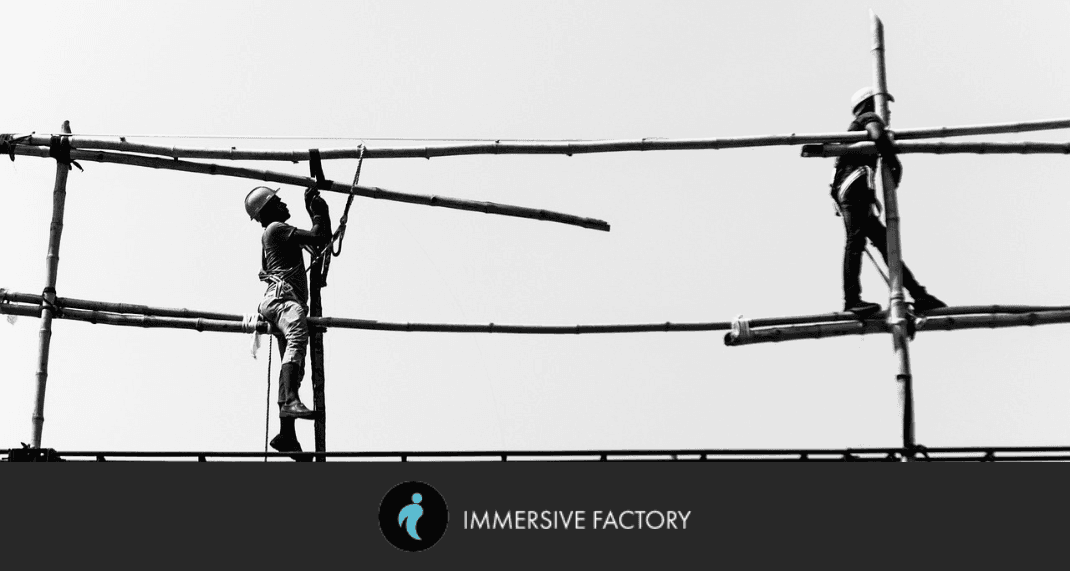
Training for High-Altitude WorkIt's possible to train for working at heights in virtual environments. The training teaches participants how to install fall protection devices and properly use personal protective equipment.
For a Virtual Reality Safety Training, Trust the Expertise of Immersive Factory
The Future Evolution of Safety Training in Business Through VR
Safety and health training in business can rapidly evolve thanks to virtual reality. In the coming years, content could become increasingly personalized according to the specific risks encountered in different sectors. Additionally, the gradual integration of artificial intelligence could provide even more interactive learning experiences.
Thus, the future of VR safety training will be marked by significant technological advancements that will contribute to improving content relevance and enhancing employee protection.
Adopt this innovative technology to improve safety in your business
Do you want to ensure the safety and health of your workers? Adopt this innovative technology today. Thanks to VR, you will raise your collaborators' awareness of occupational risks and help them adopt safer practices daily. Trust our team of experts to design comprehensive, fun, and interactive training programs.

Scritto da Aurélie Tavernier
Responsabile Marketing e Comunicazione presso Immersive Factory.
Appassionata di sensibilizzazione alla salute e sicurezza sul lavoro, convinta che un approccio adattato ai collaboratori possa trasformare la cultura della sicurezza e rafforzare la vigilanza condivisa. Il suo obiettivo: incoraggiare tutte le imprese, qualunque sia la loro dimensione, a impegnarsi attivamente nella prevenzione sanitaria e di sicurezza per il bene dei loro dipendenti.