Virtual Reality: What Is the Definition and How Does It Differ from Augmented Reality?
Virtual Reality: What Is the Definition and How Does It Differ from Augmented Reality?
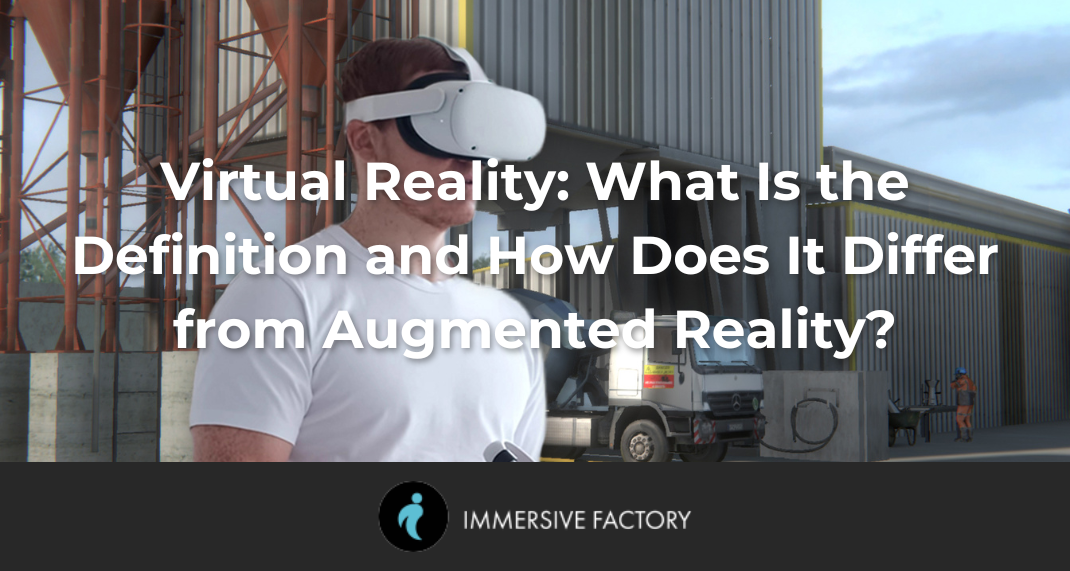
Virtual Reality: Definition and Differences from Augmented Reality.
If someone asked you:could you instantly tell the difference between virtual reality and augmented reality? Don’t worry, we wonder the same. Let’s be honest: who hasn’t confused the two when talking about their uses, applications, or technologies?
If you’re curious, drawn to digital innovation, and love digging into how immersive tech works—yes, we mean that sensory experience that excites both gamers and industry professionals—then this article is for you… and for us.
Let’s dive into this world where the virtual and physical blend together, blurring the line between reality and computer-generated imagery. You could even explore a VR training course. Today, this new technology is being used to raise awareness about workplace safety:
Why Explore Virtual and Augmented Reality?
So, what exactly is virtual reality? Let’s be real—we’ve all seen mind-blowing headset demos to explore 3D worlds, and many of us have tried catching a hidden Pokémon in our living rooms. But despite the similar vocabulary, each technology has its own logic—and that’s where things get interesting! Ready to sort it out with us and discover how these experiences are transforming learning, work, or even how we interact with art? These are questions we ask ourselves daily—and we love diving deep.
Virtual Reality: From Full Immersion Beyond the Screen—What Is It, Really?
Behind every mention of immersive virtual reality lies the same goal: to place the user (that’s us, that’s you!) inside a fully simulated 3D environment, completely detached from the real world. In other words, we put on a headset—like the Oculus Rift, HTC Vive, or Meta Quest—and disconnect from our living room or office to dive into a world where anything feels possible. Impressive, right? Have you ever tried manipulating an object with controllers, touching a virtual wall, or doing job training inside a synthetic environment?
Does It Feel Real? The Promise of Total Realism
What changes everything isn’t just the depth of field or the HD resolution of the headset—it’s the presence, that strong feeling of being somewhere else… while never even leaving your chair. You feel the urge to hit pause, to “see what it feels like”? That’s human—and exactly what virtual reality taps into.
- The VR headset covers your field of view and isolates you in a visual and audio world—the famous “wow effect”, have you felt it?
- Controllers and sensors track your movements, allowing you to freely interact with virtual objects
- Haptic gloves or tactile feedback: you touch, grab, and manipulate elements that only exist on-screen… yet your brain believes it completely
It even raises the question: who’s really in control? Is the user the author of their own immersive experience, or is the tech guiding the emotion?
Which Fields Use This Technology?
For us, virtual reality is used everywhere: corporate or hospital training, events and contemporary art, real estate and architecture, video games, scientific research… Entire teams are choosing the computer as their full-scale testing ground! Do these applications inspire you? Could they change how you work tomorrow? Honestly, we ask ourselves that every day.
Augmented Reality: Layering Digital Over the Real—But Why?
And here comes the twist! With augmented reality, you stay grounded in the real world—but add digital content directly into your field of view through glasses (like Microsoft HoloLens or Google Glass) or even a smartphone. Augmented reality is a daily ally. A QR code to scan, a card that animates, a maintenance manual projecting visual cues in front of your eyes—have you tried it?
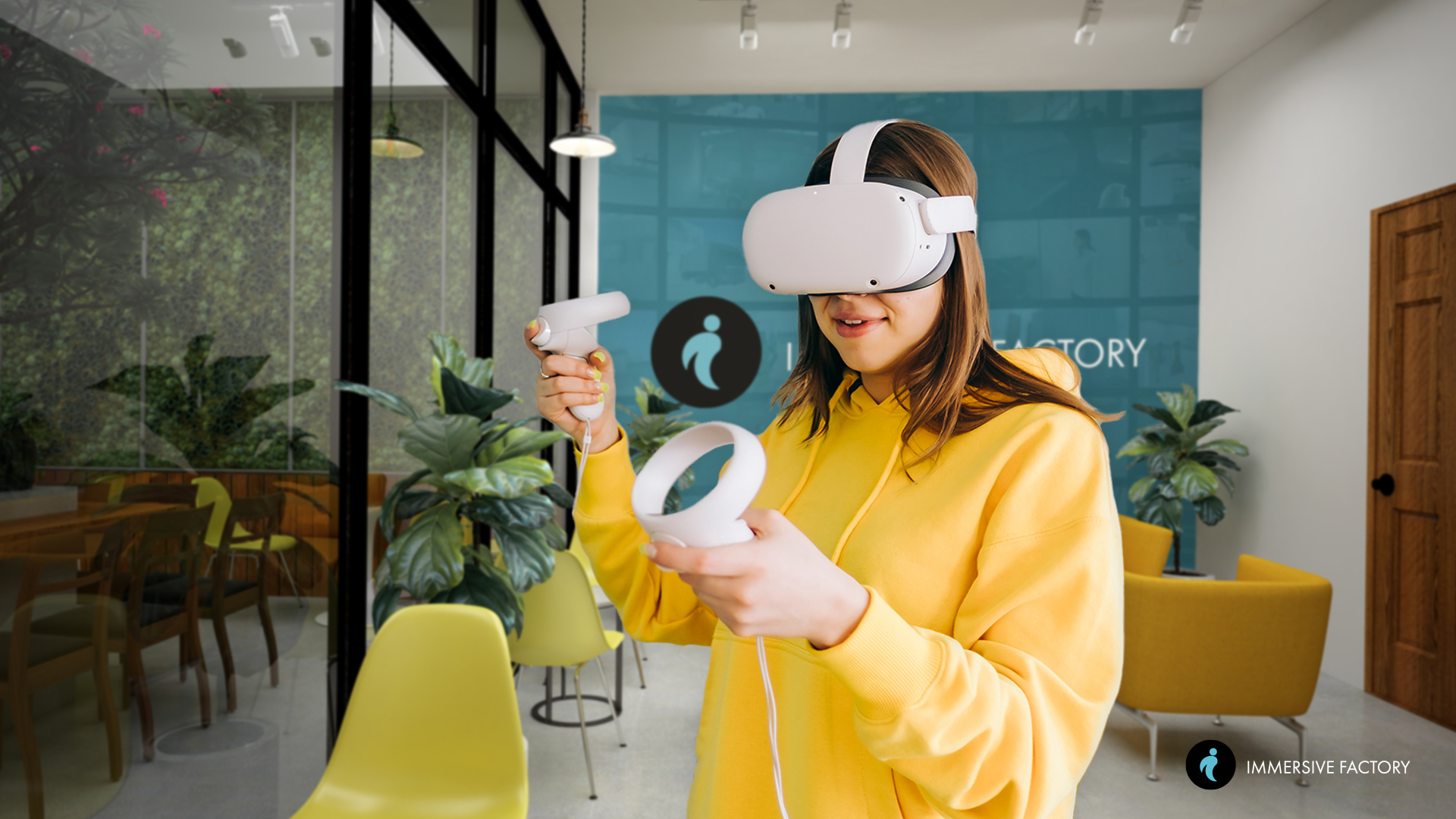
Do We Really Cross the Line Between Reality and Virtual?
Yes—but on demand, and without fully leaving reality! We add, we enhance: floating text where you’re looking, a 3D object to understand a diagram, a video appearing over a piece of furniture. Clara, at Stability AI, shared how she felt empowered by the digital guidance during a technical repair: “Honestly, it felt like I was already an expert—even though I was just starting out!” What about you? How do you picture augmented reality in your own professional life?
- Mobile apps like Pokémon GO to explore cities in new ways
- Real-time guidance during repairs, construction, or medical interventions
- Interactive presentations of objects or art in 3D, for fresh and engaging experiences
Let’s face it—it’s not the same kind of immersion as VR, but the impact on action and perception is huge. What would you like to overlay onto the real world? Share your idea—the tech can adapt.
Confused Between VR, AR, or MR? Here’s How to Make Sense of It
The terminology is evolving—and so is the conversation: VR (Virtual Reality), AR (Augmented), MR (Mixed)… Easy to get lost if you don’t take a moment to compare! Luckily, we’ve summed it up in a simple table, made for all of us who love clarity at a glance:
| Concept | Definition | Example Use Case |
|---|---|---|
| Virtual Reality (VR) | Full immersion in a digital world, disconnected from reality | Flight simulator, healthcare training, VR gaming |
| Augmented Reality (AR) | Overlay of virtual elements onto the real world | Location-based mobile game, interactive demo |
| Mixed Reality (MR) | Fusion of real-world data and interactive virtual objects | Industry, creative labs, innovative showrooms |
We love how this visual makes the differences clear: VR disconnects you from reality,AR adds a digital layer, and MR blends both in real-time. Does that help you picture your own use cases? Now it’s up to you to choose the level of digital immersion that best suits your needs…
Real Uses in Our Jobs, Lives—and Leisure?
It’s not just about fun or fantasy anymore: today, virtual, augmented, and mixed reality are being embraced across companies, industries, education, arts, and events. We’re often blown away by the feedback: faster training, fewer human errors, global tool deployment without physical limits…
- Tailored training support through immersive sensory experiences
- Simulation of real-world situations and practical learning for new careers
- Fun and interactive learning reinforced by 3D and interactivity
We often wonder: what about you? Could you imagine entering a digital environment to master a task—or discovering local heritage in augmented reality? Would you try a virtual apartment tour before buying your future home?
Need the Right Words? A Quick Glossary of Immersive Tech
Because with these innovations, nothing beats clear terminology to navigate across platforms. Have you noticed how we talk about “virtual environments,” “interactive simulation,” “sensory presence,” or “haptic feedback”? Here’s a quick breather with the essentials:
- Immersion: the almost physical sensation of being transported elsewhere, through sight, sound, and sometimes even touch
- Digital Interface: hardware or software—this is the bridge between human action and the computer-generated world
- Simulation: an almost real experience, designed from scratch to test, train, or explore
- 3D Environment: a space with depth, where you can move, interact, and experiment—even without leaving your desk!
Learning this vocabulary helps you better understand what’s behind each new application. Thought simulators were only for aviation? Try a virtual science lab or a contemporary art gallery! New uses are popping up every day—it’s up to us (and you) to grab them, own the tools, and spread the word.
We’ll say it simply, because it’s what we live every day: the line between real and virtual is fading fast. It’s pushing all of us to move forward, to imagine, to invent. So why not go all in? This world is already here… Are you ready to become an informed, creative—and enthusiastic—user of virtual and augmented reality?
Immersive Factory: Virtual Reality Like You've Never Experienced It
At Immersive Factory, we don’t just talk about virtual reality—we bring it to life.Our mission is to immerse every user in a virtual environment designed for training, work, prevention, and safety. With immersive technology, our headsets deliver real-time experiences in a world where every move counts. Whether you’re in industry, healthcare, entertainment, or education, our goal remains the same: to create an interactive, visual, and sensory space that transforms how things are done.
Each application and simulation is developed in partnership with major clients to offer realistic, impactful immersion. Because handling an object, exploring a site, or sensing a hazard—those aren’t things you learn from a PDF.
This is our world: where the user, equipped with a headset, sees, touches, acts, and learns. A new definition of training, powered by virtual reality.
Our Key Questions About Virtual Reality and Its Definition
What is virtual reality?
A headset, a new world, a dive into the unreal. Virtual reality is a technology that propels the user into a computer-generated environment that is fully immersive. With a headset like the Oculus Rift or HTC Vive, you enter a virtual universe where every image and movement is synced in real-time. This interactive experience transforms how we relate to the world, to work, to training, and to art. You touch, explore, and forget where you are. You live differently.
What does virtual reality consist of?
Virtual reality is more than just a video game—it’s total immersion. Put on a headset, and the brain follows. This technology projects the user into a 3D virtual environment that responds to movement. The goal? To offer a fully sensory and visual experience, whether in industry, education, healthcare, or entertainment. It’s a powerful tool that can simulate, train, explore, work, or teach. The virtual world becomes a second reality.
What is a simple definition of virtual reality?
Virtual reality is a digitally created world explored with a headset. The user is immersed in a virtual, often 3D, environment where they can interact with objects, hear sounds, and see in depth. This is interactive simulation, used not only in entertainment but also in professional training, engineering, medicine, and architecture. It’s a digital space designed to deliver a lifelike experience with a strong impact on perception, emotions, and even knowledge.
What is the purpose of virtual reality?
The purpose of virtual reality is to immerse users in a completely recreated environment. Whether to learn a trade, visit an industrial site, attend a cultural event, or simulate a workplace accident, virtual reality transforms the experience. It allows testing without danger, handling without risk, learning without pressure. With today’s headsets, applications are endless: training, architecture, medicine, art. In short, virtual reality pushes the boundaries of reality—freely.

Scritto da Aurélie Tavernier
Marketing and Communications Manager at Immersive Factory
She became interested in raising awareness of health and safety at work, convinced that an approach tailored to employees can transform the safety culture and reinforce shared vigilance. Her ambition: to encourage all companies, whatever their size, to invest actively in health and safety prevention for the well-being of their employees.
Condividere
Da leggere anche
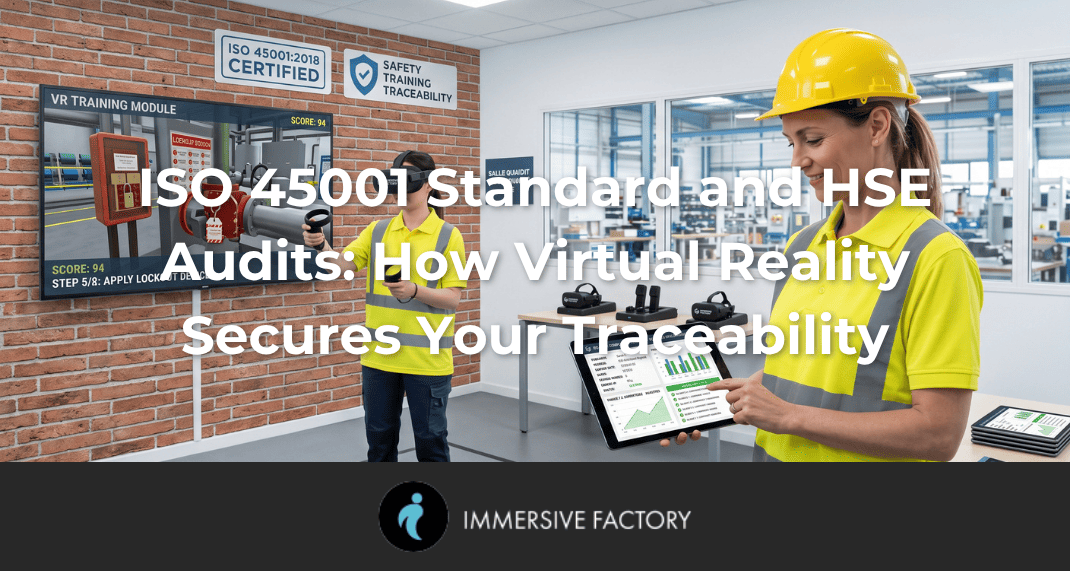
ISO 45001 Standard and HSE Audits: How Virtual Reality Secures Your Traceability
Prepare for your occupational health and safety audits with virtual reality. Discover how VR ensures the traceability of your HSE training.
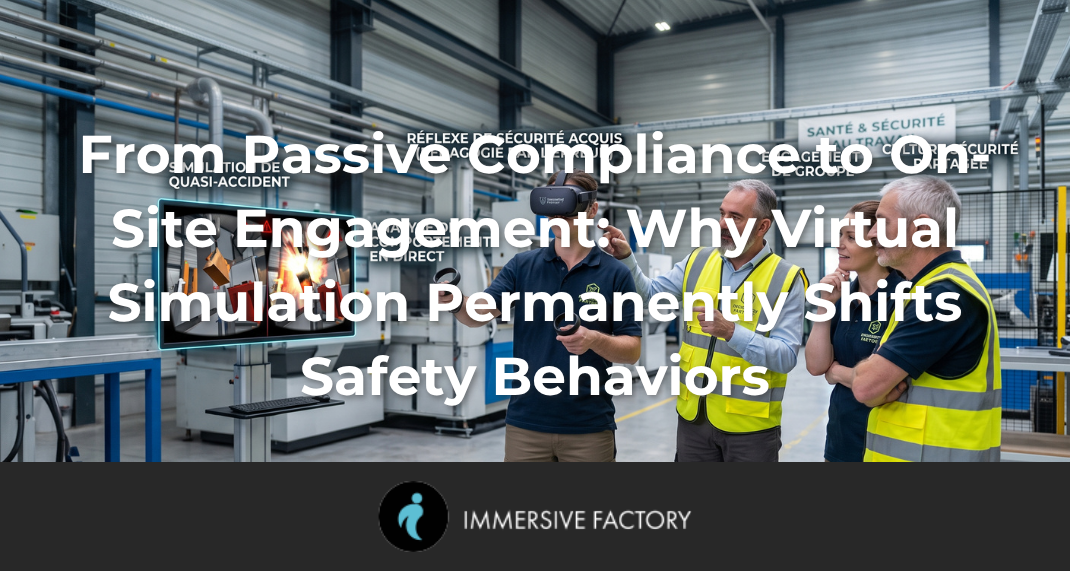
From Passive Compliance to On-Site Engagement: Why Virtual Simulation Permanently Shifts Safety Behaviors
Discover how VR shifts safety culture in industrial workplaces. Explore error-based learning, emotional risk awareness, and interactive safety talks.
Memory Retention: Why the Brain Retains VR Safety Training 4 Times Better
Discover the neuroscience behind virtual reality: why memory retention and experiential learning make VR safety training up to 4 times more effective.