Fire Safety Standards: The 4 Major Obligations for Every Company
Fire Safety Standards: The 4 Major Obligations for Every Company
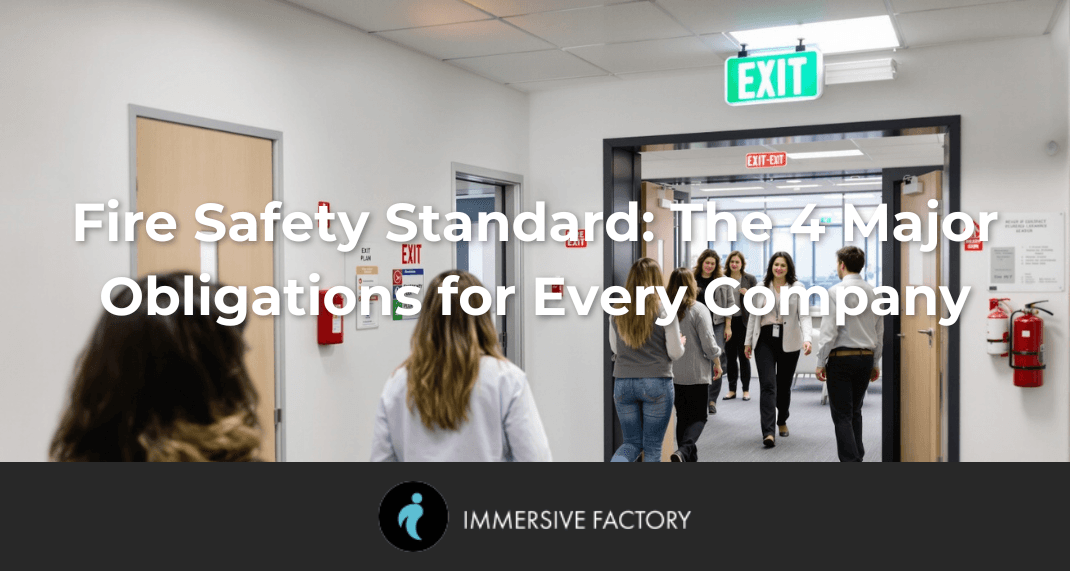
Fire Safety Standards: 4 Obligations for Every Business.
In brief: Fire safety, not just a sign behind the door
- The "millefeuille" of regulatory vigilance: The mix of the Labor Code, special decrees, and voluntary standards creates a constant balancing act, where anticipating inspections becomes an endurance sport.
- Equipment: Extinguishers, detection systems, alarms, and evacuation plans are the unsung heroes, provided they are maintained and not just forgotten in a cupboard or under a pile of old files.
- A culture of prevention is both learned and lived: Training, the "Document Unique" (Single Risk Assessment Document), a clear organizational structure—every detail counts to prevent panic when fire strikes without warning.
Fire safety is truly not an optional chapter for those who open, close, or simply walk through a company's premises each day. We've all heard the story of an extinguisher that's just sitting there and hasn't been checked in ages, a silent alarm, or an evacuation plan forgotten behind a pile of boxes.
Deep down, everyone understands very quickly, as soon as the word "fire" enters the conversation, that it's a matter of harsh reality: protection, prevention, and standards are about preserving lives, equipment, and sometimes even a lifetime's work. Sometimes, just attending a safety day is enough to fully grasp it.
The Regulatory and Normative Context of Fire Safety in Businesses
It's easy to get lost: texts, standards, regulations, safety culture... Yet, fire offers no second chances to those who think they can improvise. So what's the purpose of this succession of articles, decrees, and codes? The definition of a "fire standard" isn't a technocratic whim; it's a map where every marker counts, from access for emergency services to the installation of an SSI (Fire Safety System).
Mandatory Regulations and Voluntary Standards: Two Sides of the Same Coin
On one side, you have the Labor Code, the decree of June 25, 1980, then the one from December 30, 2011... On the other, you have AFNOR and ISO standards that emerge as required or optional elements depending on the activity, building type, and category (ERP [Public Access Buildings], residential, ICPE [Classified Installations for Environmental Protection]).
The regulatory minimum? It's mandatory—compulsory extinguishers, posted guidelines, up-to-date evacuation plans. But fire safety often means going a step further: a company that wants rock-solid security will voluntarily apply standards to strengthen its safety net. "Respecting the law is the baseline. Building on standards is advancing with a reinforced safety net." That's the long and short of it.
Regulatory References: Jungle or Compass?
When facing fire regulations, you encounter the Labor Code (mandatory protection of personnel), specialized decrees (for ERPs, residential buildings...), and each establishment must tailor its fire safety systems to its specific risks: plans, extinguishers, SSIs, alarms, firefighting resources... Applicability depends on the premises, the public it receives, the materials used, and the nature of the activity. These requirements demand vigilance, and not just a little.
The Waltz of NF Fire Standards: Who Can Make Sense of It?
The standard: a word that makes operators sweat and engineers dream. NF S61931 for installation and maintenance... NF X08070 for evacuation plans... It's a real hodgepodge. Every building, every ERP or simple office, has to navigate it. Understanding what stems from pure regulation versus what comes from a more demanding standard is key to avoiding missteps during an inspection or, worse, in a real emergency. The standard is the system's safety line, the guarantee that every technical detail—distance, access, visibility—is designed to address the reality of a fire, not just the theory on paper.
Employer: Responsibility and Inspections... to the Point of Obsession?
The safety register isn't just a file gathering dust: it's the inspection script, the passport for a visit from the firefighters or the safety commission. Extinguishers checked? Displays visible? Alarms, accessible exits, automatic extinguishing systems functional? Fire has a long memory, and so do your obligations.
"Those who anticipate, log, and validate every action save themselves many sleepless nights when an unannounced inspection occurs.”
Essential Fire Prevention Equipment and Installations
Here, we get to the heart of the matter: extinguishers, approved smoke detectors, audible and visible alarm systems, fire doors, up-to-date evacuation plans, emergency lighting units... Everyone has, at some point, seen a missing or unusable device. It seems routine, but carelessness—and sometimes real tragedy—is hidden in this "forgotten" detail.
- Approved extinguishers placed within easy reach
- Smoke detectors tested and replaced on time
- Connected and functional alarm systems
- Evacuation plans and instructions visible to all
What really makes the difference: vigilance in maintenance and regular checks. Without it, safety evaporates.
Installing an SSI: Plug-and-Play or Deep Thought?
The rule: The SSI (Fire Safety System) must be designed, positioned, and maintained with spatial and technical coherence in mind. A power outage? Accounted for. Emergency backup? Configured. Traceability is the key to follow-up: no forgotten paperwork, no being caught off guard by an inspection.
Evacuation Plans and Instructions: Readability Saves More Than Common Sense
An evacuation plan at the far end of a corridor, a symbol where the emergency exit looks just like the janitor's closet... An incredible waste of time on the day it matters. The NF X08-070 standard mandates: graphic layouts, clear pictograms, displayed pathways, and updated instructions. Trying to improvise under pressure? Panic thrives on that. Who hasn't seen an outdated plan tacked to the wall at the end of a hallway? Regular updates guarantee a rapid reaction, that essential extra element needed the day the alarm goes off.
The 4 Major Fire Safety Obligations for Every Business
Ah, the moment when every manager realizes that everything might not be "up to code." First, risk identification and assessment: the "Document Unique" (Single Risk Assessment Document), that often-forgotten chapter, should live and breathe with the company. Next, staff training: an extinguisher doesn't activate by magic, and the world's best alarm is useless if the individual's reaction is... to flee in their socks.
Preventing, training, explaining, over and over... It's a team culture far more than a simple reflex imposed by regulations.
The Immersive Factory-Style Safety Day, or How to Shake Things Up
You should see the look on a colleague's face the first time they put on the headset. Suddenly, no more excuses; safety is no longer about PowerPoint slides, it's tangible, it's virtual stress, it's sharpened reflexes.
Thirty workshops for just as many surprises, a day where routine evaporates. A 275% boost in confidence for those who use VR—that's impressive. Employees chatting about the experience over coffee the next day. Even the skeptics get caught up in it.
So, ready to experience training that leaves a mark (but no bruises)?
Practical Advice on Fire Safety Standards
What are the fire standards?
Ah, fire standards. Nothing seems more mysterious, and yet, everything is written in black and white in the famous NF S61-931 standard. It's a bit like the Michelin Guide for fire safety, the one that sets the direction. Fire Safety System, or SSI—those three letters you see everywhere when protection is discussed. The S61-931 standard lays the foundation: definitions, different SSI categories, access, who does what, and above all, how this whole ecosystem must be organized so that, on the day things "heat up," the SSI reacts in an instant. There is the art of designing effective systems, and then there is this standard, which provides the framework, sometimes down to the last comma—you'd be wise to delve into it before trying to play the hero.
What is the regulation for fire safety?
Fire safety regulation is nothing improvised. In England and Wales, it is based on the famous Regulatory Reform (Fire Safety) Order 2005, the well-known FSO. On paper, this is the backbone that governs all precautions and all obligations: workplaces, common areas of multi-occupancy buildings, it covers everything. There's no need to overcomplicate it; fire safety has its law, its framework, its language: prevention measures, warning systems, training, inspections. It is sometimes cumbersome, often time-consuming, but it's hard to imagine a more crucial topic than fire safety when everything can turn upside down in a matter of minutes.
What are the safety standards?
Safety standards? The star of the show right now is ISO 45001, the little sister (or rather, the super-successor) to OHSAS 18001 since 2021. You might think it's just one more acronym to learn, but it calls all the shots when it comes to health and safety in the workplace. Management, prevention, procedures—everything is put through the wringer by this safety standard. Each year, the famous "safety day" often dedicates an entire chapter to it. It reassures, it questions, it lays down markers. In short, safety is a standard, but above all, it's a culture, a reflex.
What are the fire-resistant standards?
In France and Europe, there is an entire classification system for reaction to fire, like a graduated scale of danger. There's little suspense: M0 (the Holy Grail) is a non-combustible product, the unsung hero that does not fuel a fire. Next, M1 is for material that burns but refuses to burst into flame. M2, the "difficult" version: it will catch, but you have to persist. M3, now we're in the medium range: it burns, not with the first match, but it burns. And then M4, the category to avoid, the "easily flammable" that makes you shudder just to think about. Fire-resistant standards are a whole subtle art of classification—reassuring? Yes, but above all, very tangible on the day a fire is looming.

Written by Aurélie Tavernier
Marketing and Communications Manager at Immersive Factory.
She became interested in raising awareness of health and safety at work, convinced that an approach tailored to employees can transform the safety culture and reinforce shared vigilance. Her ambition: to encourage all companies, whatever their size, to invest actively in health and safety prevention for the well-being of their employees.