HSE Onboarding: How Virtual Reality Protects Seasonal Workers This Summer
HSE Onboarding: How Virtual Reality Protects Seasonal Workers This Summer
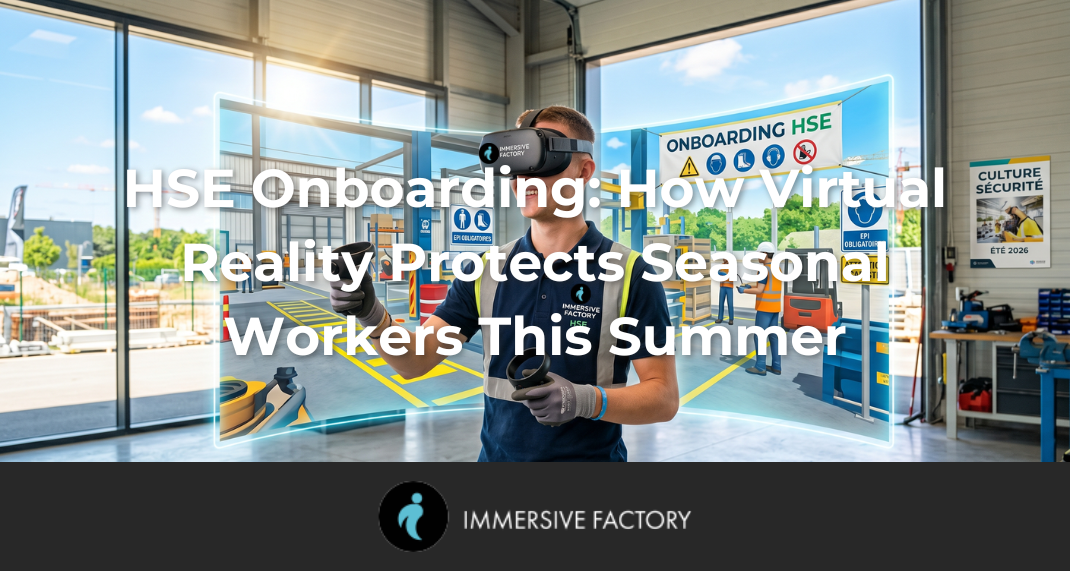
Every year as the summer season approaches, operations accelerate exponentially across key sectors such as logistics, construction, food processing, transport, and heavy industry. To cope with this massive peak in demand, recruiting seasonal workers, temporary staff, and students becomes a core priority.
While this flexibility is vital for business performance, it presents a significant challenge for safety managers and HSE directors. Statistics worldwide show a consistent trend: newcomers are twice as likely to suffer a workplace accident during their first three months on the job compared to seasoned employees.
How can you deliver a corporate safety induction that is fast, engaging, and immediately effective on the floor? The solution lies in modernizing your HSE onboarding using virtual reality workplace safety programs.
The Critical Challenge of Summer Safety Inductions
Traditionally, safety onboarding is an administrative hurdle: a tedious cycle of paper booklets, outdated videos, and generic PowerPoint presentations spanning dozens of slides.
In June, driven by tight deadlines and high production demands, this essential process hits major roadblocks:
- Lack of time: Site managers need hands on deck immediately and often push to shorten the integration phase.
- Attention deficits: Younger demographics or employees accustomed to dynamic digital formats disengage quickly from passive, theoretical lectures.
- The illusion of comprehension: Signing a safety registry does not mean a worker has developed the correct reflexes to react safely to a live hazard.
To effectively protect your summer workforce, you must transition from top-down lecture training to experiential learning.
Why Virtual Reality is a Game-Changer for Temporary Staff
Integrating VR into your HSE onboarding strategy is far from a tech gimmick; it is the most reliable tool available today for knowledge retention. Virtual reality operates on a simple yet revolutionary premise: the right to make mistakes with zero real-world consequences.
- Total Immersion Over Theory: Wearing a VR headset, seasonal workers don't just listen to instructions about preventing slips or forklift collisions—they are physically projected onto a virtual construction site or warehouse floor. They must spot hazards autonomously.
- The Power of Emotional Memory: If a trainee makes a critical mistake in VR (such as failing to lockout a machine or neglecting proper PPE), the simulation instantly visualizes the virtual accident (an explosion, a fall, an injury). This safe emotional trigger stimulates the brain's amygdala, building lasting muscle memory that dictates safer habits in the real world.
- Streamlined, Time-Efficient Training: A 15-minute virtual reality session proves more impactful than a 90-minute traditional presentation. It provides the ultimate compromise between site managers' productivity requirements and HSE teams' safety compliance standards.
3 Key Benefits of VR for Temporary Worker Safety Training
1. Flawless Standardization of Safety Protocols
Whether you are onboarding 5 seasonal workers on one site or 200 distributed across 10 factories nationwide, VR ensures that every single worker receives the exact same standard of training. The content is precisely calibrated and no longer relies on the availability, enthusiasm, or fatigue of an HSE instructor.
2. Objective Competency Evaluation Before Going On-Site
Thanks to analytical tracking platforms, you no longer have to "hope" that a worker understood the rules. You get hard data: did they identify 100% of the risks in the virtual Hazard Hunt? Did they trigger the correct emergency shutdown procedure? This provides objective proof of awareness before they ever touch real machinery.
3. Boosting Your Employer Brand
Younger generations of workers and students are highly receptive to cutting-edge tools. Introducing immersive safety training on day one demonstrates that your company genuinely cares about employee well-being, building immediate trust and fostering higher engagement among temporary staff.
Gear Up for Summer: Which VR Simulations Should You Deploy Now?
To maximize your safety induction efficiency this month, Immersive Factory recommends focusing on core, universal pillars of occupational hazard prevention:
- Hazard Hunting: Perfect for developing situational awareness and shared vigilance on the workshop or warehouse floor.
- Life-Saving Rules: Full immersion to validate non-negotiable site safety protocols (lockout/tagout, pedestrian-machinery segregation, etc.).
- PPE Management (Personal Protective Equipment): An engaging yet unyielding exercise to lock in daily protective habits.
Conclusion: Do not leave your team's safety to chance this summer. Stay ahead of June's hiring waves by upgrading your training methods. Give your seasonal workers an immersive experience that will keep them safe on the job.
👉 Looking to modernize your safety inductions before the summer rush?Contact our expertstoday to test our HSE VR simulation catalog for free.

Written by Aurélie Tavernier
Marketing and Communications Manager at Immersive Factory.
She became interested in raising awareness of health and safety at work, convinced that an approach tailored to employees can transform the safety culture and reinforce shared vigilance. Her ambition: to encourage all companies, whatever their size, to invest actively in health and safety prevention for the well-being of their employees.