Workplace Safety: Best Practices for a Secure Work Environment
Workplace Safety: Best Practices for a Secure Work Environment
Workplace Safety: Learn to Manage Risks and Legal Obligations.
A sense of security is directly linked to job satisfaction. This is why occupational risk prevention is crucial for businesses. When employees feel safe, they are more motivated and focused, which boosts a company's productivity. Implementing a workplace safety policy is key to reducing workplace accidents and improving team well-being. This concept includes all measures and actions required to create a safer work environment.
Regulations and Safety Standards in the Workplace
According to labor laws, employers must ensure the health and safety of employees. This includes implementing prevention, information, and training measures, such as organizing a safety day. Employers are also required to conduct a risk assessment, with the findings documented in the Occupational Risk Assessment Report (DUERP).
Additionally, workplace safety is governed by other standards, such as ISO 45001, which sets the requirements for an occupational health and safety management system. Obtaining ISO 45001 certification helps minimize risks related to injuries, accidents, and occupational illnesses, thereby strengthening workplace safety.
Employer and Employee Responsibilities
While employers are responsible for ensuring workplace safety, employees also play a role. They must:✅ Follow established safety guidelines✅ Use the protective equipment provided✅ Participate in safety training and awareness programs, including Safety Days
Workplace Risks and How to Prevent Them
Identifying Occupational Risks
The first step in workplace safety is to identify occupational risks, which can be categorized into:
- Physical risks: slips, falls, radiation, noise, extreme pressure levels.
- Chemical risks: exposure to liquids, fumes, flammable products.
- Ergonomic risks: poor posture, repetitive movements, non-adapted workstations.
- Biological risks: exposure to viruses, bacteria, insects, fungi.
- Psychosocial risks: violence, stress, harassment.
Methods and Tools for Risk Assessment
Common risk assessment methods include:📌 On-site surveys📌 Employee observations📌 Analysis of past incidents📌 Health questionnaires📌 Risk management software
Selecting the appropriate tools depends on the types of risks and available resources.
Implementing Preventive Measures
Once risks have been identified and analyzed, preventive measures should be implemented, such as:✅ Ergonomic workstation adjustments✅ Installation of collective protective devices✅ Provision of personal protective equipment (PPE)✅ Updating safety protocols✅ Employee awareness programs
Training and Tools to Improve Workplace Safety
The Importance of Continuous Training
As business activities evolve, new risks can emerge in the workplace. Therefore, employee training must be conducted regularly to:✔ Keep knowledge up to date✔ Maintain a high level of safety awareness✔ Ensure compliance with new legal requirements
Immersive Solutions and Virtual Reality Training
Immersive solutions and virtual reality (VR) training are transforming workplace safety awareness. These technologies make learning more engaging by allowing participants to experience realistic digital environments.
Practical VR training helps employees:🔥 Identify hazards quickly🚧 Avoid risks effectively🦺 Adopt responsible safety behaviors in situations like:
- Driving
- Working at heights
- Handling hazardous chemicals
- Fire emergencies
Examples of Innovative Safety Tools
Many innovative tools enhance workplace safety, such as:🚗 Driving simulators⚠ Hazard scenario simulations💻 Interactive e-learning modules📊 Risk management software📱 Hazard reporting apps🎯 Safety awareness events
These tools are continuously evolving to meet the specific needs of businesses.
Building a Strong Safety Culture: Employee Engagement and Accountability
Developing a workplace safety culture requires a proactive approach to employee protection. This involves:✔ Raising awareness✔ Encouraging responsibility
Raising Awareness and Engaging Employees
To establish a proactive safety culture, companies must continuously engage employees in risk prevention efforts. Leadership plays a key role in this process. By setting an example and promoting safety values, management encourages active employee participation.
Best Practices for Building a Safety Culture
To successfully implement a workplace safety culture, businesses should adopt the following practices:✅ Encourage reporting of hazardous situations❌ Penalize risky behaviors🏆 Reward safe behavior🗣 Establish open communication
Immersive Factory: Creating a Safer and More Efficient Workplace with VR Training
Immersive Factory specializes in custom immersive training programs to help businesses improve workplace safety. Our programs are designed for all industries and provide engaging, interactive learning experiences.
Our realistic digital simulations allow employees to practice hazardous situations in a safe environment, making them better prepared for real-life risks.
By implementing our VR training solutions, your company can:✔ Reduce workplace accidents✔ Enhance employee safety awareness✔ Boost overall business performance

Written by Aurélie Tavernier
Marketing and Communications Manager at Immersive Factory
She became interested in raising awareness of health and safety at work, convinced that an approach tailored to employees can transform the safety culture and reinforce shared vigilance. Her ambition: to encourage all companies, whatever their size, to invest actively in health and safety prevention for the well-being of their employees.
Share
Related articles
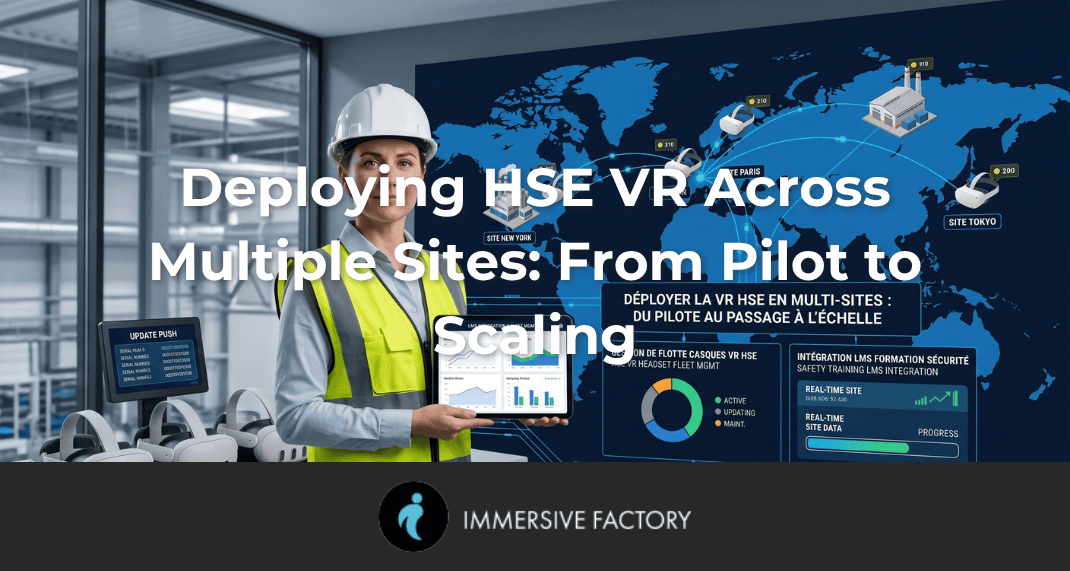
Deploying HSE VR Across Multiple Sites: From Pilot to Scaling
Discover how to successfully scale enterprise virtual reality for multi-site safety training: fleet management, LMS integration, and local adoption.
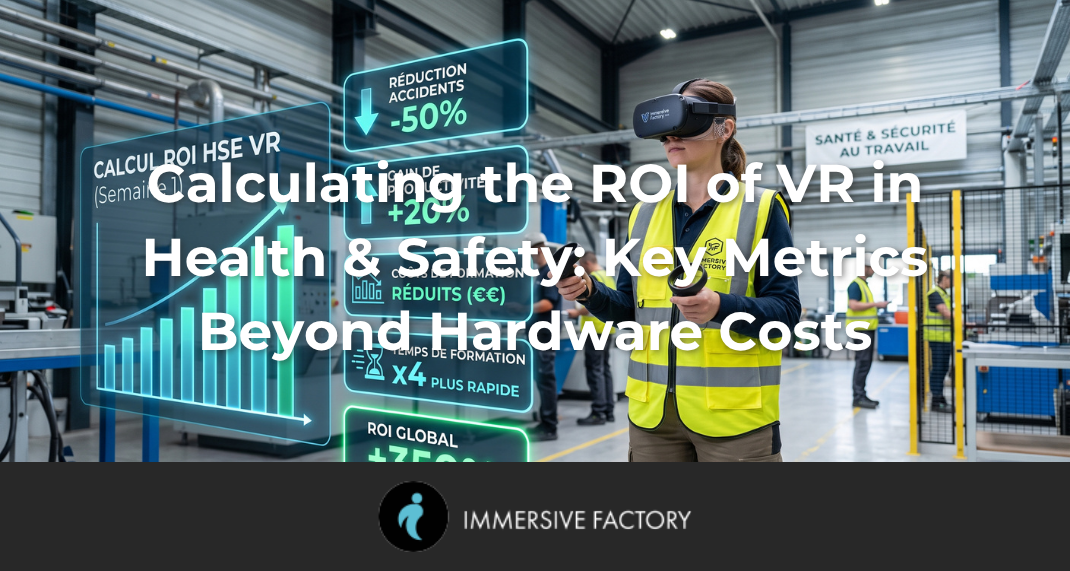
Calculating the ROI of VR in Health & Safety: Key Metrics Beyond Hardware Costs
Learn how to measure the true ROI of virtual reality in HSE safety training. Key metrics, hidden cost savings, and incident rate reduction.
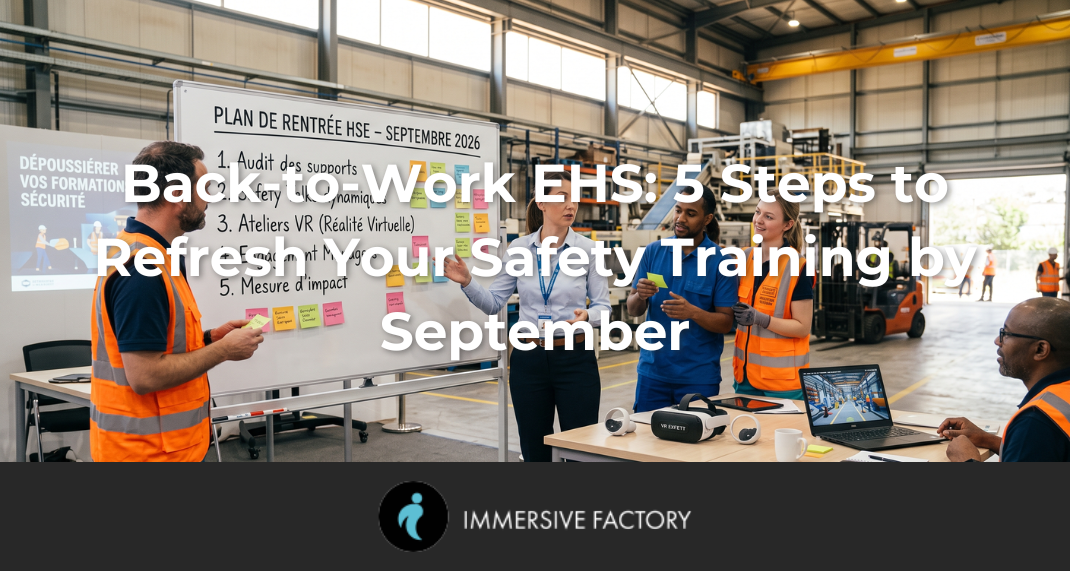
Back-to-Work EHS: 5 Steps to Refresh Your Safety Training by September
Gear up for the fall EHS restart! Discover 5 actionable steps to refresh your safety training, re-engage teams in September, and integrate VR.