Neuroscience and HSE: Why Our Brain Retains Risks 4 Times Better Thanks to VR?
Neuroscience and HSE: Why Our Brain Retains Risks 4 Times Better Thanks to VR?
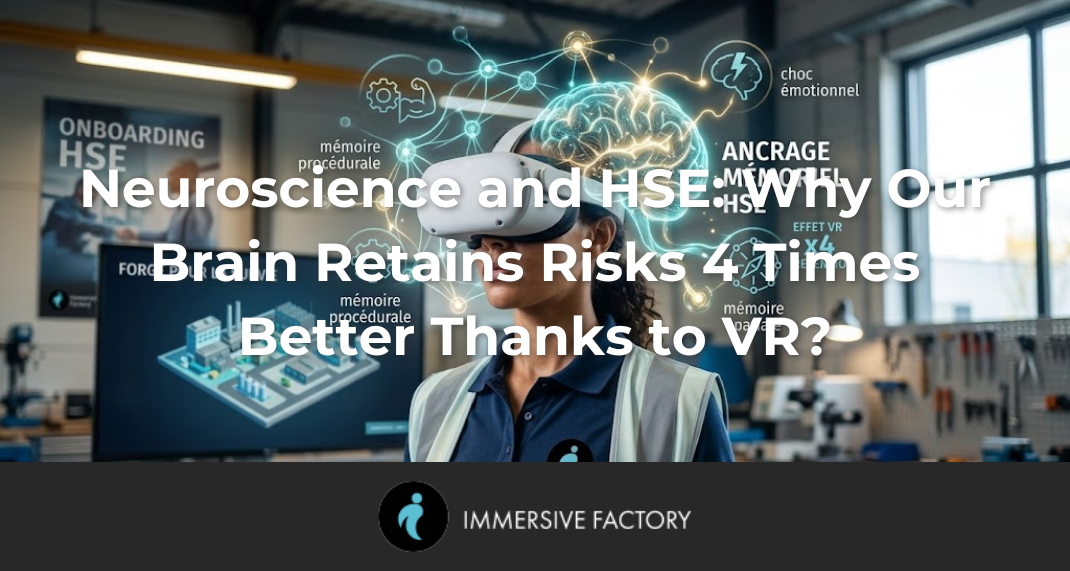
When it comes to Health, Safety, and Environment (HSE), the goal of training isn’t to hand out attendance certificates—it’s to save lives. Yet, training directors frequently battle a formidable enemy: Ebbinghaus’s forgetting curve. Just days after a standard classroom presentation, the human brain forgets nearly 70% of the information received.
Faced with this reality, an increasing number of HSE departments are turning to Virtual Reality (VR). What was once seen as a gaming gimmick is now thoroughly validated by neuroscience and cognitive science. Studies (such as the prominent PwC report on immersive learning) demonstrate that VR learners absorb information up to 4 times faster than in traditional classrooms, with unparalleled long-term retention.
But what exactly happens in our brains when we put on a VR headset? Here is the neuroscientific breakdown of VR training effectiveness.
The Power of Learning Through Mistakes (Without the Danger)
Our brains evolved to learn through experience, and particularly through trial and error. A child learns that fire burns the day they get too close to it. However, in an industrial setting or on a construction site, learning by trial and error is not an option: a single mistake can be fatal.
This is where virtual reality performs a brilliant cognitive "hack." VR tricks the brain into experiencing an ultra-realistic situation while guaranteeing a zero-risk physical environment. The trainee can make a mistake, suffer the virtual accident (a slip and fall, an explosion, an electrical arc), and learn a visceral lesson from it. The brain records the experience as having been "lived," not just "listened to."
The 3 Neuroscientific Pillars of Virtual Reality in HSE
The exceptional memory retention provided by virtual reality relies on three major cognitive levers that traditional formats (2D e-learning, PowerPoint) struggle to activate.
1. Activating Spatial and Procedural Memory
When you navigate a virtual environment that replicates your factory or warehouse, you aren’t just using semantic memory (the memory of concepts). You actively engage your procedural memory (muscle memory and automatic reflexes) and spatial memory. By virtually grabbing a fire extinguisher or locking out a machine using hand controllers, you build new motor neural pathways. The day a real danger arises, the body already "knows" how to react because it has physically rehearsed the motion.
2. The Central Role of the Amygdala and Emotions
The amygdala is the region of the brain responsible for processing emotions, especially fear and surprise. Neuroscience proves that information paired with a strong emotion is memorized much more durably. When a learner forgets to check their PPE in a simulation and sees a heavy load fall toward them virtually, the resulting startle creates an emotional spike. This mild positive stress (eustress) permanently seals the safety message into long-term memory.
3. Absolute Focus Through Sensory Isolation
One of the greatest plagues of corporate training is mental overload and distractions (a vibrating smartphone, a chatting colleague). A virtual reality headset literally blocks out external visual and auditory stimuli. This sensory isolation plunges the prefrontal cortex into a state of deep concentration (the famous Flow state), thereby maximizing knowledge absorption capacity.
From "Knowing" to "Doing": The Educational ROI of VR
Proving the Return on Investment (ROI) of safety training is notoriously difficult. With the immersive approach, educational ROI becomes highly measurable:
- Time Savings: An experience that takes 1 hour to explain in a classroom is lived and understood in just 15 minutes of VR immersion.
- Reduced Accident Rates: Employees trained in VR develop better "shared vigilance" and spot on-site anomalies almost instinctively.
- Increased Confidence: Learners report feeling 275% more confident to act on what they learned after VR training compared to classroom training (Source: PwC study).
Conclusion: Virtual reality isn’t magic; it’s biology applied to pedagogy. By aligning your HSE training methods with how the human brain naturally functions, you are no longer just training your employees: you are forging their survival reflexes.
👉 Ready to beat the forgetting curve?Explore our modulesand request a demo to experience the "memory retention" effect for yourself with Immersive Factory.

Written by Aurélie Tavernier
Marketing and Communications Manager at Immersive Factory
She became interested in raising awareness of health and safety at work, convinced that an approach tailored to employees can transform the safety culture and reinforce shared vigilance. Her ambition: to encourage all companies, whatever their size, to invest actively in health and safety prevention for the well-being of their employees.
Share
Related articles
High-Risk Scenarios: 3 Critical Industrial Hazards You Can Finally Simulate with VR
Learn how VR enables safe, realistic simulation of major industrial hazards: Lockout/Tagout (LOTO), working at height, and confined space entry.
Occupational Accidents in Europe (2026): Beyond the Numbers, the Urgency to Act
What do 2026 European workplace accident stats really reveal? Immersive Factory analyzes the EUROGIP study & offers actionable VR safety solutions.
Heatwaves and Extreme Heat at Work: How Virtual Reality Helps Prevent Risks
As summer temperatures continue to soar year after year, extreme heatwaves are no longer exceptional events. For companies worldwide, managing thermal discomfort and high temperatures has become a critical annual health and saf...