Beyond the Headset: How to Leverage VR Training Data to Predict Accidents
Beyond the Headset: How to Leverage VR Training Data to Predict Accidents
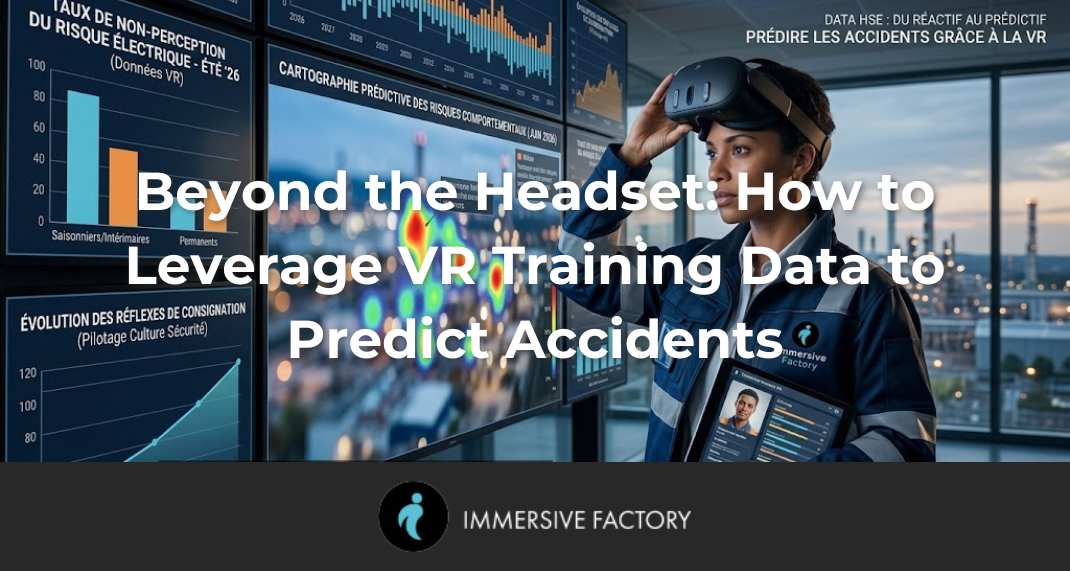
As June draws to a close, Health, Safety, and Environment (HSE) departments are deep into their mid-year reviews. On corporate dashboards, traditional performance indicators are being heavily scrutinized: Total Recordable Incident Rate (TRIR), Lost Time Injury Frequency Rate (LTIFR), near-miss counts...
While these occupational safety KPIs are essential, they all share a major flaw: they are lagging indicators. They measure what has already happened. But isn't the true essence of occupational hazard prevention to act before the accident occurs?
Today, Virtual Reality (VR) is shattering this paradigm. The technology is no longer just an educational breakthrough; it has become the most powerful behavioral HSE data generator on the market. Here is how analyzing VR training data allows organizations to transition from reactive safety to predictive safety.
The Limitation of Traditional Training: A Lack of Behavioral Data
Until now, measuring the effectiveness of safety training has largely been confined to two weak metrics:
- Completion rates: Did the employee sign the attendance sheet?
- Quiz scores: Did they get a passing grade on the multiple-choice test?
These metrics prove theoretical knowledge, but they reveal absolutely nothing about actual behavior in the face of danger. An employee might score 100% on a Lockout/Tagout quiz and still, due to habit or rushing on the factory floor, forget to physically lock the machine.
VR Data: The New Gold Mine for HSE Management
When you deploy an HSE VR training solution, the headset does much more than display 3D images. It captures thousands of data points per second: gaze direction, reaction times, hesitations, and most importantly, the specific mistakes made under simulated stress.
All this information feeds into a centralized tracking platform (like the dashboard provided by Immersive Factory), offering HSE managers a precise, unprecedented map of their teams' behavioral vulnerabilities.
3 Ways to Use VR Data to Drive Your Safety Culture:
1. Identifying Blind Spots in Your Prevention Policy
Imagine running a virtual Hazard Hunt module for 100 warehouse employees. The dashboard reveals that 95% of them spotted the poorly stacked pallet, but 60% failed to notice the exposed electrical wire near a puddle of water. This data is invaluable: it highlights a systemic flaw in electrical risk perception. Armed with this knowledge, you can schedule a highly targeted "Safety Toolbox Talk" on that exact topic the very next morning.
2. Mapping Individual Competencies for Safer Clearances
Before granting operational clearance or allowing a temporary worker to manage a complex production line, VR data provides an objective assessment of their reflexes. The platform meticulously tracks whether emergency procedures were executed in the correct chronological order.
3. Measuring Safety Culture Evolution (ROI)
By running regular immersive training campaigns, you can track progress scores year over year, or benchmark the safety performance of one industrial site against another. It serves as a powerful safety culture management tool, allowing you to justify HSE investments to executive leadership using clear, tangible graphs.
Toward Predictive Safety: Foresee to Prevent
Leveraging this HSE data finally allows companies to establish true leading indicators. By analyzing the frequency of specific virtual errors within a team, the system highlights the probability of a real-world incident occurring. The HSE manager can then perform a surgical intervention—updating a procedure or adding physical signage—long before a near-miss ever happens on the floor.
Conclusion: Virtual reality does not replace human oversight on the ground; it equips safety professionals with incredibly precise data. This June, don't just count your days without accidents; start analyzing virtual behaviors to ensure tomorrow remains safe.
👉Request a demoof the Immersive Factory platform and start driving your safety training with precision.

Written by Aurélie Tavernier
Marketing and Communications Manager at Immersive Factory
She became interested in raising awareness of health and safety at work, convinced that an approach tailored to employees can transform the safety culture and reinforce shared vigilance. Her ambition: to encourage all companies, whatever their size, to invest actively in health and safety prevention for the well-being of their employees.
Share
Related articles
ISO 45001 Standard and HSE Audits: How Virtual Reality Secures Your Traceability
Prepare for your occupational health and safety audits with virtual reality. Discover how VR ensures the traceability of your HSE training.
From Passive Compliance to On-Site Engagement: Why Virtual Simulation Permanently Shifts Safety Behaviors
Discover how VR shifts safety culture in industrial workplaces. Explore error-based learning, emotional risk awareness, and interactive safety talks.
Memory Retention: Why the Brain Retains VR Safety Training 4 Times Better
Discover the neuroscience behind virtual reality: why memory retention and experiential learning make VR safety training up to 4 times more effective.