Near Miss: Definition, Examples, and How to Leverage It for Prevention
Near Miss: Definition, Examples, and How to Leverage It for Prevention
At a Glance
A near miss is a zero-damage event that reveals a real hazard.
- Bird identifies 600 near misses for every 1 serious accident across 641 studied scenarios
- INRS confirms that analyzing near misses prevents future occupational injuries
- AI-powered sensors now detect these weak signals before disaster strikes
A near miss is that suspended load that swings inches from a coworker's foot without ever touching it. The event leaves no physical trace, causes no lost workdays, and triggers no mandatory box to check on an official form. Yet, it tells the exact same story as a catastrophic accident—except the scenario stopped one second before impact. At Immersive Factory, we often emphasize this during VR training: a near miss is a free dress rehearsal. You might as well take full advantage of it.
Most companies let these signals slip away due to a lack of collective reflexes. We have all seen that construction site where a shaky scaffold scared everyone without hurting anyone, and where no one bothered to fill out a single form. This article fills that exact gap with practical insights, hard numbers, and a field-tested methodology.
Near Miss: Definition and Distinction from an Accident
What exactly is a near miss?
A near miss refers to an unplanned event that could have caused a workplace accident but resulted in no physical injury or property damage. A load drops, the ground gives way, a tool slips—yet nothing and no one is struck. INRS (the French National Research and Safety Institute) emphasizes a frequently overlooked truth: this non-event carries the exact same diagnostic value as an actual accident; catastrophic severity was simply avoided through sheer luck. The safety pyramid has illustrated this principle for nearly a century, and it warrants a closer look below. In the field, learning how to conduct a hazard hunt is precisely what enables teams to spot these precursors before they turn into full-blown accidents.
Difference between a near miss, an incident, and a workplace accident
An incident affects operations, property, or equipment without posing an immediate human hazard; a workplace accident results in a recognized bodily injury; and a near miss sits right between them, in that gray area where high risk existed without tangible harm. This distinction underpins any serious QHSE approach. A workplace accident entitles the employee to compensation, triggers employer liability, and legally mandates a formal declaration within 48 hours. A near miss, on the other hand, carries no statutory reporting requirement—and that is precisely where the system falters.
Why this distinction is crucial for prevention
Confusing these three concepts discards half the value of safety data. A prevention plan that only analyzes reported accidents operates on truncated information, because the vast majority of hazardous events never escalate into recordable injuries. At Immersive Factory, we believe this confusion proves costly for organizations that invest heavily in safety initiatives without ever targeting the root cause. A safety talk (or toolbox talk) remains the simplest tool to clarify these three concepts without jargon, directly on the floor with frontline teams.
KEY TAKEAWAY: A near miss produces no visible consequences, yet it exposes the exact same causal chain as a serious accident.
Concrete Examples of Near Misses by Industry
Near misses in construction and job sites
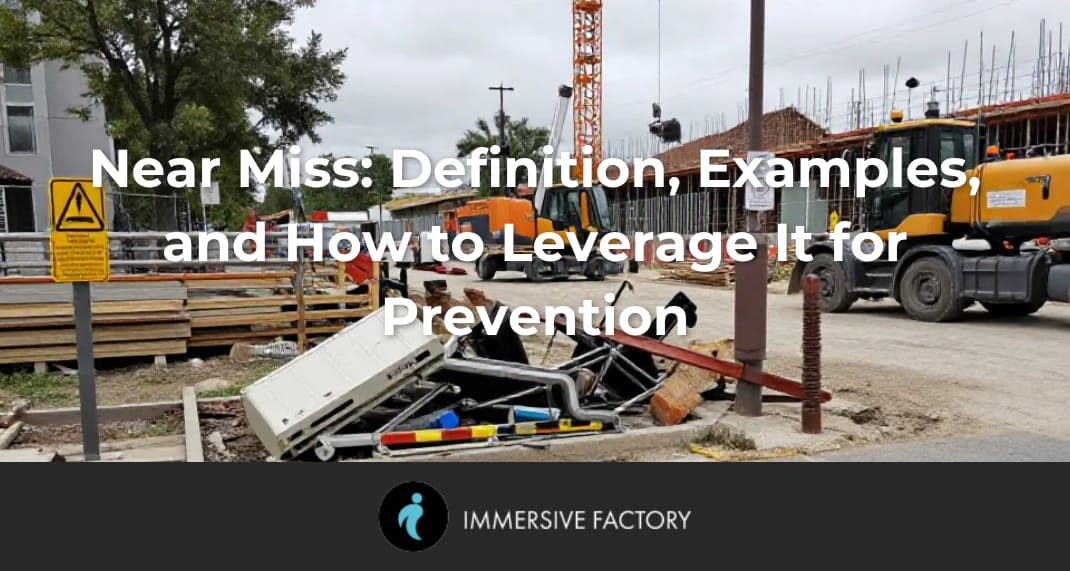
On a construction site, the classic scenario is a crane load swinging inches past a worker, or poorly anchored scaffolding swaying under a crew's weight. These situations happen every week and go unanalyzed due to time pressures. A site manager who systematically documents these warnings will mechanically lower workplace injury rates over the course of the project.
Near misses in manufacturing and industrial plants
In a manufacturing plant, a near miss often looks like a machine performing an emergency stop in the nick of time thanks to an optical safety sensor, or an operator narrowly dodging contact with an unguarded moving part. Root-cause analyses of these events frequently reveal a breakdown in preventive maintenance rather than simple human error.
Near misses in healthcare
In a hospital setting, a near miss might involve a medication dosing error intercepted right before administration, or a patient narrowly catching themselves before falling on a wet floor. The psychological toll on healthcare staff remains genuine even without physical trauma, and this dimension requires dedicated corrective actions within the facility's prevention plan.
KEY STAT: 600 / 641 $\rightarrow$ Proportion of abnormal safety events classified as near misses according to Bird.
The Safety Pyramid: Why Near Misses Reveal Everything
Understanding Heinrich's Law and its implications
Back in 1931, H.W. Heinrich established a foundational ratio based on 330 industrial accidents: 300 resulted in no injury, 29 in minor injuries, and 1 in a major injury. Frank E. Bird refined this model in 1969 after analyzing 1,753,498 accidents reported across 297 companies; his ratio of 600 near misses for every 1 serious accident still defines the safety pyramid used in modern prevention programs. This model proves that the boundary between a harmless close call and a fatality is often pure luck, not the nature of the hazard.
Near misses as a predictive leading indicator of serious accidents
A near miss operates as a statistical leading indicator. As the base of the pyramid expands, the probability of a catastrophic event occurring at the peak increases proportionally. Any company that ignores this base is ignoring a free predictive tool already present in its daily operations.
How to leverage near-miss data for proactive prevention
Centralizing this data in a tracking dashboard helps uncover recurring patterns by workstation, shift, or time of day. An action plan that targets these specific friction points curbs incident rates far more effectively than generic awareness campaigns.
TIP: Cross-reference near-miss logs by physical site zone to pinpoint recurring risk hot spots.
Reporting a Near Miss: Why Workers Hold Back and How to Fix It
Overcoming psychological barriers to reporting
Fear of reprimand is the single greatest obstacle to reporting. A worker who flags a near miss often worries about being blamed rather than commended. The works council (CSE) serves as an essential bridge of trust here—provided leadership explicitly guarantees a non-punitive reporting policy.
Building a fear-free reporting culture
An effective reporting process treats every submission as a valuable contribution, never as an admission of guilt. Organizations that successfully navigate this cultural shift consistently communicate the concrete improvements made as a result of reported near misses, proving to employees that speaking up drives change.
Reporting forms and tools that actually work
A concise form accessible via smartphone, requiring no more than three fields, achieves far higher completion rates than a two-page paper checklist. Modern HSE platforms incorporate mobile workflows to simplify data collection directly in the field.
BENEFITS:
- Early risk detection
- Lower loss and incident costs
- Stronger organizational safety culture

Effectively Analyzing a Near Miss: Beyond the Root Cause Tree
The 4 actions of a workplace first aider (SST) in a near miss
A workplace first aider systematically applies four core reflexes: secure and protect the area, alert supervisors, investigate the circumstances, and provide support if needed despite the lack of casualties. This structured approach, originally designed for accidents, applies just as effectively to near misses to ensure reliable reporting.
Step-by-step analysis method for near misses
The analysis begins with a factual reconstruction of events, strictly avoiding blame. It continues by uncovering root causes through cause tree analysis, followed by prioritizing the organizational, technical, and human factors involved in the sequence.
Turning analysis into sustainable, measurable actions
An action plan that assigns an owner, a deadline, and a tracking metric prevents findings from gathering dust in a binder. Every measurable corrective action should be reviewed within 30 days to verify its real-world effectiveness on the floor.
KEY TAKEAWAY: A near miss analyzed without a measurable action plan is a diagnosis without treatment.
Artificial Intelligence and Automated Near-Miss Detection
Emerging technological detection tools (AI, sensors, computer vision)
Optical sensors paired with computer vision algorithms now detect hazardous behaviors in real time, without waiting for manual self-reporting. These systems trigger automatic alerts the moment a danger threshold is crossed—long before an accident materializes.
Case study: Eco-Counter and detecting cycling near misses
Brittany-based firm Eco-Counter deploys an AI solution that maps conflict zones between cyclists and motorists on public roadways. Its Propulse system analyzes cycling near misses so municipalities can re-engineer infrastructure before fatal collisions occur—a concept directly applicable to industrial sites.
Moving toward predictive rather than reactive safety
ISO 45001 explicitly encourages continuous improvement driven by weak-signal analysis. Data-backed predictive prevention will steadily replace the retrospective reviews that still dominate most corporate safety programs today.
QUOTE: A near miss is not an avoided problem; it is a solution waiting to be heard.
Near Misses: The Vigilance That Changes the Game
A thoroughly analyzed near miss is often more valuable than an accident that is poorly reviewed. The data already exists in the field; you simply need to capture it, document it, and act on it before luck runs out. Train your teams to adopt this reflex, and your next near miss will become your most effective prevention tool rather than a hallway anecdote.
Near-Miss FAQ
Can you provide an example of a near miss?
A heavy crate detaching from a crane hook and crashing to the floor right next to a worker without striking them is a textbook near miss on a job site. The causal chain is identical to that of a fatal accident; only the outcome differed.
What are the 4 prevention measures following a near-miss analysis?
- Technical corrective actions: Repair or upgrade defective equipment.
- Organizational measures: Update internal operating procedures.
- Training actions: Upskill and coach the teams involved.
- Monitoring measures: Audit and confirm the long-term effectiveness of the fixes.
Is reporting a near miss legally mandatory?
Under the French Labour Code, reporting a near miss is not legally mandatory, unlike an occupational injury which requires a formal declaration within 48 hours. Employers are nonetheless strongly encouraged to organize internal reporting systems—with the support of the CSE—to feed their risk prevention programs.

Written by Aurélie Tavernier
Marketing and Communications Manager at Immersive Factory
She became interested in raising awareness of health and safety at work, convinced that an approach tailored to employees can transform the safety culture and reinforce shared vigilance. Her ambition: to encourage all companies, whatever their size, to invest actively in health and safety prevention for the well-being of their employees.
Share
Related articles

High-Risk Scenarios: 3 Critical Industrial Hazards You Can Finally Simulate with VR
Learn how VR enables safe, realistic simulation of major industrial hazards: Lockout/Tagout (LOTO), working at height, and confined space entry.
Occupational Accidents in Europe (2026): Beyond the Numbers, the Urgency to Act
What do 2026 European workplace accident stats really reveal? Immersive Factory analyzes the EUROGIP study & offers actionable VR safety solutions.

Heatwaves and Extreme Heat at Work: How Virtual Reality Helps Prevent Risks
As summer temperatures continue to soar year after year, extreme heatwaves are no longer exceptional events. For companies worldwide, managing thermal discomfort and high temperatures has become a critical annual health and saf...